
Reading the grade on a Henley-on-Thames specification
Calcium sulphate screed grades are written under the British and European screed standard. In a code like CA-C25-F5, C stands for compressive strength and F for flexural, with both values in N/mm2. CA-C20-F4 covers a home whose floors see only light foot traffic. Most homes, flats and offices end up specified at CA-C25-F5. CA-C30-F6 goes where use is heavier. We supply the grade on the drawing rather than a near match.
Alpha hemihydrate mixes sit in a family of their own. Designers turn to them for speedier drying or a slimmer section, and each brand's data sheet sets out its own depth, drying and heating limits.
The material itself shrinks very little as it cures. Because of that, bays can be big and joints few compared with cement, handy across an open-plan ground floor or an entire storey of a block of flats. We still mark out bays and joints beforehand, paying attention to doorways and anywhere the floor runs from one structure onto another.
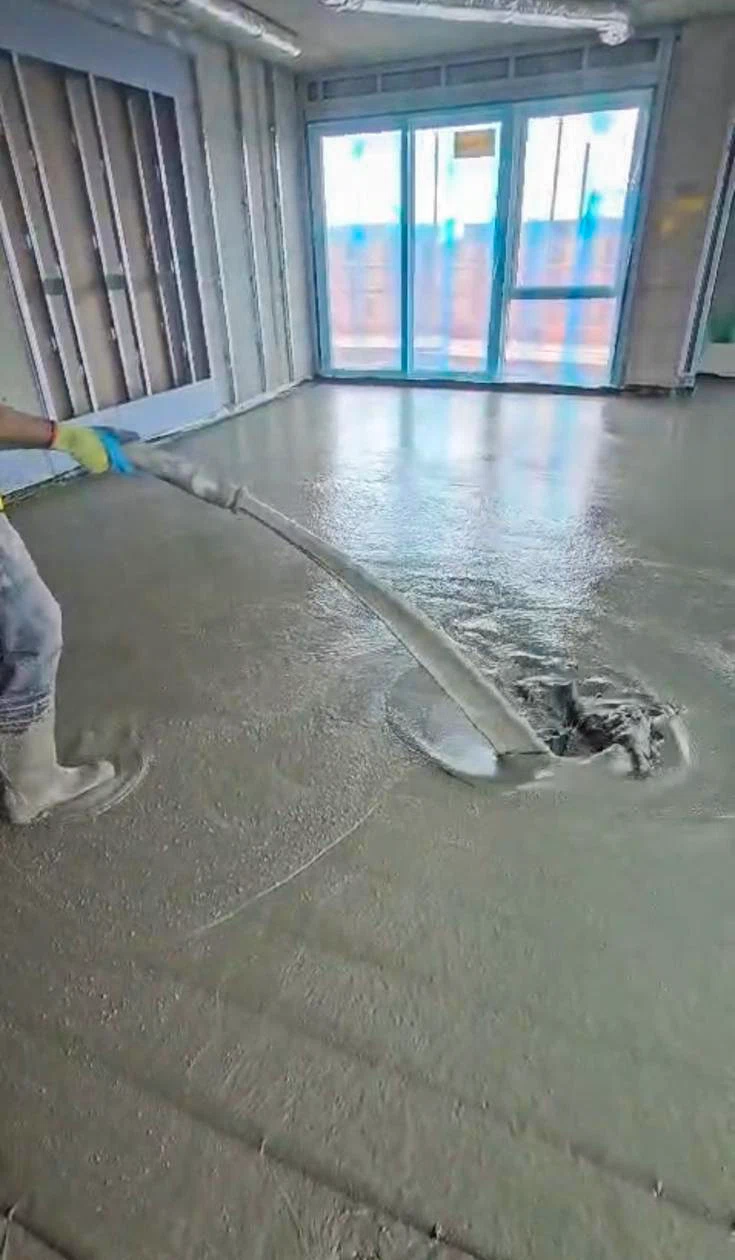
What calcium sulphate cannot do is live with water. Put it in a wet room, or anywhere water may sit, and it will suffer, so in those spots we switch to a cement based flowing screed. For how a flowing screed is pumped and placed, see liquid screed in Henley-on-Thames. There is more on how it behaves in our guide to anhydrite screed.
Laitance, testing and priming on Henley-on-Thames floors
The step that decides whether flooring stays down is surface preparation. While the screed settles, a fine, soft skin known as laitance rises to its surface. After drying, that skin is sanded away to get down to solid screed. Tiles or LVT bonded to laitance can lift, however good the screed below.
Moisture testing comes next. Tile and LVT manufacturers usually set a tighter moisture figure for calcium sulphate than for cement screed, so the same hygrometer number can be fine on one and too wet on the other. A hygrometer test shows where it stands. If there is underfloor heating, running it to force dry calcium sulphate is normally possible from about 7 days, which brings forward the flooring date in new Henley houses and flats.
Priming is the last check. Calcium sulphate needs a primer that is compatible with it, especially under cement based adhesives and levelling compounds. Our written handover covers drying and laitance, so whoever lays your flooring can see what is done and what still needs doing. If a thin skim is wanted before a sheet finish, floor levelling in Henley-on-Thames explains the compound stage.
Anhydrite & Flow Screed prices in Henley-on-Thames
Liquid flowing screed (which includes anhydrite): £24 to £31 per m² supplied and laid (MyJobQuote, August 2026), so £960 to £1,240 for 40 m². MyJobQuote does not say whether these figures include VAT. See our floor screeding cost guide or screed calculator.
Who lays your anhydrite and flow screed in Henley-on-Thames
K & B Screeding’s own team, led by director Donatas Bardisevicius. Founded 2019, company 12298780.
See what customers say in our Google reviews and on our testimonials page.
Anhydrite & Flow Screed from Slough to Henley-on-Thames
On the map, Henley-on-Thames sits west of Slough, about 11.2 miles from our base in a straight line (postcodes including RG9), next to Woodley (5.8 miles), Marlow (6 miles), Reading (6.5 miles) and Maidenhead (8 miles).
More on anhydrite screed, part of our screeding services.