
What the grade on a Beaconsfield specification means
Every calcium sulphate screed carries a code from the European standard for screed materials, and that code tells you how much load the floor is built for. Take CA-C25-F5: CA marks it as calcium sulphate, C25 gives its compressive strength and F5 its flexural strength, each in N/mm2.
For nearly all Beaconsfield work the choice narrows to three. CA-C20-F4 covers a lightly used domestic floor. CA-C25-F5 is the normal grade for houses, apartments and offices, which takes in most of the large homes here, and CA-C30-F6 is kept for floors that take harder wear. Whatever grade the drawing shows is the grade we order, with no cheaper substitute.
Flats show why the code matters. In Beaconsfield, 17% of homes sit in purpose-built blocks. Floors in buildings of that type often have a flowing calcium sulphate screed over acoustic or thermal insulation. Because the material shrinks so little, the bays can be big and the joints few, and we set that layout out well before the pour.
Alpha hemihydrate screeds sit apart from the CA grades. A specifier picks one when the floor must dry faster or be thinner, and each has a data sheet setting its depth and drying, which we work to in place of the general figures.
If you are weighing up materials rather than following a specification, the general liquid screed page covers pumping and suitability, and our guide to anhydrite screed explained goes deeper into the chemistry.
Laitance, sanding and moisture testing in Beaconsfield
Setting is only the halfway point for this material. While it dries, laitance, a thin and weak skin, rises to the top, and no adhesive will grip it properly. Once the screed has dried, we take the laitance off with a sander and apply a primer designed for calcium sulphate. Standard cement primers are not the right choice.
Testing comes before any of that. The bar is lower for this material: many flooring manufacturers set a tighter moisture limit on calcium sulphate than on cement, so a result that tiles on sand and cement would pass can still be too wet here. Our readings come from a hygrometer, not from looking at the colour of the surface. That applies to every new floor, whether in one of the 8% of Beaconsfield homes built since 2015 or in a new extension on an older house.
Drying can be helped. If the floor has heating pipes in it, the system can usually start drying it from about 7 days.
One limit is firm. A wet room, plant room or any floor that could get wet should not have calcium sulphate; we pour a flowing screed with a cement base there instead. Preparing the surface properly is part of floor preparation.
Anhydrite & Flow Screed prices in Beaconsfield
Liquid flowing screed (which includes anhydrite): £24 to £31 per m² supplied and laid (MyJobQuote, August 2026), so £960 to £1,240 for 40 m². MyJobQuote does not say whether these figures include VAT. See our floor screeding cost guide or screed calculator.
Who lays your anhydrite and flow screed in Beaconsfield
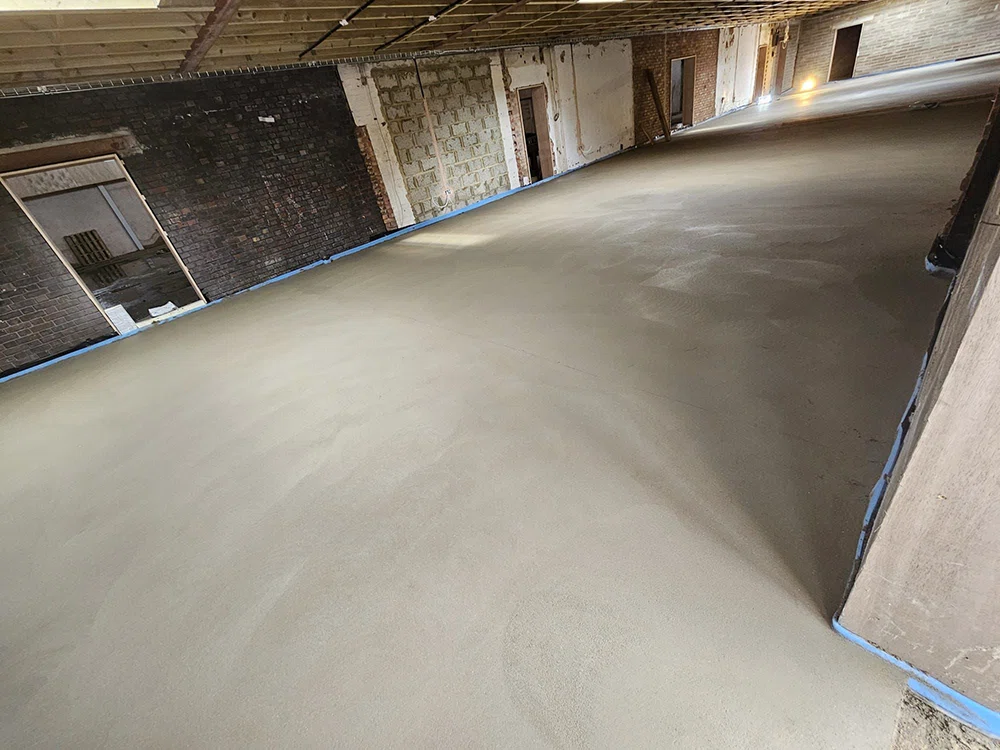
K & B Screeding’s own team, led by director Donatas Bardisevicius. Founded 2019, company 12298780.
See what customers say in our Google reviews and on our testimonials page.
Anhydrite & Flow Screed from Slough to Beaconsfield
Beaconsfield is about 5.4 miles north of our Slough base as the crow flies, with postcodes including HP9 and HP10. The nearest towns to it are High Wycombe (4.7 miles), Amersham (4.9 miles), Chorleywood (6.2 miles) and Marlow (6.3 miles).
More on anhydrite screed, part of our screeding services.
