
Where pumped screed fits Beaconsfield's larger floors
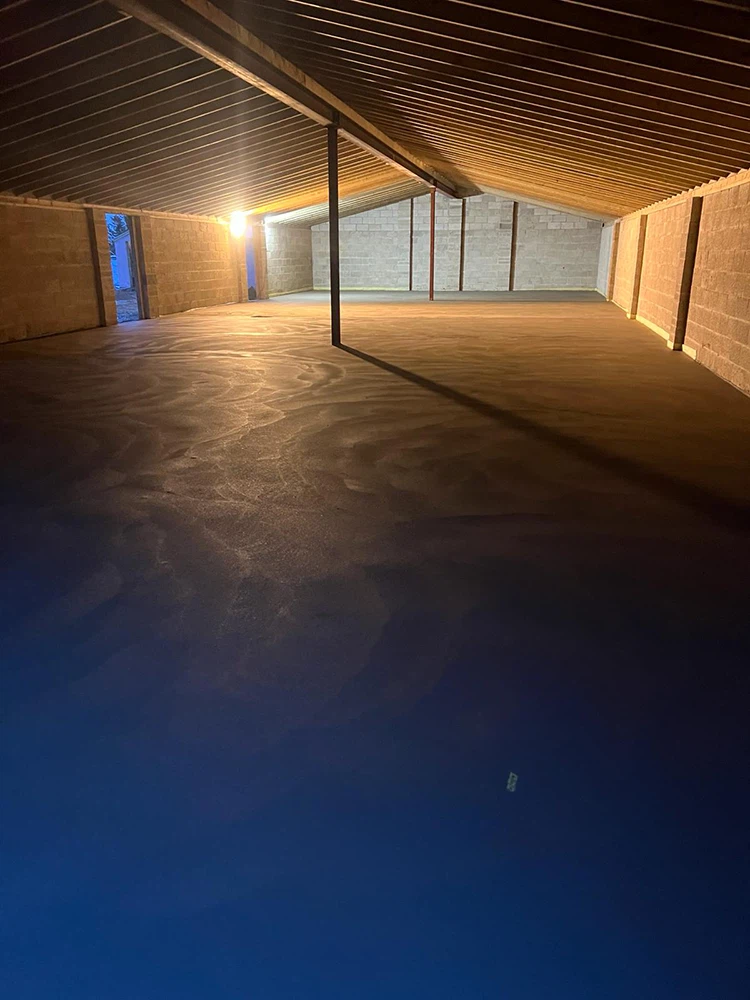
Open ground floors are where the pump pays for itself in Beaconsfield. A single pour can run from the front hall to the back of a new garden room without a break, and because liquid screed shrinks very little it needs far fewer joints than a hand-laid floor. That matters under large format tiles and long runs of engineered boards, where a crack line would show.
The newer stock is the natural fit. Some 23% of the town's homes were built since 2000, and a house of that age usually has an insulated ground floor that takes a floating screed well. The homes consented at Wilton Park will be new build plots of the same kind, where the floor build-up is set at the design stage.
Flats are the other good case. With 18% of Beaconsfield's homes being flats, there are upper floors where carrying sand and cement up a stair would be slow, heavy work, while a pump hose simply runs up to the room.
Depth is modest. Laid floating in a house, liquid screed can go down at about 35mm where sand and cement would need about 65mm, so the new floor is easier to bring in line with an old threshold or door. Liquid screed is made both with calcium sulphate and with a cement base. Our page on anhydrite screed for Beaconsfield covers the calcium sulphate type and its grades, while the liquid versus sand and cement comparison weighs one method against the other.
Getting the pump hose into a Beaconsfield house
Both the pump and the mixer stay outside the house. On a detached plot they usually sit on the drive and the hose runs through the nearest door, down a hallway or up a staircase to the room. Long gardens can mean a long hose, which is fine as long as the route is clear and protected. Above a shop on either high street, check where a mixer can legally stand for a few hours, because a flat there may have no off-road space at all.
Have the room ready before the hose comes through the door: edge strip fixed round all the walls, a membrane over the insulation with its joints taped, and a dam at each doorway so the screed stays where it should. On the morning we look over those layers, and if they are missing we can bring them under our insulation, membrane and preparation work.
A floor you can stand on can still hold plenty of water. Before the new kitchen floor or boards go down, give it a day per millimetre of depth up to 40mm, and more again past that. Our screed drying times guide explains why, and how to plan the flooring date around it.
Liquid Screed prices in Beaconsfield
Liquid screed: £24 to £31 per m² supplied and laid (MyJobQuote, August 2026), so £960 to £1,240 for 40 m². MyJobQuote does not say whether these figures include VAT. See our floor screeding cost guide or screed calculator.
Who lays your liquid screed in Beaconsfield
K & B Screeding’s own team, led by director Donatas Bardisevicius. Founded 2019, company 12298780.
See what customers say in our Google reviews and on our testimonials page.
Liquid Screed from Slough to Beaconsfield
Beaconsfield is about 5.4 miles north of our Slough base as the crow flies, with postcodes including HP9 and HP10. The nearest towns to it are High Wycombe (4.7 miles), Amersham (4.9 miles), Chorleywood (6.2 miles) and Marlow (6.3 miles).
More on liquid screed, part of our screeding services.
