Choosing an anhydrite grade for a Chorleywood house
Calcium sulphate screeds are labelled with a code set by the European screed standard. In that code, CA means calcium sulphate, the C number is compressive strength and the F number is flexural strength, each in N/mm2. Nearly every house job uses one of three. For a domestic floor with little traffic, CA-C20-F4 is enough. CA-C25-F5 is what most homes, apartments and offices get. CA-C30-F6 takes heavier wear.
In Chorleywood, 65% of homes are in council tax bands F to H, and large detached houses with kitchen and family room extensions drive much of the floor work. A floor running as one open-plan space from kitchen to family room usually starts from CA-C25-F5, though an architect's or engineer's specification always takes priority. Where a faster dry or a thinner floor is needed, a specification may call for an alpha hemihydrate product. In that case its own product sheet sets the rules, and we follow them.
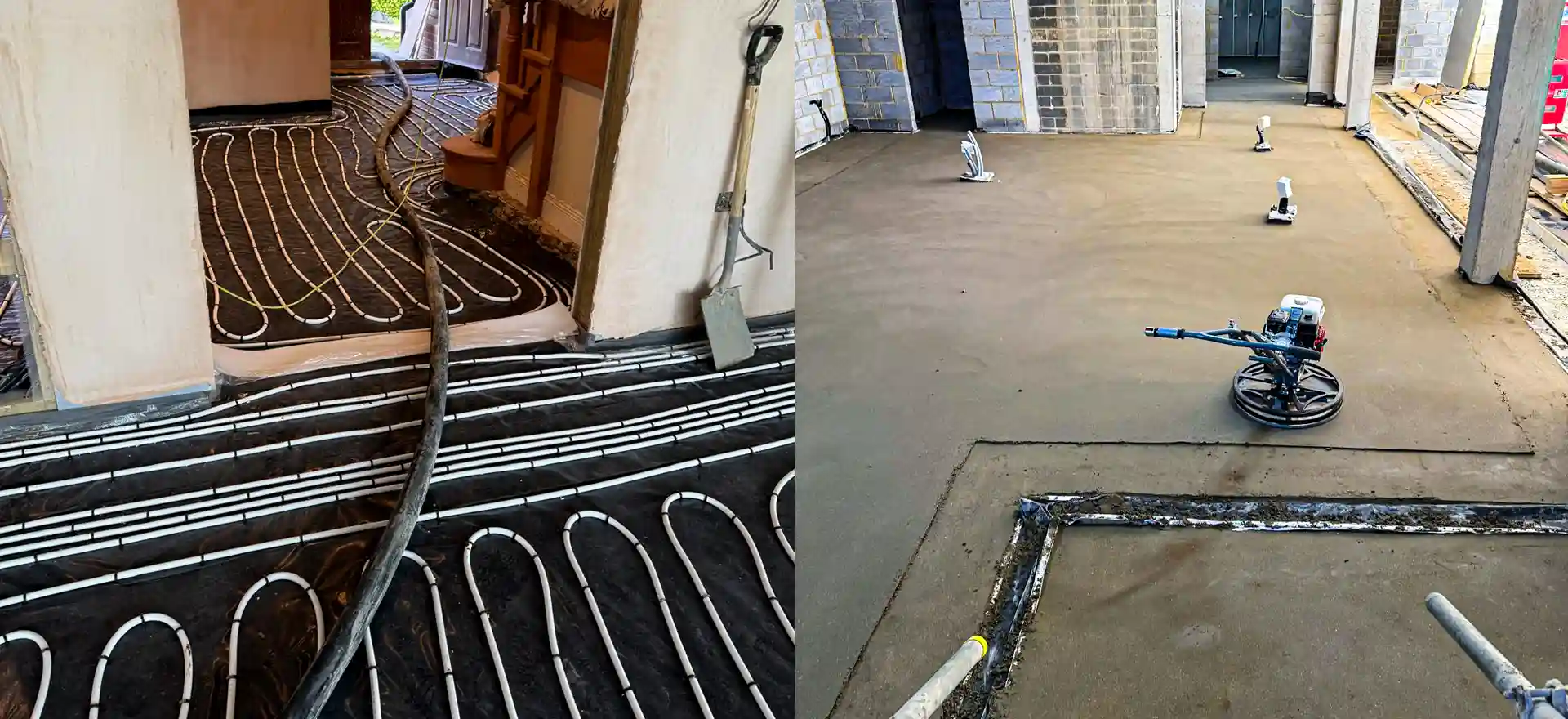
The material's other strength is how little it shrinks. That lets us pour it in wide bays with few joints, which fits a ground floor where kitchen, family room and hallway all open into one another. We plan the bay and joint layout before pouring, usually with joints at doorways or where heating zones meet.
Only 10% of Chorleywood's homes were built since 2000, so anhydrite here goes mainly into existing houses and their extensions rather than new build plots. For the chemistry behind it, see anhydrite screed explained.
Laitance, moisture and primers on Chorleywood floors
As it dries, calcium sulphate screed leaves laitance, a thin and weak skin on top. It must come off. Once a moisture reading says it is dry enough, that skin is sanded back and the floor is primed with something designed for calcium sulphate. Skipping this step is how tiles end up bonded to a crust rather than to the screed.
Moisture is the second check. Flooring manufacturers often allow calcium sulphate less moisture than cement before fixing, which is why a Chorleywood floor can look ready and still fail. We measure it with a hygrometer and log the result. Pipes in the floor help: the heating can usually start force drying it from about 7 days and take a good deal off the wait.
Anhydrite is not for every room. Water sitting on it for long weakens it, so showers, wet rooms and any utility floor that could flood go in a cement based flowing screed or sand and cement laid by hand in Chorleywood. If the finished floor then needs a thin skim for sheet vinyl or LVT, our floor levelling service covers it.
Anhydrite over existing slabs in older Chorleywood houses
Not every Chorleywood ground floor refurbishment starts with a dig. A house from the post-war decades, which account for 47% of Chorleywood's homes, may have a concrete slab that is still sound, and the job is then to add insulation and a new screed over it. Calcium sulphate flow screed is a strong candidate for that because of the depth it needs.
Laid as a floating screed over insulation in a house, anhydrite can go down from about 35mm, where hand-laid sand and cement would need about 65mm. Over the area of a large ground floor, those saved millimetres decide whether the insulation fits under the existing door thresholds and kitchen plinths, or whether doors must be cut and stairs adjusted.
Anhydrite is never bonded to the old slab. It floats on insulation or on a separating membrane laid over the concrete, with edge strip around every wall. Before that, the slab needs checking. A damp slab will feed moisture into the screed from below, so the existing damp protection is confirmed, or a new membrane is added on top of the concrete. Cracks or hollow areas in the slab are repaired first.
Where even a thin build will not fit, the options are a thinner insulation board, breaking out the slab in the rooms where height matters most, or raising the floor and adjusting doors. We set out the finished level for each option before pricing, so the choice is made on paper rather than on the day.
Anhydrite and flow screed prices in Chorleywood
Liquid flowing screed (which includes anhydrite): £24 to £31 per m² supplied and laid (MyJobQuote, August 2026), so £960 to £1,240 for 40 m². MyJobQuote does not say whether these figures include VAT. See our liquid screed cost per m² guide or screed calculator.
Who lays your anhydrite and flow screed in Chorleywood
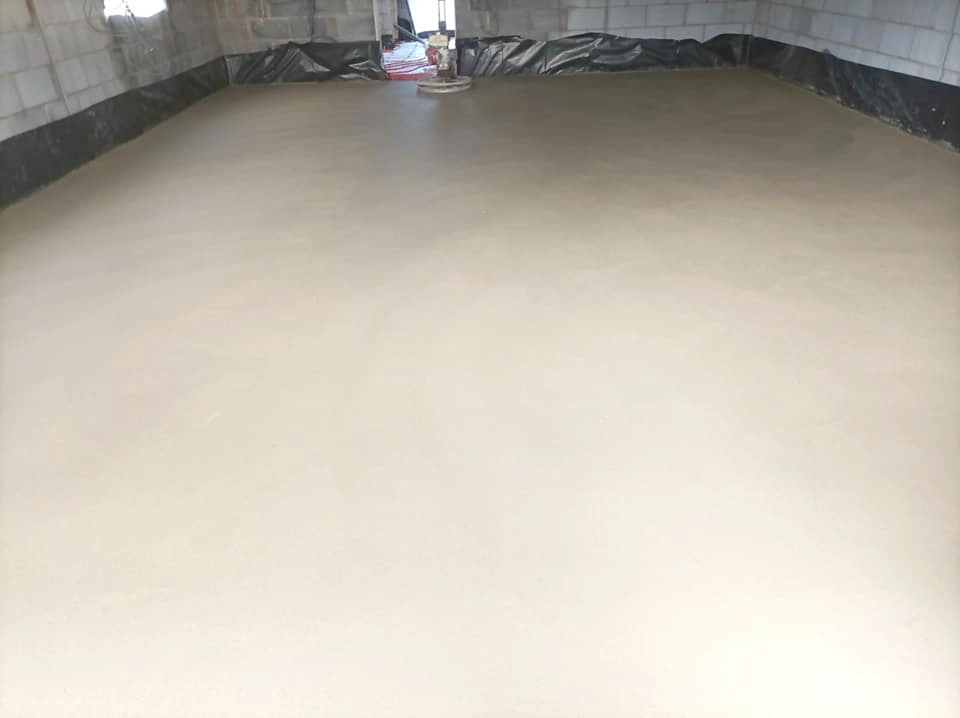
K & B Screeding’s own team, led by director Donatas Bardisevicius. Founded 2019, company 12298780.
See what customers say in our Google reviews and on our testimonials page.
Anhydrite and flow screed from Slough to Chorleywood
As the crow flies, our base in Slough is about 10 miles from Chorleywood, which lies to the north-north-east. Postcodes here include WD3, and Rickmansworth (2.5 miles), Amersham (4 miles), Chesham (5.2 miles) and Watford (5.4 miles) are close by.
On Chorleywood streets where the anhydrite delivery cannot park off the road, a suspension or dispensation comes from Three Rivers District Council (suspensions and dispensations). We confirm on the quote whether it is needed.
More on anhydrite screed, part of our screeding services. For every screed we lay locally, see floor screeding in Chorleywood.
Further reading: calcium sulphate screed guide.