
Blending a Chorleywood extension into the old floor
An extension floor is usually new screed, level and true. The house floor it joins may be decades older, with a slight fall, a hump over an old wall line or a crack where two slabs meet. Put a rigid finish like LVT or large porcelain across that join and every fault shows through.
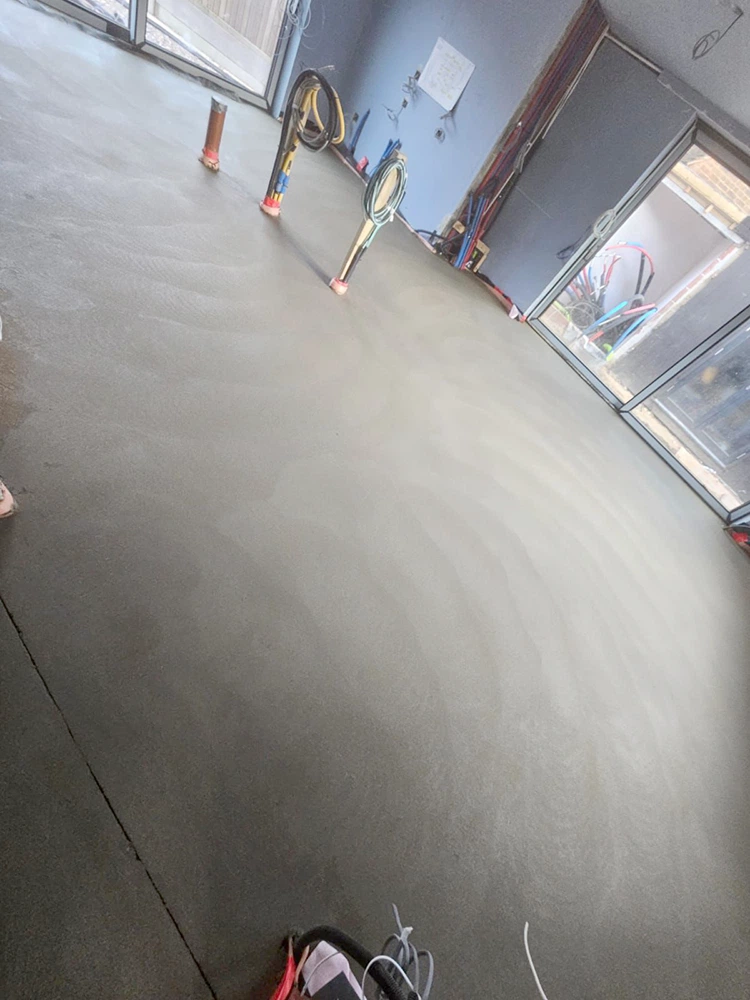
Levelling compound solves most of these. We prepare the surface, prime it to suit the base, and pour a compound that flows across both floors and settles flat. The primer matters: sand and cement, calcium sulphate, old concrete and existing tiles each need a different one, and the wrong primer is a common reason a compound lets go.
What we work to is a flatness class. Those classes come from BS 8204: SR1 permits 3mm under a 2m straightedge, SR2 5mm, SR3 10mm. SR1 is the class many thin sheet finishes demand, so for vinyl and LVT that is usually what we aim for.
Chorleywood's housing is not only large detached houses. Semis make up 21% of homes, and 16% were built between 1973 and 1999. Concrete ground floors of that age can carry decades of wear, old tile adhesive and patch repairs, and they respond well to levelling once loose material is removed, and our floor preparation work covers grinding and cleaning where the surface needs it first.
When a Chorleywood floor needs screed, not compound
Compound has a limit. Compound normally goes down at roughly 2mm to 10mm, a few products deeper, but used thick to cover a badly out of level, hollow or crumbling floor it tends to crack and come away. Past that, the floor wants fresh screed, and we will say so.
The signs are fairly clear. If a 2m straightedge shows gaps well beyond 10mm, if the floor sounds hollow when tapped, or if the old screed crumbles when scraped, compound will not fix it. In an older Chorleywood house that often means taking the floor up and relaying it, and our page on relaying floors in sand and cement explains that job. Isolated damage can sometimes be cut out and patched as a screed repair before levelling.
We tell you which one your floor needs at the survey, not after a failed pour. Levelling is not wood floor sanding, and we do not sell products for DIY use; this is a laid, primed and checked surface ready for the flooring fitter.
The same service is available for floor levelling in Watford, a little over 5 miles away.
How we price floor levelling in Chorleywood
A fixed written price within 24 hours, once we know the area and the base. See our floor screeding cost guide.
Who levels your floor in Chorleywood
K & B Screeding’s own team, led by director Donatas Bardisevicius. Founded 2019, company 12298780.
See what customers say in our Google reviews and on our testimonials page.
Floor Levelling from Slough to Chorleywood
As the crow flies, our yard in Slough is about 10 miles from Chorleywood, which lies to the north-north-east. Postcodes here include WD3, and Rickmansworth (2.5 miles), Amersham (4 miles), Chesham (5.2 miles) and Watford (5.4 miles) are close by.
More on floor levelling, part of our screeding services. Not sure whether you need a thin compound or a full flowing screed? See self levelling screed explained.