
Screeding heated rooms at Great Western Park
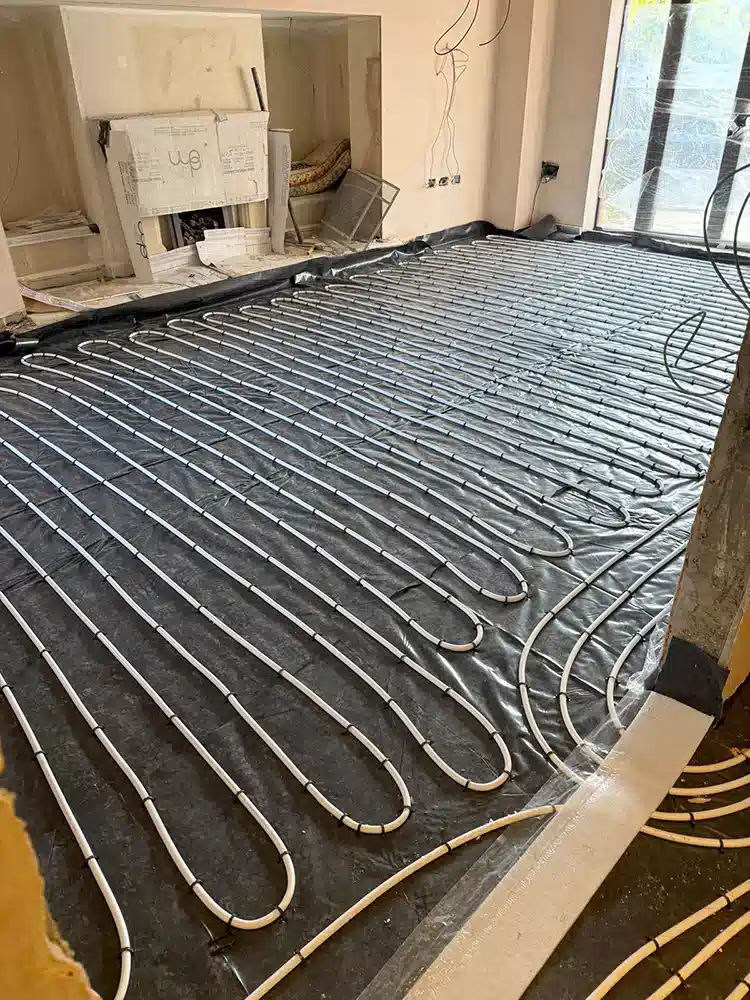
A new room with underfloor heating is a layered job. At the bottom is the slab, then insulation boards and an edge strip around the walls, then a membrane, then the heating pipes clipped in place, and finally the screed. Each layer has a job, and the screed is the one that turns warm water in the pipes into a warm floor.
Over pipework, most floors get a liquid screed. Because it runs beneath and between the pipes and leaves no gaps of trapped air, heat spreads evenly and the room comes up to temperature sooner. With 25mm minimum over the pipes, the finished depth is usually 45 to 50mm. More on the material itself is on our page for liquid screed in Didcot.
Sand and cement can also be laid over heating, with about 45mm of cover. It gives a thicker, heavier floor that takes longer to warm and to dry, but it suits a room that needs a cement base.
In a house built since 2000, which 34% of Didcot's homes are, the finished floor level of the existing rooms is usually known, so the new build-up is worked back from it.
Before we pour, the heating engineer must have the pipes clipped, filled and pressure tested. Loose pipes can lift as liquid screed flows around them. We also inspect the insulation, perimeter strip and membrane, and provide them where our price includes them. Typical layer depths are set out in our guide to screed depths.
Commissioning a new Didcot heated floor
Once the screed is down, the heating has to wait, and then it has to start gently.
A calcium sulphate floor can normally have the system running from around 7 days. For sand and cement, allow at least 21 days. Either way, the water should start cool and be raised a little at a time across several days, as the screed manufacturer's schedule sets out. A floor heated too fast can crack or curl.
That same heating can help the floor dry. On calcium sulphate, running the heating from around 7 days to force dry it usually brings the flooring date forward. The heating engineer controls the system; we set out in writing when each step can begin.
In Ladygrove, where conservatories are being replaced by solid extensions, adding heating to the new room raises a question of height: the new floor must meet the existing kitchen, so the insulation, pipes and screed all have to fit a set depth. A liquid screed's shallower cover over the pipes often makes the difference.
Detached houses make up 22% of the town's homes, and on a larger heated ground floor a flowing screed's full pipe cover helps the whole area warm evenly. Published UK rates for 2026 put liquid screed laid over heating pipes at £20 to £35 per m². Wantage, about 8 miles away, has its own page on heated floors in Wantage.
Underfloor Heating Screed prices in Didcot
Liquid screed over underfloor heating: £20 to £35 per m² supplied and laid (trade2base, June 2026), so £700 to £1,230 for 35 m². trade2base gives these figures excluding VAT. See our floor screeding cost guide or screed calculator.
Who lays your underfloor heating screed in Didcot
K & B Screeding’s own team, led by director Donatas Bardisevicius. Founded 2019, company 12298780.
See what customers say in our Google reviews and on our testimonials page.
Underfloor Heating Screed from Slough to Didcot
On the map, Didcot sits west of Slough, about 26.2 miles from our base in a straight line (postcodes including OX11), next to Abingdon-on-Thames (4.7 miles), Wantage (8 miles), Oxford (10.1 miles) and Thatcham (14.1 miles).
More on underfloor heating screed, part of our screeding services.
