
Clearing old coatings from Milton Park and Southmead units
Laboratories sit alongside offices and industrial units at Milton Park, while Southmead Industrial Estate has housed motorsport firms. When a unit of either kind changes tenant or use, the slab is often left carrying something the next occupier does not want: paint from a workshop, glue from carpet tiles, a sealer, or patched areas finished higher than the floor around them.
Grinding is how we get back to a sound surface. Rotating diamond heads cut a thin layer from the slab with each pass. Coarse segments strip coatings and bring down ridges between bays; finer segments leave a uniform texture that primers and compounds can grip. Laitance, the weak skin on top of a poured floor, comes away at the same time.
The aim is a clean, open surface, ready for the trade that follows. That may be us, laying levelling compound or a new screed, or it may be a specialist applying a resin system to a laboratory floor. We do not install resin or polished concrete ourselves. Nor do we sell or hire grinders and diamond tooling; grinding is a service carried out by our own crew.
For very large floor areas, or coatings too thick to grind economically, shot blasting or scarifying may suit better, and preparing large commercial floors covers those methods. Where a unit then needs a new wearing floor, a commercial wearing screed can follow on the prepared slab.
Ladygrove extensions, old glue and dust in Didcot
In Ladygrove, built in the 1980s and 1990s, knocking a kitchen through or replacing a conservatory with a brick extension means new floor meeting old. Across the town, 37% of homes date from 1973 to 1999. Where the new slab and screed meet the original floor, the join is rarely perfect, and a lip or a slightly proud bay is ground down so one covering can run across both rooms.
Lifting the old kitchen flooring adds another job. Carpet glue, vinyl adhesive and the remains of tile beds sit on the original screed, and a thin coat laid over soft residue can fail. Grinding takes the floor back to clean screed. Latex for thin finishes in Didcot is often the next step.
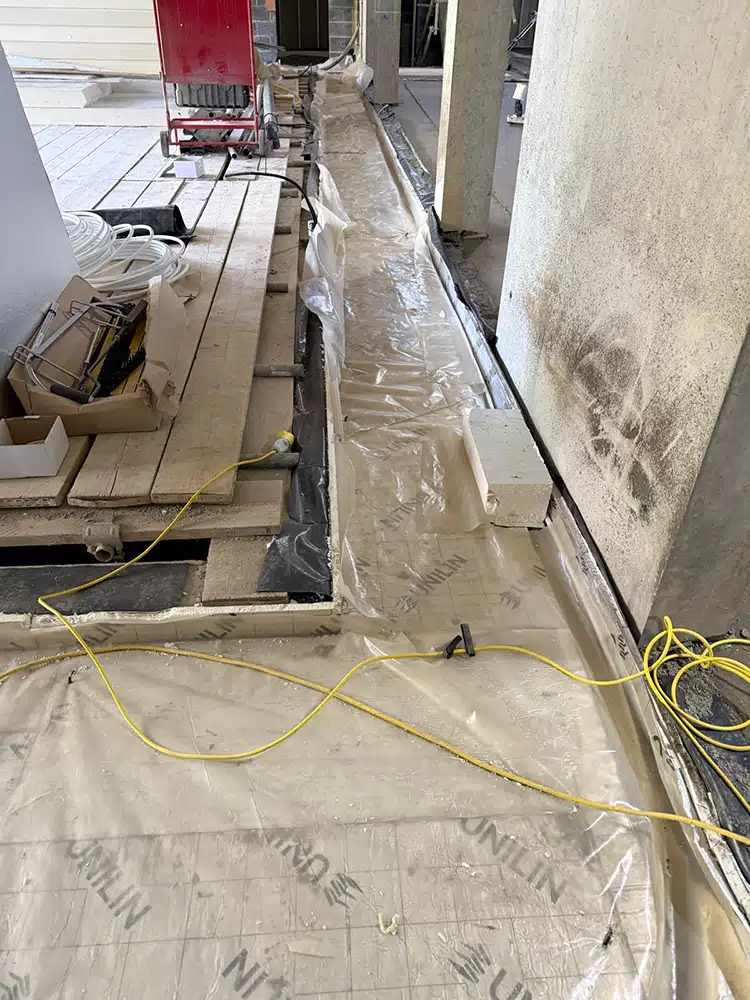
Dust is the part we treat most seriously. Concrete and screed contain silica, and grinding releases respirable crystalline silica dust. Our grinders run only with extraction attached, rooms are sealed with sheeting, and adjoining areas stay protected.
One misunderstanding to avoid: grinding will not flatten a floor that falls or sags across a whole room, and cutting too deep into a screed can leave it below its minimum depth. In that case the high spots are ground and the floor is brought flat with levelling compound on the prepared floor or a new screed.
How we price floor grinding in Didcot
A fixed written price within 24 hours, once we know the area and what has to come off. See our floor screeding cost guide.
Who grinds your concrete floor in Didcot
K & B Screeding’s own team, led by director Donatas Bardisevicius. Founded 2019, company 12298780.
See what customers say in our Google reviews and on our testimonials page.
Concrete Floor Grinding from Slough to Didcot
On the map, Didcot sits west of Slough, about 26.2 miles from our base in a straight line (postcodes including OX11), next to Abingdon-on-Thames (4.7 miles), Wantage (8 miles), Oxford (10.1 miles) and Thatcham (14.1 miles).
More on floor grinding, part of our screeding services.
