
Grinding floors for Thame offices and warehouses
Diamond grinding works by cutting. Heads set with diamond segments spin against the floor and pare its surface down a little at a time, so a ridge, a trowel mark or a lip where two bays meet can be brought down until it runs flush with the floor around it.
On a commercial floor that is usually the first step of a refit. Besides the two head offices, Thame has W. Lucy & Co., which moved to the town from Oxford in 2005. When an office is stripped for new carpet tiles, or a warehouse floor is prepared for racking, the old finish rarely comes up clean. Carpet tile adhesive, floor paint, thin coatings and bumps left by old fixings all stay behind, and grinding clears them.
What is left is an open, clean surface that a primer, levelling compound or new screed can key into. It is also the right start for a resin system, though resin is a job for others. Neither resin nor polished concrete is something we lay; our part ends at a prepared floor.
Grinding has limits on very large areas or heavy coatings. Across a big warehouse, or where a thick coating must come off, shot blasting or scarifying can be quicker, and our floor preparation service covers both. Under raised access flooring, the aim is a sound, dust free base, and grinding followed by levelling compound for Thame refits is a usual route.
We are a contractor, not a hire shop. Grinders and diamond tooling are not for sale or hire from us, and each machine arrives with our own operators.
Extension joins and garage slabs in Thame houses
At home, the obvious candidates are the extensions and garage conversions that Thame's 1970s to 1990s houses tend to get.
Where a new extension slab meets the original floor, the two rarely finish at exactly the same height. A small lip across the opening will show under LVT or a run of tiles, so the high side is ground down and the join smoothed over afterwards. A garage being turned into a room brings different trouble: oil stains, paint or an old sealer on the slab, none of which a new layer will stick to.
Lifted carpet or vinyl is the other trigger. Old floors often keep a hard layer of adhesive that levelling compound or latex cannot hold onto, and grinding takes it back to bare concrete.
Know what grinding cannot do. It flattens local high spots, but a floor that falls or sags across a whole room stays that way, and chasing it with the grinder can take a screed below its minimum depth. In that case we grind the high spots and then level or rescreed, and our screed repairs page covers damaged patches.
Dust is the real hazard. Silica is present in concrete, screed and tile, and cutting them throws up fine respirable crystalline silica. We grind only with extraction connected to the machine, sheet off doorways into rooms still in use, and clean down before we leave.
How we price floor grinding in Thame
A fixed written price within 24 hours, once we know the area and what has to come off. See our floor screeding cost guide.
Who grinds your concrete floor in Thame
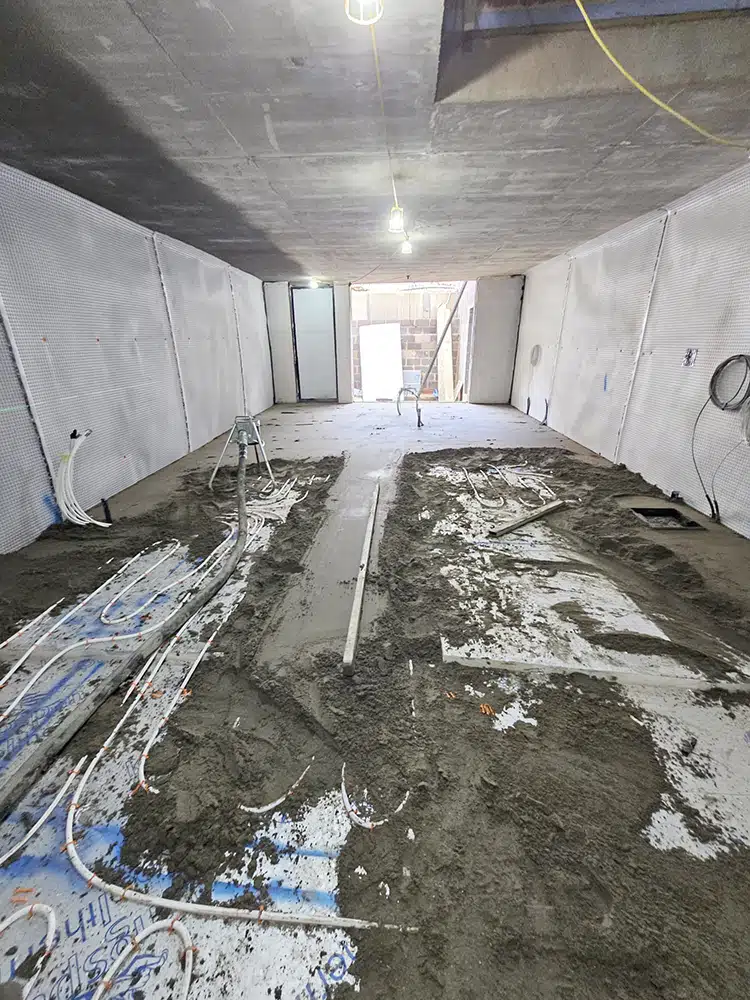
K & B Screeding’s own team, led by director Donatas Bardisevicius. Founded 2019, company 12298780.
See what customers say in our Google reviews and on our testimonials page.
Concrete Floor Grinding from Slough to Thame
Thame is about 20.7 miles north-west of our Slough base as the crow flies, with postcodes including OX9. The nearest towns to it are Aylesbury (8.7 miles), Oxford (11.9 miles), Bicester (12.6 miles) and High Wycombe (12.9 miles).
More on floor grinding, part of our screeding services.
