
Where pumped screed pays off in Thame
A flowing screed earns its keep where the floor is big and uninterrupted. In Thame that usually means the 1970s to 1990s housing, where a rear kitchen extension, a garden room or an open-plan knock-through creates one large new floor. It also means the newest homes: 15% of Thame's homes were built in 2015 or later.
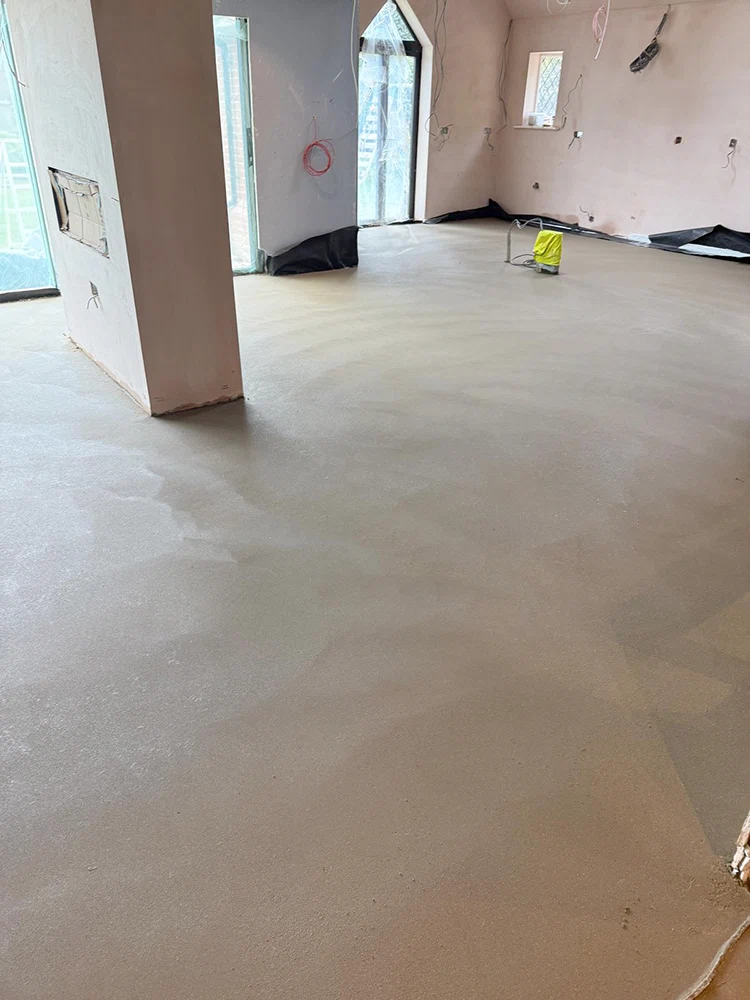
Because it is pumped in and finds its own level, a liquid screed covers that kind of area in a single visit and settles dense and flat. It will normally reach SR1 or SR2 flatness, and that counts if you have chosen big format tiles or LVT for the new kitchen.
Depth is lower than a traditional screed. Floating on insulation, a liquid screed in a house can be as thin as about 35mm, or about 40mm in commercial premises, against 65mm for the sand and cement equivalent. When a Thame extension floor must finish flush with the house it joins, those spare millimetres can go into deeper insulation instead. The numbers are all in our guide to screed depths.
Liquid screed comes with either a calcium sulphate or a cement binder, and which we pick follows from how the room is used and what goes on top. Because it barely shrinks, an open-plan knock-through can usually be poured in one piece with only a handful of joints, where a hand-laid floor would need many more.
Do not mistake walking on it after a day or two for it being dry. Allow roughly one day for each millimetre up to 40mm, then longer for anything deeper, which puts a 50mm floor weeks away from its flooring.
Getting the pump to a Thame room
Every liquid pour depends on the mixer and pump reaching within a hose run of the room. On a driveway at a semi or detached house there is usually space. Terraced streets, cottages off the Lower High Street and flats above ground level each need a little more planning, with the pump in the road and the hose led through a hallway, down a side passage or up a stair.
Before we quote, mention where a van could park, how wide the side access is and what level the room is on, and from that we work out where the pump goes and the route for the hose. Our screed pumping service explains how that part of the job is set up. We do not hire out pumps, so the machine always arrives with our own crew.
On pour day we need the room closed to the weather and plastered, and the insulation, membrane and edge strip already down. The perimeter and every joint in the membrane are taped so the screed cannot run underneath and lift the insulation boards.
If you are weighing liquid against a traditional mix for a Thame extension, the comparison in liquid screed vs sand and cement sets out both. We also pump liquid screed in Aylesbury.
Liquid Screed prices in Thame
Liquid screed: £24 to £31 per m² supplied and laid (MyJobQuote, August 2026), so £960 to £1,240 for 40 m². MyJobQuote does not say whether these figures include VAT. See our floor screeding cost guide or screed calculator.
Who lays your liquid screed in Thame
K & B Screeding’s own team, led by director Donatas Bardisevicius. Founded 2019, company 12298780.
See what customers say in our Google reviews and on our testimonials page.
Liquid Screed from Slough to Thame
Thame is about 20.7 miles north-west of our Slough base as the crow flies, with postcodes including OX9. The nearest towns to it are Aylesbury (8.7 miles), Oxford (11.9 miles), Bicester (12.6 miles) and High Wycombe (12.9 miles).
More on liquid screed, part of our screeding services.
