
Where liquid screed earns its place in Bicester
The bigger and more open the room, the more sense a flowing screed makes. A rear extension that joins a kitchen, dining area and family room into one space is the classic case, because the whole area can be poured without the joints and hand trowelling a traditional screed would need. Left to find its own level, it reaches SR1 or SR2 readily, and that flatness is what LVT, big tiles and engineered boards want underneath.
Kingsmere and the Elmsbrook eco-town, where the first residents moved in during May 2016, are among the newest parts of Bicester. When owners of recent houses extend or reconfigure the ground floor, a flowing screed gives the new area the same flat, dense finish across the whole room.
Flats are another good match. They make up 10% of Bicester's homes, and a pumped screed can be placed on an upper floor through a hose rather than carried up by the bag.
Liquid screed comes in two kinds: calcium sulphate, which suits heated floors and rooms that stay dry, and cement based flowing screed for any floor that might see water. We choose between them for the room, not by habit.
Liquid screed is not always the answer. A tiny cloakroom, a wet room with falls or a garage floor usually suits sand and cement screed in Bicester. The two are set side by side in our guide to choosing between liquid and traditional screed.
Getting the pump to a Bicester floor
Every liquid pour starts outside the house. A lorry brings the mix, the pump pushes it down a hose into the room, and both need somewhere to stand by the house with a clear line for the hose to run. A driveway is ideal. Where a house has only street parking, or sits in a terrace with the access at the back, we plan the hose run before the day and tell you what space we need.
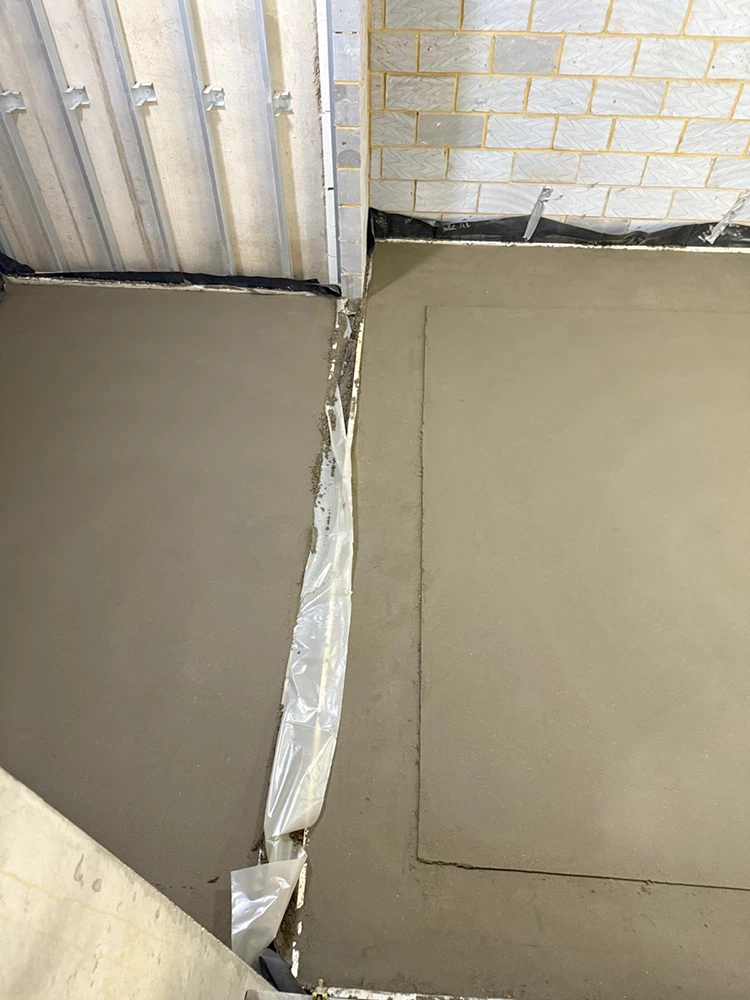
The room itself has to be prepared before that hose comes in. Insulation goes down first, an edge strip lines every wall, the membrane is taped wherever sheets overlap, and each doorway is dammed so the flow cannot escape. Our screed pumping service explains the kit and how the hose is routed through a house.
Once it is poured, shut the door on it for a day or two and keep heaters and draughts off the fresh surface. You can cross it after 24 to 48 hours, though being able to stand on it does not mean it has dried. Allow roughly a day for each mm of the first 40mm, with the rate slowing after that; our piece on screed drying times helps you pick a date for the flooring. The same service is available for homes in liquid screed in Kidlington.
Liquid Screed prices in Bicester
Liquid screed: £24 to £31 per m² supplied and laid (MyJobQuote, August 2026), so £960 to £1,240 for 40 m². MyJobQuote does not say whether these figures include VAT. See our floor screeding cost guide or screed calculator.
Who lays your liquid screed in Bicester
K & B Screeding’s own team, led by director Donatas Bardisevicius. Founded 2019, company 12298780.
See what customers say in our Google reviews and on our testimonials page.
Liquid Screed from Slough to Bicester
As the crow flies, our yard in Slough is about 33.3 miles from Bicester, which lies to the north-west. Postcodes here include OX26, and Kidlington (7.8 miles), Brackley (9.4 miles), Buckingham (10.1 miles) and Oxford (11 miles) are close by.
More on liquid screed, part of our screeding services.
