
Screeding over heating pipes at Graven Hill
Graven Hill, the self-build neighbourhood on former Ministry of Defence land, is where heating and screed decisions are made from scratch. A self-builder there typically fixes the heating system first, then asks which screed goes over it, and the answer depends on the floor covering that will finish each room.
A liquid screed is the usual pick over pipes. It flows around every pipe with no air pockets, and a floor with no voids heats faster and more evenly. With 25mm minimum above the pipes, the whole floor usually ends up 45 to 50mm deep. Read more on pumped liquid screed in Bicester if you have not yet chosen.
A traditional mix can go over heating too, though it wants roughly 45mm above the pipes. That makes the floor thicker and heavier, and slower to warm up and to dry.
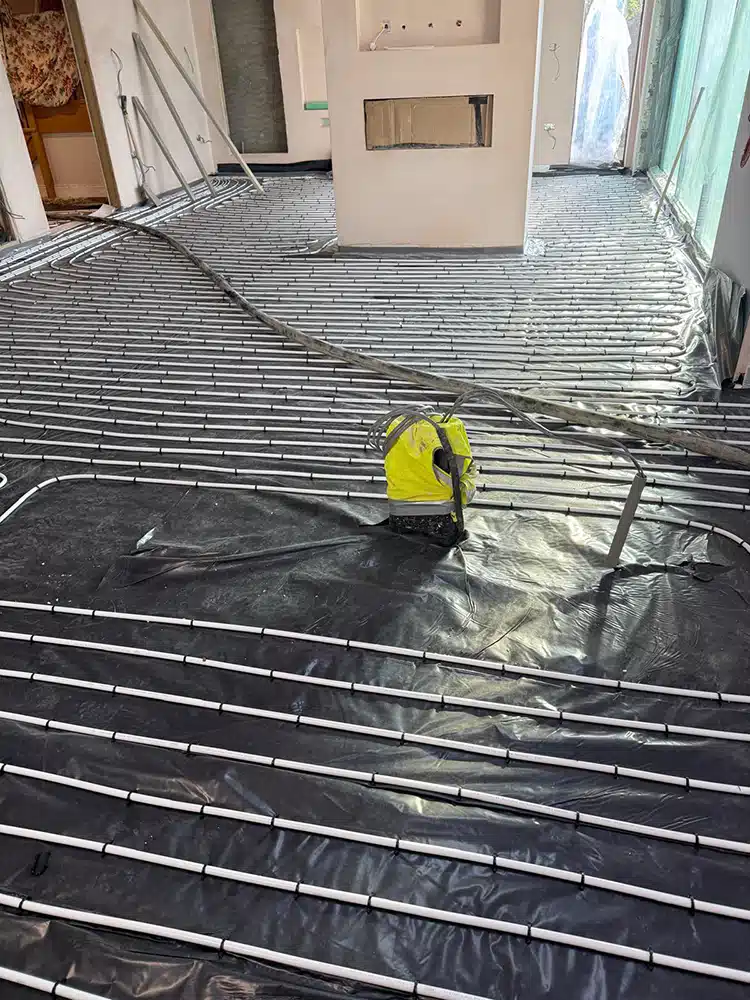
Your installer has to clip the pipes firmly, fill the circuit and pressure test it before we start. Below them sit insulation boards, an edge strip around every wall to allow for expansion, and a membrane lapped and taped at the joins. We check that build-up on arrival, and supply the insulation and membrane where they are part of our quote. The insulation and membranes service sets out what goes under the screed and why.
For tiles, LVT or engineered wood, the flatness of the screed matters as much as its depth, so we finish to the class your flooring needs.
Retrofitting heating in older Bicester houses
Not every heated floor in Bicester is new. With 29% of Bicester homes detached, there are plenty of houses where an extension or a ground floor refit is the obvious moment to put heating under the floor. The difficulty in an older house is floor height. Insulation, pipes and screed all take space, and the finished floor still has to meet the hallway and the door thresholds.
That is where the screed choice becomes a height decision. A liquid screed at 45 to 50mm total over pipes is thinner than a sand and cement build-up, and the saving can make a retrofit possible without lowering the slab. The screed thickness guide walks through typical build-ups.
After the pour, resist the urge to warm the house up. On calcium sulphate, the system can start running from around 7 days. A sand and cement floor should be left 21 days or more before any heat goes through it. In both cases the first run is at a low setting, stepped up a little at a time over several days in line with the manufacturer's schedule. Going straight to full temperature risks cracking the floor.
For a liquid screed laid over heating pipes, published UK prices in 2026 range from £20 to £35 per m². Buckingham, about 10 miles off, has its own page on heated floor screeding in Buckingham.
Underfloor Heating Screed prices in Bicester
Liquid screed over underfloor heating: £20 to £35 per m² supplied and laid (trade2base, June 2026), so £700 to £1,230 for 35 m². trade2base gives these figures excluding VAT. See our floor screeding cost guide or screed calculator.
Who lays your underfloor heating screed in Bicester
K & B Screeding’s own team, led by director Donatas Bardisevicius. Founded 2019, company 12298780.
See what customers say in our Google reviews and on our testimonials page.
Underfloor Heating Screed from Slough to Bicester
As the crow flies, our yard in Slough is about 33.3 miles from Bicester, which lies to the north-west. Postcodes here include OX26, and Kidlington (7.8 miles), Brackley (9.4 miles), Buckingham (10.1 miles) and Oxford (11 miles) are close by.
More on underfloor heating screed, part of our screeding services.
