
Screeding heated floors in Buckingham's newer homes
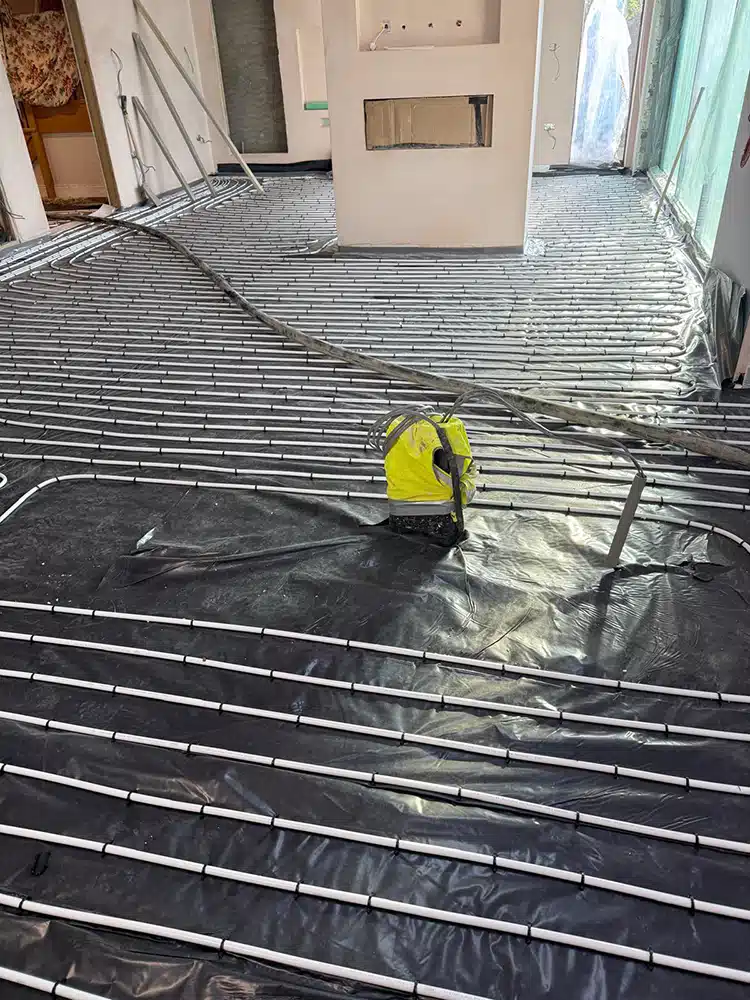
Some 17% of Buckingham's homes were built since 2015, and in a new house or extension the depth for insulation, pipes and screed can be set at design stage. Without the screed, the pipes would just be pipes. It spreads the heat evenly and holds it, so the floor warms steadily.
The cover above the pipes sets strength and heat spread. A pumped screed is poured to cover the pipes by 25mm or more, so the floor usually ends up 45 to 50mm thick. It flows around every pipe with no air pockets, so the warm-up is faster and the system more efficient. Hand-laid screed calls for roughly 45mm over them, which means more depth and more weight.
Under the pipework, insulation holds the heat in, a membrane sits between that insulation and the screed, and edge strip leaves room for the floor to move as it warms. Every layer is checked before we pour, and we can provide the insulation and membranes ourselves.
Keep the circuit pressurised after its test and right through the pour, so a damaged pipe makes itself known at once. Confirm the test with your heating engineer before the pour date.
For a new heated floor across a large open ground floor, pumped liquid screed for Buckingham homes is the usual choice. If the drawings for a new Buckingham home specify a calcium sulphate grade, the anhydrite grades page explains what it means. The system and manifold are designed and fitted by your heating engineer, never by K & B.
Retrofitting heating in existing Buckingham semis
Semi-detached houses are 28% of Buckingham's homes. Adding underfloor heating to one normally means lifting the ground floor, because there is rarely enough height to build insulation, pipes and screed on top without creating steps at every doorway.
Floor height is the constraint. A thinner liquid screed helps, but the depth still has to be planned before the old floor comes out. In small wet rooms, sand and cement laid to falls can still go over pipes with the right cover.
The heat-up must be gradual. Once poured, calcium sulphate can normally have the heating on from around day 7, but sand and cement has to wait until day 21 or later. Start the thermostat low and raise it in small steps over the following days, following the screed maker's heat-up table. Our drying guide explains why.
Heat applied too quickly dries the surface faster than the body of the screed, which can crack it or lift the edges. Tell your heating engineer the screed type and pour date so commissioning can be planned, and check the flooring maker's limits for surface temperature and moisture before the final covering goes down. If the old floor comes up, we can lay the new insulation and membrane layers as well.
Underfloor Heating Screed prices in Buckingham
Liquid screed over underfloor heating: £20 to £35 per m² supplied and laid (trade2base, June 2026), so £700 to £1,230 for 35 m². trade2base gives these figures excluding VAT. See our floor screeding cost guide or screed calculator.
Who lays your underfloor heating screed in Buckingham
K & B Screeding’s own team, led by director Donatas Bardisevicius. Founded 2019, company 12298780.
See what customers say in our Google reviews and on our testimonials page.
Underfloor Heating Screed from Slough to Buckingham
As the crow flies, our yard in Slough is about 35.6 miles from Buckingham, which lies to the north-north-west. Postcodes here include MK18, and Brackley (7.1 miles), Towcester (9 miles), Bicester (10.1 miles) and Milton Keynes (10.3 miles) are close by.
More on underfloor heating screed, part of our screeding services.