
Screed over pipes at Whitehouse and Fairfields
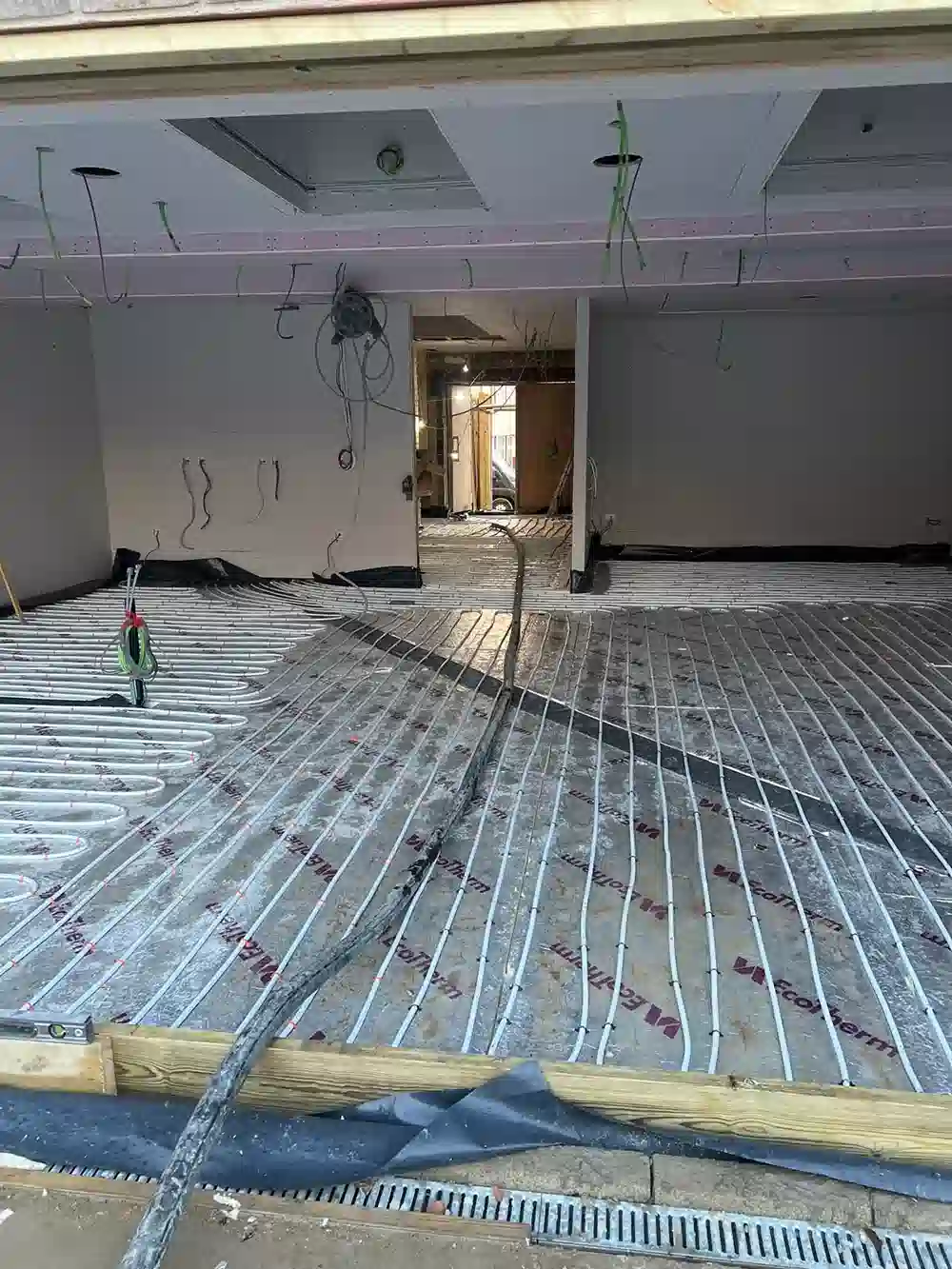
The Western Expansion Area at Whitehouse and Fairfields is one of the places in Milton Keynes where a flowing screed over pipes is the usual specification. The heating engineer lays and clips the pipes over insulation, fills and pressure tests the system, and then the screed goes on top. The screed has two jobs: to protect the pipes and to spread their heat evenly across the room. A thin or patchy layer leaves warm stripes above each pipe and cold bands between them, and it can crack under furniture where the cover is too shallow.
So the depth over the pipes comes first. With liquid screed we need 25mm or more above them, which usually puts the whole floor at around 45 to 50mm. Sand and cement asks for roughly 45mm over the pipes, so the floor ends up deeper and a good deal heavier. Because pumped screed around the heating loops runs beneath and between every pipe, no trapped air is left to hold back the warm-up.
Before we pour, we check the edge strip, the membrane and the insulation, or supply them if they are missing. The edge strip gives the warm screed room to expand, so it does not crack where it meets the walls. That layer is explained on our page about what goes under a screed.
In a new Fairfields house, the result is a base ready for tiles, LVT or engineered boards above the pipes.
Adding heating to a Milton Keynes extension
A kitchen extension on a grid square estate is where floor height gets tight. Insulation, pipes and screed all have to fit into the depth between the new slab and the level of the existing house floor. A thinner liquid screed often makes the numbers work where sand and cement would leave the floor too high. It also helps to agree the insulation thickness with the heating engineer early, because thicker boards save energy but eat into the depth left for screed. To see how those layers stack up, read how thick screed needs to be.
The heating cannot simply be switched on at full power once the floor is down. With calcium sulphate, warming can normally begin at around 7 days; with sand and cement, not before 21 days. Even then, the water temperature is brought up a few degrees at a time, so the screed dries evenly and does not crack. Keep a written record of the heat-up for the flooring fitter, who will want to see it before laying tiles or wood over the new floor.
If you are planning a heated garden room or extension in a nearby town, the same approach applies to underfloor heating screed in Bedford.
Underfloor Heating Screed prices in Milton Keynes
Liquid screed over underfloor heating: £20 to £35 per m² supplied and laid (trade2base, June 2026), so £700 to £1,230 for 35 m². trade2base gives these figures excluding VAT. See our floor screeding cost guide or screed calculator.
Who lays your underfloor heating screed in Milton Keynes
K & B Screeding’s own team, led by director Donatas Bardisevicius. Founded 2019, company 12298780.
See what customers say in our Google reviews and on our testimonials page.
Underfloor Heating Screed from Slough to Milton Keynes
As the crow flies, our yard in Slough is about 35.6 miles from Milton Keynes, which lies to the north. Postcodes here include MK9, MK6, MK10 and MK13, and Newport Pagnell (3.3 miles), Bletchley (3.5 miles), Leighton Buzzard (9.6 miles) and Buckingham (10.3 miles) are close by.
More on underfloor heating screed, part of our screeding services.
