Levelling unit floors at Bradwell Abbey, Kiln Farm and Tongwell
Milton Keynes has several established employment areas near the A5 and M1. Bradwell Abbey Industrial Estate has around 69 units, Kiln Farm lies north west of the centre off Monks Way, and Tongwell sits to the north near junction 14. When a unit changes tenant and its office or showroom area is refitted, the existing floor is often patched, scarred by old fixings or uneven between bays.
BS 8204 grades flatness by the gap under a 2m straightedge: up to 3mm for SR1, 5mm for SR2 and 10mm for SR3. Thin sheet finishes often need SR1, since vinyl and LVT show any ripple in the floor below. Compound normally goes down at between about 2mm and 10mm, and a fast drying product keeps a unit refit to its timetable.
Preparation decides whether it lasts. Before priming, old adhesive, paint and any weak surface layer are removed, using concrete floor grinding where needed; the primer is then matched to the base, whether that is concrete, screed or old tiles. Leave the primer out and the compound is far more likely to lose its bond. The primer also stops the base drawing water out of the compound too quickly.
Warehouse floors carrying racking or forklifts are different. Compound is for the finish, not the load, and those areas may need floor preparation and repair or a new screed instead.
Joining old and new floors in Milton Keynes homes
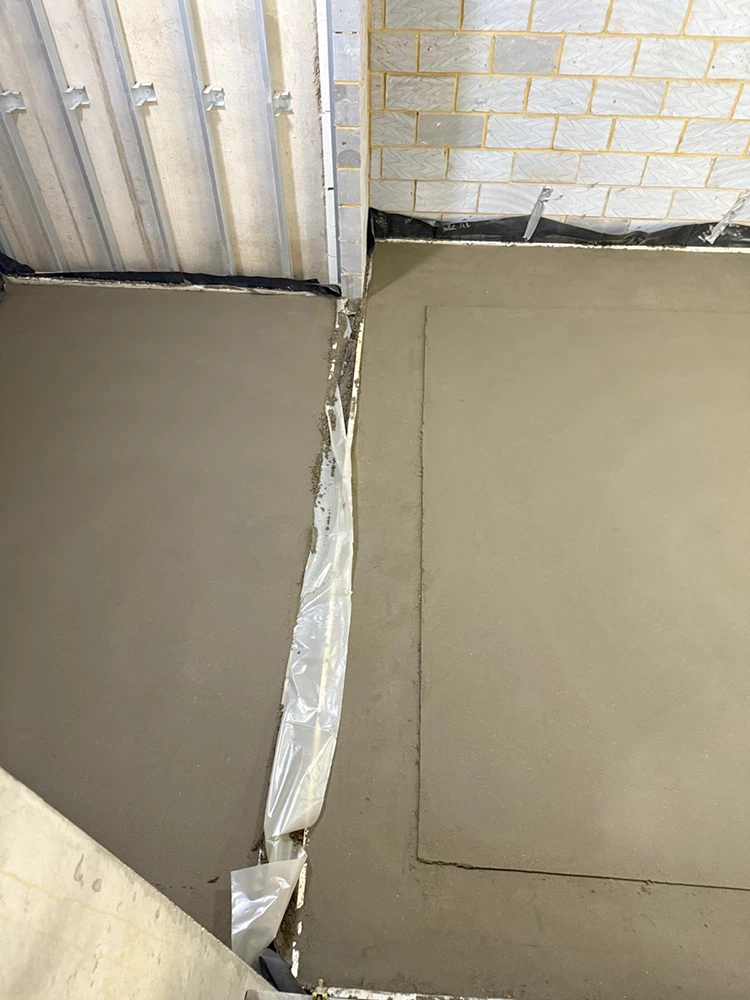
Semi-detached houses are 27% of homes here, and a rear extension on a semi is a typical place for two floors to meet unevenly. The original floor may have settled a few millimetres, or carry old tiles, while the new screed is laid to a fresh level. Compound feathered across the join gives one flat surface for a continuous floor finish through the knocked-through room. A garage conversion can show the same step where its new floor meets the hall.
Which primer goes on depends on the base: concrete, cement screed and old tiles each take a different one. With calcium sulphate, the laitance is sanded off first and a compatible primer follows, as set out on our page about anhydrite floors.
Compound has limits. A dip deeper than the compound's range, a hollow or cracked screed, or a floor that moves underfoot needs repair or a new screed rather than a thick pour of compound, which can crack and debond. For thin smoothing over sound floors, latex screed is another option. We will tell you honestly which the floor needs.
Self levelling screed or compound in a Milton Keynes house
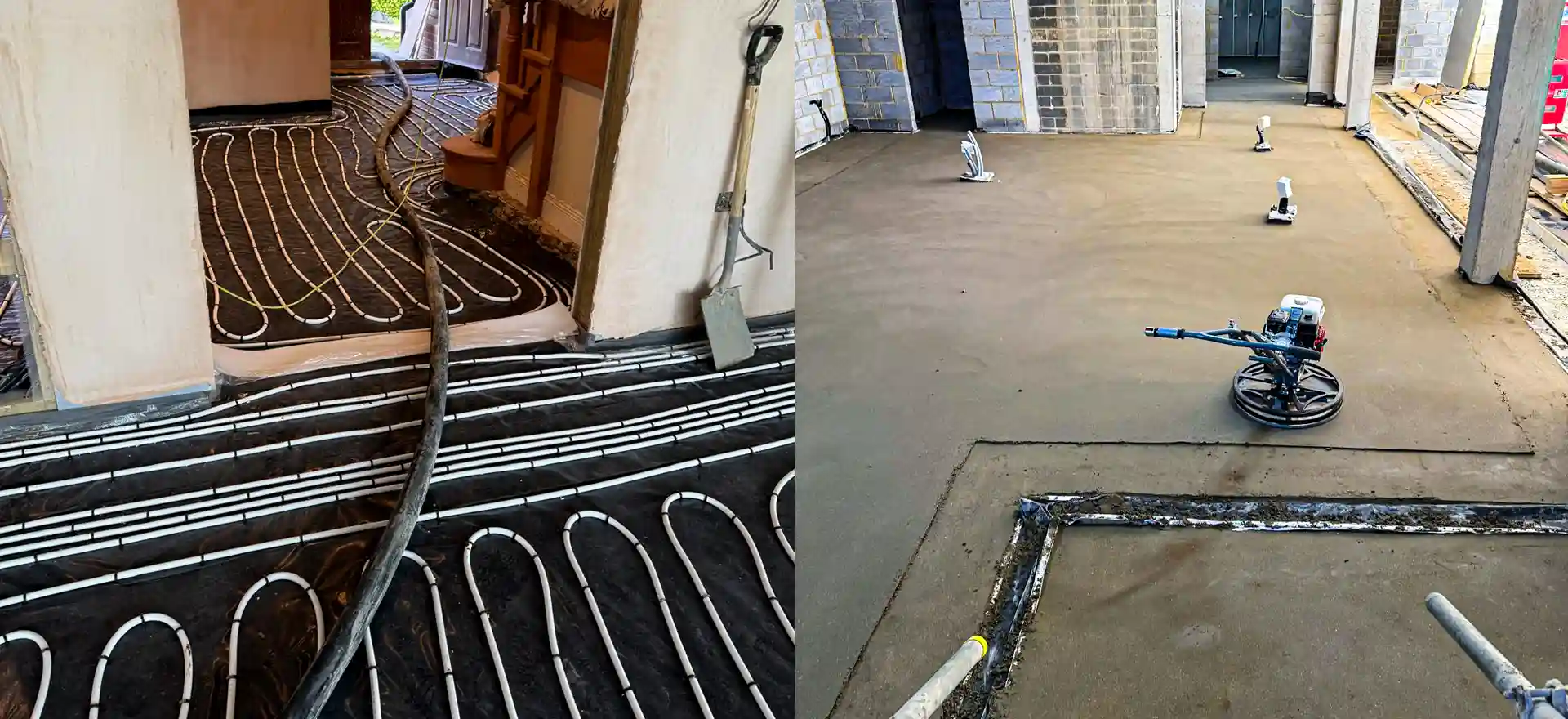
Search for self levelling screed and you will find two quite different things under one name. One is a thin compound, poured from about 2mm up to around 10mm, which smooths a floor that is already solid and nearly flat. The other is a flowing screed, pumped at full depth from about 35mm in a house, which forms the floor itself over insulation or heating pipes. Working out which one your Milton Keynes floor needs saves a lot of confusion when comparing prices.
Two local examples show the difference. A garage conversion on a grid square estate starts with a low, sloping and uninsulated slab. That floor has to be built up by tens of millimetres, so it needs a membrane, insulation and a screed, which is where full-depth flowing screed comes in. A thin compound poured that deep would be likely to crack and lose its bond.
A newer house at Whitehouse or Fairfields, by contrast, may already have a flowing screed over its heating. If a fitter finds it slightly out for LVT, the fix is a few millimetres of compound after the laitance is removed and the floor is primed.
The straightedge settles it. If the gap under a 2m edge is a matter of millimetres, compound will do. If you are filling a step or building up from insulation, you need a screed.
How we price floor levelling in Milton Keynes
A fixed written price within 24 hours, once we know the area and the base. See our self levelling screed cost guide.
Who levels your floor in Milton Keynes
K & B Screeding’s own team, led by director Donatas Bardisevicius. Founded 2019, company 12298780.
See what customers say in our Google reviews and on our testimonials page.
Floor levelling from Slough to Milton Keynes
As the crow flies, our base in Slough is about 35.6 miles from Milton Keynes, which lies to the north. Postcodes here include MK9, MK6, MK10 and MK13, and Newport Pagnell (3.3 miles), Bletchley (3.5 miles), Leighton Buzzard (9.6 miles) and Buckingham (10.3 miles) are close by.
More on floor levelling, part of our screeding services. For every screed we lay locally, see floor screeding in Milton Keynes. Not sure whether you need a thin compound or a full flowing screed? See self levelling screed explained.
Further reading: how to level a concrete floor and latex, self levelling compound or screed.