
Heated extension floors that meet existing Kempston levels
Adding a heated floor to an extension means stacking several layers into a fixed height: insulation, the pipes on their clips or panels, and the screed over them. The finished surface then has to line up with the kitchen or hall it joins.
Pipe cover sets the screed depth. With liquid we need no less than 25mm over the pipework, typically 45 to 50mm overall; hand-laid sand and cement calls for about 45mm above the pipes. With liquid screed, that thinner section can leave room for more insulation under a floor tied to an existing threshold, which is often the deciding point.
Encapsulation is the second concern. Air pockets around the pipes reduce heat output and can weaken the screed. Pumped liquid screed runs beneath and between the pipes by itself; hand-laid screed only fills those gaps if it is tamped down with care between each loop.
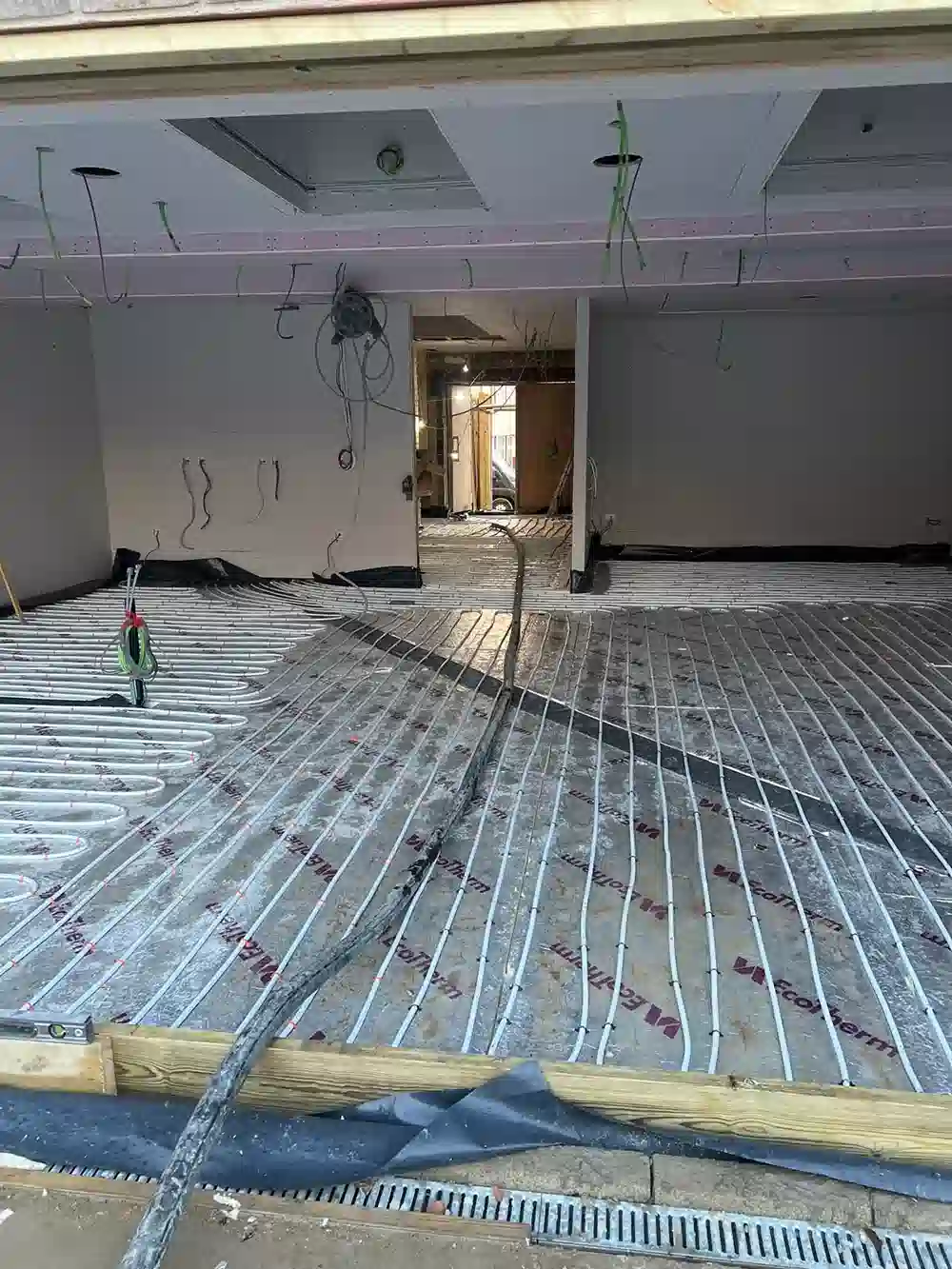
By the time our team gets to the extension, the loops should be down, pressure tested and still under pressure, with edging fixed round the walls and the membrane seams taped.
28% of Kempston homes were built from 1945 to 1972, and post-war semis are where many of the town's extensions are added. Measuring the existing floor first tells us how much depth the new build-up can have. Where the heated area is small, a sand and cement build-up can be the simpler option.
Commissioning a new heated floor in Kempston
Switching the heating on too early or too fast can spoil a new floor. The screed needs time to gain strength before it is warmed.
On calcium sulphate, warmth can usually be introduced from roughly the seventh day; with sand and cement, hold off for 21 days or longer. Whichever it is, begin with a cool flow temperature, nudge it up a little at a time over several days and hold it there before any flooring is laid. Going from cold to full heat in one go risks cracking it.
The heating can also help drying, which our screed drying guide covers. A moisture test still has to confirm the floor is ready before tiles, wood or vinyl are laid.
Larger houses bring their own jobs. 21% of Kempston's homes are detached, and on a bigger ground floor the heating may be split into several zones. We plan joints in the screed to follow the heating circuits.
Pipes are the heating engineer's job to install and test, and the screed is ours. If your project is in Flitwick instead, see heated floor screed in Flitwick.
Underfloor Heating Screed prices in Kempston
Liquid screed over underfloor heating: £20 to £35 per m² supplied and laid (trade2base, June 2026), so £700 to £1,230 for 35 m². trade2base gives these figures excluding VAT. See our floor screeding cost guide or screed calculator.
Who lays your underfloor heating screed in Kempston
K & B Screeding’s own team, led by director Donatas Bardisevicius. Founded 2019, company 12298780.
See what customers say in our Google reviews and on our testimonials page.
Underfloor Heating Screed from Slough to Kempston
As the crow flies, our yard in Slough is about 40.8 miles from Kempston, which lies to the north. Postcodes here include MK42, MK40, MK43 and MK45, and Bedford (2 miles), Flitwick (7.8 miles), Sandy (9.1 miles) and Newport Pagnell (9.6 miles) are close by.
More on underfloor heating screed, part of our screeding services.