
Pipe cover on St Neots new builds and extensions
Homes built between 2000 and 2014 are 16% of St Neots, and building continues at Wintringham and Monkfields. New homes like those going up along Cambridge Road commonly take flowing screed over wet underfloor heating. On a new plot the drawings usually fix the screed type and depth. On an extension, the choice is ours to recommend.
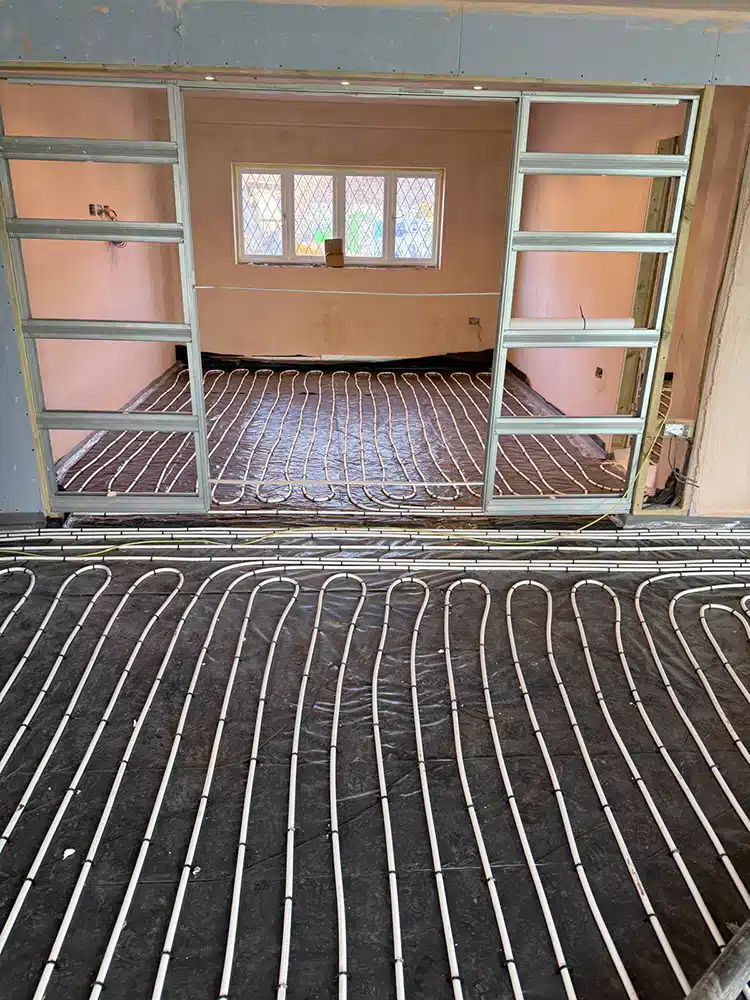
First, how much screed goes over the pipes. With liquid screed that means 25mm or more above them, so the floor usually ends up 45 to 50mm deep, and because it flows, it surrounds each pipe without trapping air that would hold the heat back. Sand and cement wants roughly 45mm over the pipes, which makes for a deeper floor. Skimp on that cover and cracks can open along the pipe runs. Overdo it and the room takes longer to heat up.
Detached houses make up 28% of St Neots homes. Where one of those gains a heated extension, the new floor usually has to meet the existing level, which limits depth and favours a pumped liquid screed. A utility or boot room with heating, where the floor may get wet, suits hand-laid sand and cement over pipes instead.
We inspect the insulation, membrane and edge strip ahead of the pour, and can provide any of them. The pipes must already be fixed and pressure tested. The finished floor should be flat enough for tiles, LVT and engineered wood.
Commissioning the heating in a Wintringham home
The day the heating first goes on matters more than people expect. Calcium sulphate can normally have gentle heat put through it once it is about 7 days old. Sand and cement has to sit for 21 days or more first. After that, the temperature is raised slowly in steps and held, so the screed dries evenly instead of cracking. You get that schedule from us on paper, and your heating engineer follows it.
On any new build, this is where a programme can slip, because fitters want to start before the screed is ready. A heated calcium sulphate screed can be force dried, but the laitance still needs sanding and the moisture still needs testing before flooring. Our guide to how long screed takes to dry sets realistic expectations.
Retrofitting heating into an older St Neots house is harder. If the old floor stays in place, insulation, pipes and screed may simply not fit unless the level goes up. We will look at that before recommending anything. The same service covers underfloor heating screed in Huntingdon, about 8 miles away.
Heated floors in Wintringham apartments off Cambridge Road
Wintringham is not only houses. Durkan and other builders are delivering apartments along Cambridge Road as well, and purpose-built flats already make up 14% of St Neots homes. A heated floor in a block raises different questions from a house.
Height comes first. In a block, the acoustic layer, insulation, pipes and screed all share a fixed zone between the structural slab and the door thresholds, so the build-up is set on the drawings and there is little room to add depth on site. That is why a flowing screed, with its thinner cover over the pipes, is usually the one drawn.
Sound is the second. Where the screed floats on an acoustic layer, it must not touch the walls or bridge down to the slab, or noise will travel to the flat below. The edge strip round every wall and the lapped joints in the membrane keep it separate, so we check both before each pour and close any gaps.
Timing across many homes is the third. Each apartment's heating is commissioned on its own warm-up, and flooring fitters on a block tend to work through flat by flat. Grouping the pours so that a whole floor of apartments reaches its first gentle heat on the same date gives the heating engineer and the flooring team one programme to follow.
Underfloor heating screed prices for St Neots floors
Liquid screed over underfloor heating: £20 to £35 per m² supplied and laid (trade2base, June 2026), so £700 to £1,230 for 35 m². trade2base gives these figures excluding VAT. See our liquid screed cost per m² guide, the floor screeding cost guide or the screed calculator.
Who lays your underfloor heating screed in St Neots
K & B Screeding, led by director Donatas Bardisevicius. Founded 2019, company 12298780.
See what customers say in our Google reviews and on our testimonials page.
Underfloor heating screed from Slough to St Neots
As the crow flies, our base in Slough is about 50.7 miles from St Neots, which lies to the north-north-east. Postcodes here include PE19, and Sandy (6.9 miles), Huntingdon (8 miles), Biggleswade (9.8 miles) and Bedford (10.5 miles) are close by.
Where the screed lorry must park in a marked bay in St Neots, a suspension or dispensation from Huntingdonshire District Council (suspensions and waivers) covers it; the quote tells you if it is needed. An extension floor usually needs building regulations approval (Part L sets the insulation standard in England); the council building control service for St Neots is 3C Shared Services Building Control.
More on underfloor heating screed, part of our floor screeding service. For every screed we lay locally, see floor screeding in St Neots.
Further reading: screed depth for underfloor heating and underfloor heating on a concrete floor.