
CA grades on Wintringham and Monkfields specifications
All flats together make up 16% of St Neots homes, and apartment floors are one of the places a calcium sulphate grade is most often specified. The grade codes follow the BS EN screed standard. Read the code in two halves: after the C comes compressive strength, after the F comes flexural strength, each given in N/mm2.
A domestic floor with light footfall can take CA-C20-F4. Most houses, apartments and offices are specified at CA-C25-F5. Floors that will work harder get CA-C30-F6. When a Wintringham or Monkfields plot arrives with a grade already set by the designer, we work to it and prepare the full build-up ourselves.
The material's advantages are practical. Because calcium sulphate barely shrinks, it can run in big bays with few joints, and we set out where those bays and joints go before pouring. Where there is underfloor heating, that heat can usually help dry it from about 7 days onwards.
When the programme is tight or the floor lacks depth, alpha hemihydrate products come into play, since they dry faster or work in thinner sections. They follow their own product sheet, so the drying and depth rules come from the manufacturer's data rather than a general figure.
Calcium sulphate is not for every room. Rooms that might get wet take a flowing screed with a cement base instead, and we can pour both kinds on one plot. For how it behaves over pipes, see our page on underfloor heating screed in St Neots.
Sanding, testing and priming a St Neots anhydrite floor
Looking dry and being ready for flooring are two different things with calcium sulphate. During drying, the top develops laitance, a fine and fragile skin. That layer must come off: the floor is sanded once dry, then primed with a product compatible with calcium sulphate. Skip it, and adhesives or levelling compounds can lose their grip, so tiles and LVT lift later. Sanding it off is part of what our floor preparation work includes.
The second easily skipped step is checking moisture. We use a hygrometer, and the reading has to meet the flooring maker's limit, which for calcium sulphate is often set lower than for cement. A floor that would pass for a cement screed may still fail for anhydrite. On a new St Neots home, with the heating running from about 7 days, test before the sanding and priming stage rather than on the day the fitter arrives, so any extra drying time is known early.
Everything about drying and laitance goes to you in writing, so whoever lays the flooring knows where things stand. There is more on how the material works in our anhydrite screed guide.
Anhydrite & Flow Screed prices in St Neots
Liquid flowing screed (which includes anhydrite): £24 to £31 per m² supplied and laid (MyJobQuote, August 2026), so £960 to £1,240 for 40 m². MyJobQuote does not say whether these figures include VAT. See our floor screeding cost guide or screed calculator.
Who lays your anhydrite and flow screed in St Neots
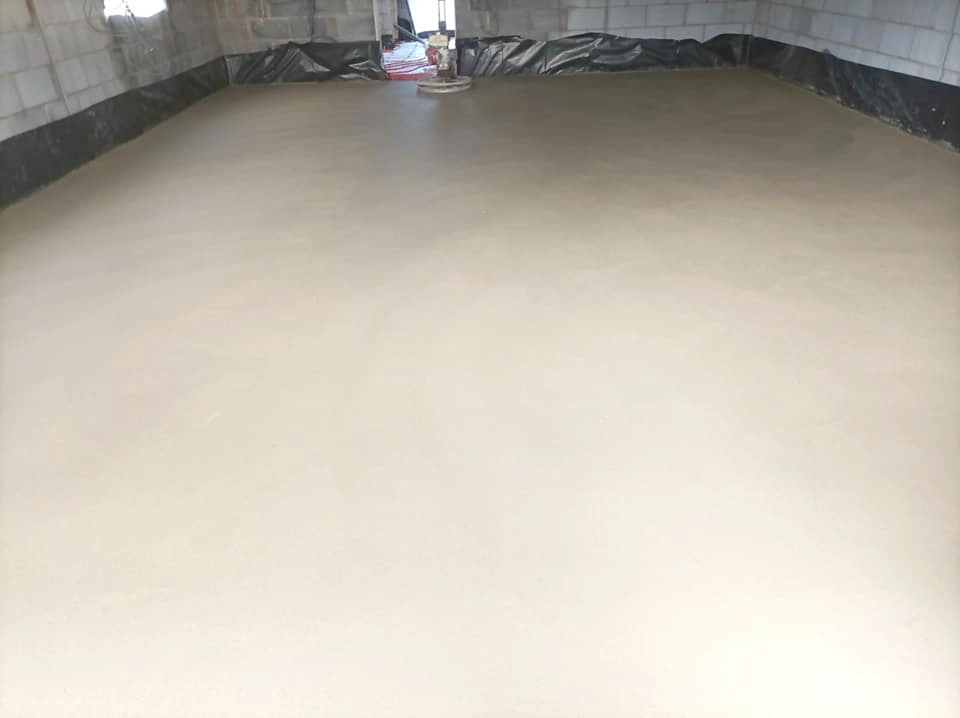
K & B Screeding’s own team, led by director Donatas Bardisevicius. Founded 2019, company 12298780.
See what customers say in our Google reviews and on our testimonials page.
Anhydrite & Flow Screed from Slough to St Neots
As the crow flies, our yard in Slough is about 50.7 miles from St Neots, which lies to the north-north-east. Postcodes here include PE19, and Sandy (6.9 miles), Huntingdon (8 miles), Biggleswade (9.8 miles) and Bedford (10.5 miles) are close by.
More on anhydrite screed, part of our screeding services.
