
Anhydrite grades for Sandy flats and new plots
Purpose-built flats make up 10% of Sandy's homes, and just 4% of the town's housing was built from 2015 onwards. That is a small base of new building, and on those projects an anhydrite pour usually comes with a set specification from an architect or engineer.
The designation on the drawing tells you what is needed. In that code, set by European rules for screeds, C stands for compressive and F for flexural strength, each measured in N/mm2. A house floor with light use can take CA-C20-F4. Flats, offices and the majority of homes are specified at CA-C25-F5. Where a floor takes heavier traffic, the engineer goes to CA-C30-F6.
Instead of a CA grade, a drawing may list a branded alpha hemihydrate screed. Designers choose them when the floor needs to dry sooner or be laid thinner, and each brand publishes its own rules for depth and drying. We follow that sheet.
The material has one big practical advantage. Because it barely shrinks, a flat or a wide open-plan ground floor goes down in large bays with only a handful of joints. We mark out any joints in advance, typically under door thresholds and where heating zones meet. Everything underneath, insulation through to edge strip, is laid by our own team.
Our guide, anhydrite screed explained, goes further into how it behaves.
Moisture testing anhydrite floors in Sandy
Pouring is the easy part. While drying, anhydrite grows a weak top skin called laitance, and it has to be sanded away before any floor finish. Left in place, it takes the adhesive's grip away from the screed, and the tiles or LVT may lift later on. Sanding is followed by a coat of primer made to suit calcium sulphate, so the adhesive has a sound surface to hold.
Then comes the moisture test. Flooring manufacturers frequently allow calcium sulphate less moisture than cement, so counting weeks on a calendar can mislead you. A hygrometer reading, checked against your flooring maker's figure, decides when it is ready. With underfloor heating in, force drying can usually start from about day 7 and shortens the wait.
Calcium sulphate should not go into rooms that may get wet. So a shower area, a wet room or a utility room where a machine might leak gets a flowing cement based screed or a hand-laid sand and cement screed in Sandy instead. For a project further south, see anhydrite flow screed in Stotfold.
Anhydrite & Flow Screed prices in Sandy
Liquid flowing screed (which includes anhydrite): £24 to £31 per m² supplied and laid (MyJobQuote, August 2026), so £960 to £1,240 for 40 m². MyJobQuote does not say whether these figures include VAT. See our floor screeding cost guide or screed calculator.
Who lays your anhydrite and flow screed in Sandy
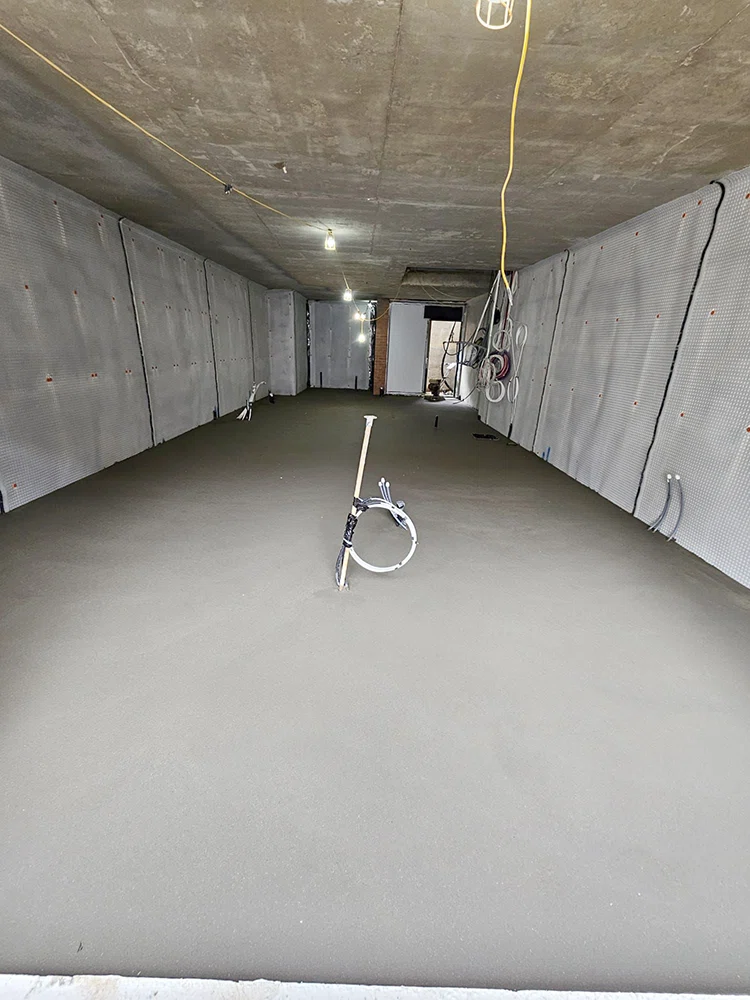
K & B Screeding’s own team, led by director Donatas Bardisevicius. Founded 2019, company 12298780.
See what customers say in our Google reviews and on our testimonials page.
Anhydrite & Flow Screed from Slough to Sandy
As the crow flies, our yard in Slough is about 44 miles from Sandy, which lies to the north-north-east. Postcodes here include SG19, and Biggleswade (3.1 miles), St Neots (6.9 miles), Bedford (7.7 miles) and Stotfold (8.2 miles) are close by.
More on anhydrite screed, part of our screeding services.