
Anhydrite grades for Huntingdon apartments and new plots
Calcium sulphate screeds carry a coded designation from the European standard for screed materials. In it, CA marks calcium sulphate, and the figures after C and F are the compressive and flexural strengths in N/mm2. Housing mostly uses three grades. CA-C20-F4 is for lightly trafficked domestic floors, CA-C25-F5 suits most houses, flats and offices, and CA-C30-F6 is kept for heavier use.
In a Huntingdon apartment block the grade comes from the engineer, and we pour it as specified. If speed or a thin section matters, the drawings might name an alpha hemihydrate product in its place. Its own data sheet then governs depth and drying, and we keep to that.
Why choose calcium sulphate at all? Shrinkage is very low, so big bays need few joints and a whole floor of Huntingdon flats can often go down in one visit. That also suits new-build plots, including those planned at Alconbury Weald. Some joints still have to go in, at door thresholds and between heating zones, and we agree where before pouring.
Our own team can prepare the full build-up, including insulation, membrane and edge strip, so the screed goes onto a base built for it. For offices, CA-C25-F5 is the usual starting grade unless heavier use is expected. More on the material sits in what anhydrite screed is.
Before flooring: sanding and testing Huntingdon anhydrite
A calcium sulphate floor that looks dry may still not be ready for flooring. As it cures, a weak surface film called laitance forms. That film comes off with a sander before any adhesive, primer or compound, and the floor is then vacuumed and primed with a product made for calcium sulphate. Tiles and LVT coming loose can often be traced back to this step being missed.
Moisture testing follows. A flooring maker will commonly accept less moisture in calcium sulphate than in cement, so a hygrometer reading replaces guesswork. If underfloor heating is fitted, running it can usually force dry the floor from about 7 days.
Calcium sulphate should not go where floors may stay wet. In apartments, bathrooms and wet rooms need a cement based flowing screed instead, which can be poured alongside on the same programme. You get our drying and laitance notes in writing, so the flooring fitter can see the floor was sanded, tested and primed.
For the heated version of this floor see heated screed in Huntingdon, and for a thin smoothing layer afterwards see levelling compound for Huntingdon floors.
Anhydrite & Flow Screed prices in Huntingdon
Liquid flowing screed (which includes anhydrite): £24 to £31 per m² supplied and laid (MyJobQuote, August 2026), so £960 to £1,240 for 40 m². MyJobQuote does not say whether these figures include VAT. See our floor screeding cost guide or screed calculator.
Who lays your anhydrite and flow screed in Huntingdon
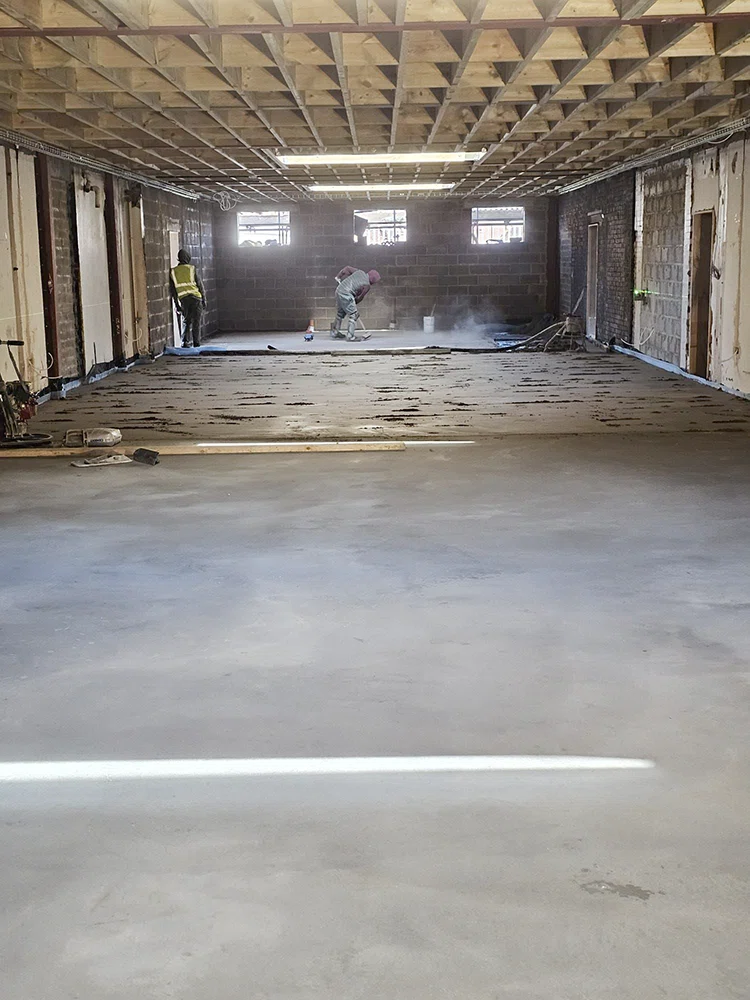
K & B Screeding’s own team, led by director Donatas Bardisevicius. Founded 2019, company 12298780.
See what customers say in our Google reviews and on our testimonials page.
Anhydrite & Flow Screed from Slough to Huntingdon
Huntingdon is about 58.6 miles north-north-east of our Slough base as the crow flies, with postcodes including PE29 and PE28. The nearest towns to it are St Ives (4.7 miles), St Neots (8 miles), Chatteris (13.2 miles) and Sandy (14.6 miles).
More on anhydrite screed, part of our screeding services.
