
Reading an anhydrite specification for a Chatteris plot
The European standard for screed materials gives every anhydrite screed a coded name. In that code CA is calcium sulphate, C plus a number is compressive strength, and F plus a number is flexural strength, both in N/mm2. Three grades cover almost all housing. Lightly used domestic floors get CA-C20-F4; CA-C25-F5 suits the general run of homes, apartments and offices; CA-C30-F6 is for heavier use.
On an East Chatteris plot or any developer site, the grade is the engineer's call, and that is what goes in. Occasionally the spec names an alpha hemihydrate product instead, where a thinner section or quicker drying is wanted. Its own product sheet then sets depth, drying and heating, and we go by that sheet.
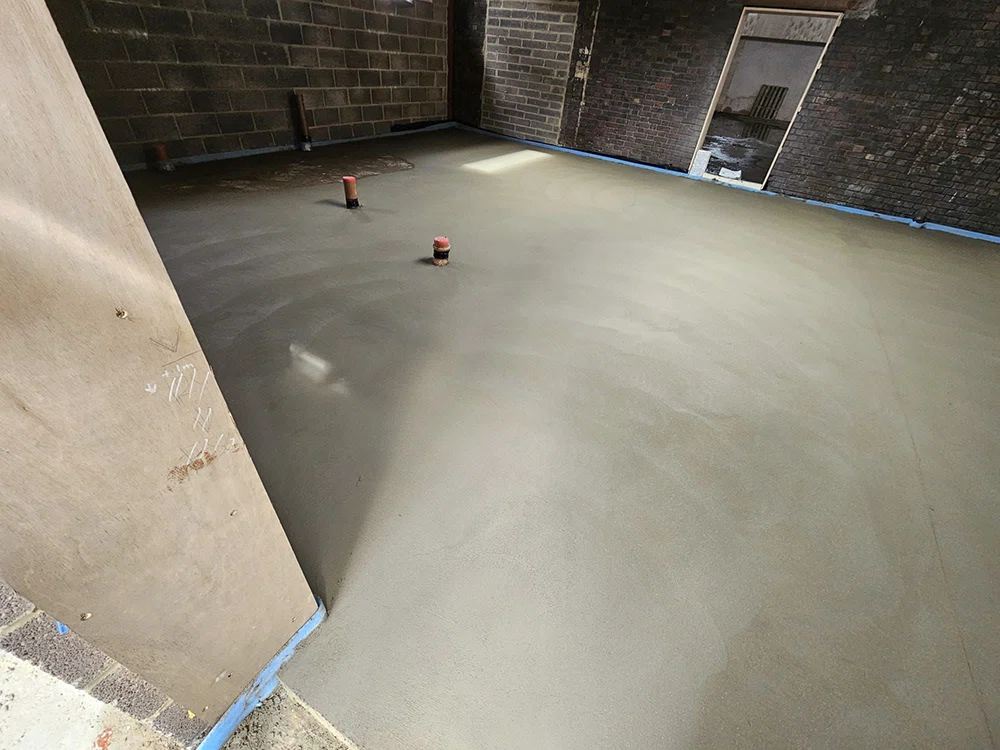
The material's main strength is low shrinkage. Since it barely shrinks, it can be poured in wide bays with few joints, a good fit for the open ground floor of a new-build house or an apartment block floor. Flats are only a small part of Chatteris, with purpose-built blocks at 6% of homes, so here the material is mostly met in houses. Any joints, say at a threshold or between heating zones, are set out and agreed before pouring.
Anhydrite is not always the answer. Any floor at risk of getting wet is switched to a cement based flowing screed, which we also lay. Our anhydrite guide has more on the material.
Sanding, testing and priming Chatteris anhydrite floors
Drying calcium sulphate grows a thin, weak top skin, called laitance. It has to be removed by sanding before any adhesive, primer or levelling compound goes on, otherwise the finish bonds to a crust that can let go months later. Once dry enough, it is sanded back, vacuumed and primed with a calcium sulphate primer.
Moisture is the other check. Flooring makers often set a lower moisture ceiling for calcium sulphate, so a floor that looks ready, and would pass were it cement, can still fail. Only a hygrometer reading settles it. Heating pipes already in place can usually force dry it from about 7 days, handy on a winter programme.
On fen ground there is a further reason for care: the screed must be separated from any damp below by an intact membrane, because calcium sulphate is weakened by prolonged moisture. The membrane is checked before the pour.
We leave written drying and laitance notes when we finish. Heated plots can follow underfloor heating screed in Chatteris, and if a flat finish is needed for sheet flooring afterwards, see smoothing compound before LVT.
Anhydrite & Flow Screed prices in Chatteris
Liquid flowing screed (which includes anhydrite): £24 to £31 per m² supplied and laid (MyJobQuote, August 2026), so £960 to £1,240 for 40 m². MyJobQuote does not say whether these figures include VAT. See our floor screeding cost guide or screed calculator.
Who lays your anhydrite and flow screed in Chatteris
K & B Screeding’s own team, led by director Donatas Bardisevicius. Founded 2019, company 12298780.
See what customers say in our Google reviews and on our testimonials page.
Anhydrite & Flow Screed from Slough to Chatteris
Chatteris is about 70.5 miles north-north-east of our Slough base as the crow flies, with postcodes including PE16. The nearest towns to it are March (6.5 miles), Ely (9.9 miles), Whittlesey (10.1 miles) and St Ives (10.6 miles).
More on anhydrite screed, part of our screeding services.