
Specifying anhydrite for a Whittlesey new build
Calcium sulphate screed is chosen for its low shrinkage, which lets it run in large bays with few joints, and for the way it can usually be force dried with the heating from about 7 days. On a new house or self-build in Whittlesey, it is typically specified by grade under the BS EN screed standard.
The codes are simple once decoded. The C value gives compressive strength and the F value flexural strength, measured in N/mm2. For a lightly used domestic floor, CA-C20-F4 is enough. The grade most houses, apartments and offices get is CA-C25-F5. Heavier duty floors move up to CA-C30-F6. Flats are only 8% of homes in Whittlesey, so the grade here is usually being chosen for a house rather than an apartment block.
Then there are alpha hemihydrate products, picked when the floor must dry sooner or be laid thinner. Each follows its own product sheet, so the manufacturer's data sets its limits.
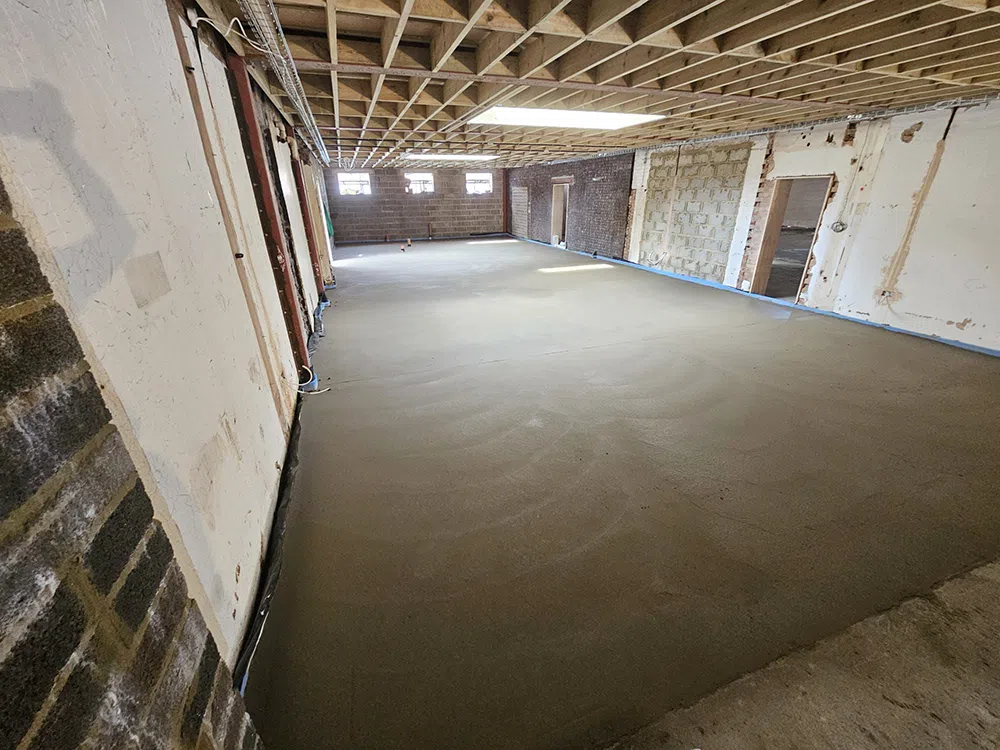
Our team puts down the whole build-up, edge strip, membrane and insulation included, and works out the bays and joints in advance. Where a room may get wet, such as a shower area or utility, calcium sulphate is not the right material, and a cement based flowing screed is poured there instead.
For how the same floor works with heating pipes in it, see our Whittlesey underfloor heating screed page. For the material itself in more depth, read anhydrite screed explained.
Laitance and moisture checks on Whittlesey floors
Once a calcium sulphate screed has dried, there is still work to do before the floor covering goes on.
First, the laitance. This thin, weak surface layer forms as the screed dries, and adhesives and levelling compounds will not hold to it reliably. We sand it away, then apply a primer that is made to work with calcium sulphate. Skip that and tiles or LVT can work loose later. Our floor preparation work includes the sanding.
Second, moisture. A hygrometer test shows whether the floor is dry enough. Flooring makers often allow less moisture in calcium sulphate than in cement, so a figure that would be acceptable on a cement screed can still mean an anhydrite floor is too wet. Test against the limit for your chosen covering, and test in more than one spot on a large floor.
Where a newer Whittlesey floor needs snagging work, these two checks are a sensible place to start. Our advice on drying and laitance is handed to you on paper, ready for whoever lays the flooring.
Anhydrite & Flow Screed prices in Whittlesey
Liquid flowing screed (which includes anhydrite): £24 to £31 per m² supplied and laid (MyJobQuote, August 2026), so £960 to £1,240 for 40 m². MyJobQuote does not say whether these figures include VAT. See our floor screeding cost guide or screed calculator.
Who lays your anhydrite and flow screed in Whittlesey
K & B Screeding’s own team, led by director Donatas Bardisevicius. Founded 2019, company 12298780.
See what customers say in our Google reviews and on our testimonials page.
Anhydrite & Flow Screed from Slough to Whittlesey
As the crow flies, our yard in Slough is about 74.2 miles from Whittlesey, which lies to the north-north-east. Postcodes here include PE7, and Peterborough (5 miles), March (9.1 miles), Chatteris (10.1 miles) and Huntingdon (15.8 miles) are close by.
More on anhydrite screed, part of our screeding services.
