
Preparing Whittlesey floors for LVT and tiles
Detached houses make up 46% of Whittlesey homes, and semi-detached houses 29%. Where the base under one of these floors is sound, the sensible route to a new finish is usually to bring it flat rather than rebuild it.
Flatness is judged by laying a 2m straightedge across the floor and checking the gap beneath. For SR1 that gap can be 3mm at most, for SR2 it is 5mm, and SR3 accepts 10mm. Many thin sheet floor coverings insist on SR1, so a floor that never bothered anyone under carpet can turn into a problem the moment LVT is picked.
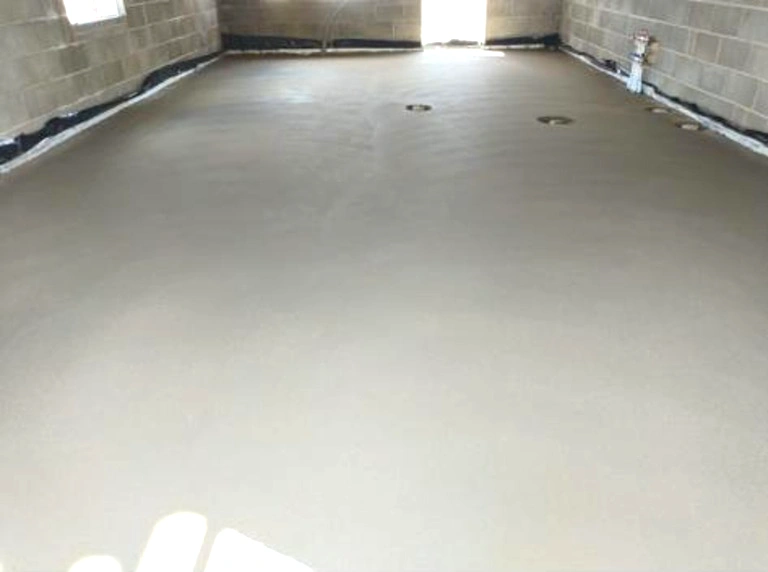
We always work in the same sequence. First we clear old adhesive and anything loose, and fix any cracks. Next comes a primer chosen for the base, because old tiles, concrete, calcium sulphate and sand and cement each take their own. Finally the compound is poured and spread, finding its own level.
Extension joins need the same care. Where a single storey extension floor meets the older house, a small lip or dip can appear, and compound can feather it out so one run of flooring crosses both rooms.
There is a limit. Pouring compound thick to get round a floor that really wants screeding risks cracks and debonding. A hollow, damp or badly uneven floor needs a fresh sand and cement floor or a repair to the screed first.
When a Whittlesey floor needs more than compound
Think of compound as the last thin layer under the flooring. It cannot mend a floor that is failing underneath. Before pouring it, the base has to be sound, dry and bonded. On newer homes in Whittlesey, snagging problems on developer floors can include hollow or cracked patches that must be repaired first, because compound laid over them simply cracks along the same line.
Older properties near the Market Place bring a different risk: a solid floor without a working damp proof membrane. Levelling compound will not stop damp coming through, so the floor may need rebuilding with a membrane before any finish goes down.
Where only a few millimetres need correcting, a thin latex screed often does the job. Fast drying compounds keep a refurbishment moving, which matters when the kitchen fitter or flooring team is booked.
Factory and processing floors, such as those at the King's Dyke brickworks or the McCain plant, are different again. They generally need concrete repair or a hard wearing screed rather than a thin compound. For levelling work a little further out, see floor levelling in Chatteris.
How we price floor levelling in Whittlesey
A fixed written price within 24 hours, once we know the area and the base. See our floor screeding cost guide.
Who levels your floor in Whittlesey
K & B Screeding’s own team, led by director Donatas Bardisevicius. Founded 2019, company 12298780.
See what customers say in our Google reviews and on our testimonials page.
Floor Levelling from Slough to Whittlesey
As the crow flies, our yard in Slough is about 74.2 miles from Whittlesey, which lies to the north-north-east. Postcodes here include PE7, and Peterborough (5 miles), March (9.1 miles), Chatteris (10.1 miles) and Huntingdon (15.8 miles) are close by.
More on floor levelling, part of our screeding services. Not sure whether you need a thin compound or a full flowing screed? See self levelling screed explained.
