
Smoothing old slabs and extension joins in St Ives
Homes from 1945 to 1972 make up 26% of St Ives, and floors that old have usually had several coverings over the years. Lift the carpet for LVT or big tiles and every old adhesive patch and hollow shows up. Thin sheet flooring forgives very little: many such finishes ask for SR1, meaning no gap over 3mm beneath a 2m straightedge. The looser classes are SR2, at 5mm, and SR3, at 10mm.
We begin with the base. Old adhesive and anything loose is scraped off, cracks are filled, and the right primer goes on, since concrete, sand and cement, calcium sulphate and old tiles each take a different one. Then the compound is poured and spread, and it flows out to a smooth, level surface.
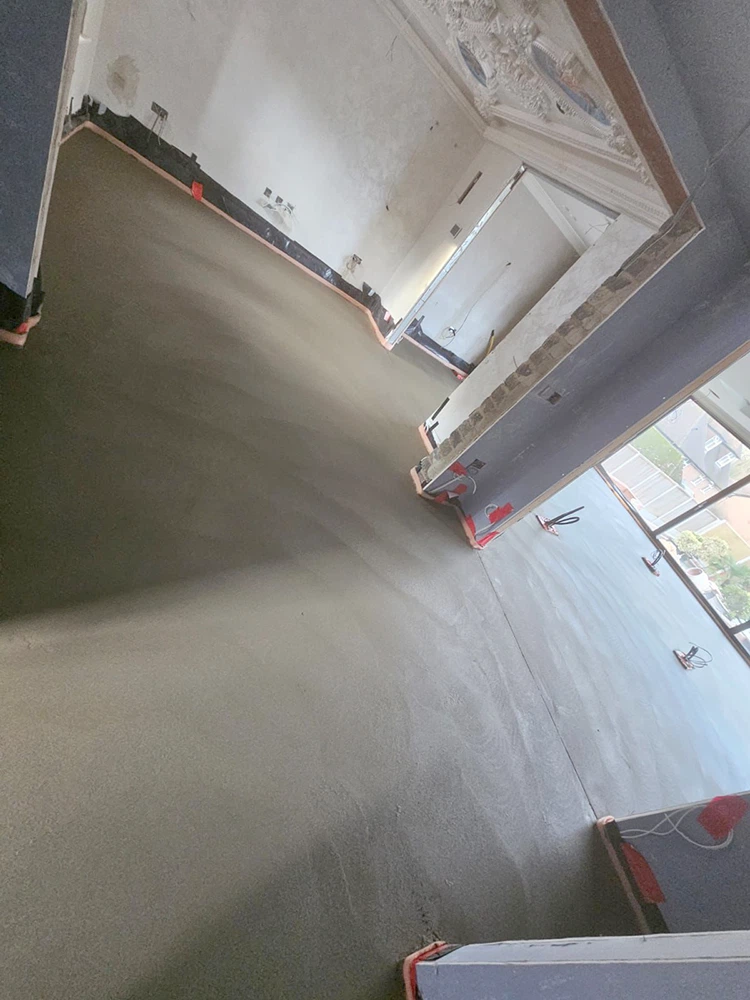
The extension join is the typical St Ives problem. The new floor may stand a few millimetres higher than the old, or the original slab may fall away towards the wall. Feathering compound across the line lets one length of flooring run through both rooms.
Compound has its limits, though. It is normally laid somewhere between about 2mm and around 10mm, with some products able to go thicker, but pouring it deep to rescue a floor that needs screeding tends to end in cracks and debonding. If the floor sounds hollow, is breaking up or is well out of level, the honest fix is repairs to the existing screed or a new hand-laid sand and cement floor.
Refits on Edison Road, Roman Way and Compass Point
Units on Edison Road and Burrel Road, on Roman Way Industrial Estate and at Compass Point Business Park on Stocks Bridge Way include workshops, trade units and warehouses. When one changes hands, the incoming tenant often wants a new floor finish in the offices, showroom or trade counter, and the slab underneath rarely matches the flatness that finish needs.
Levelling a commercial floor follows the same steps as a house, on a larger scale: clean back, repair, prime and pour. We use fast drying compounds where the fitters need to follow on soon, so a refit in one of these units does not stall. For areas where the compound only needs to be a few millimetres, a latex screed is often the right product.
Workshop and warehouse floors that take forklifts or heavy racking are a different matter. A thin compound will not survive that wear, so those floors usually need concrete repair or a harder wearing screed instead. We will say which applies after seeing the slab.
For refits about 4.7 miles away, the same service covers floor levelling in Huntingdon.
How we price floor levelling in St Ives
A fixed written price within 24 hours, once we know the area and the base. See our floor screeding cost guide.
Who levels your floor in St Ives
K & B Screeding’s own team, led by director Donatas Bardisevicius. Founded 2019, company 12298780.
See what customers say in our Google reviews and on our testimonials page.
Floor Levelling from Slough to St Ives
On the map, St Ives sits north-north-east of Slough, about 59.9 miles from our base in a straight line (postcodes including PE27), next to Huntingdon (4.7 miles), Chatteris (10.6 miles), St Neots (10.6 miles) and Cambridge (11.6 miles).
More on floor levelling, part of our screeding services. Not sure whether you need a thin compound or a full flowing screed? See self levelling screed explained.
