
Reading a CA grade on a St Ives specification
Every calcium sulphate screed is labelled with a code from the British and European screed standard. In a code such as CA-C25-F5, the number after C gives compressive strength and the number after F gives flexural strength, each in N/mm2. On a St Ives drawing, CA-C20-F4 points to a lightly used domestic floor, CA-C25-F5 is the everyday grade for houses, apartments and offices, and CA-C30-F6 is for floors that take heavier use.
Homes built from 2000 to 2014 account for 8% of St Ives, and flats of all kinds for 13%. Those newer houses and apartment floors are where you tend to find a CA grade written into the drawings, as the designer has picked calcium sulphate for its low shrinkage and for running in large bays with few joints. It is the same story at Houghton Grange and The Spires, where building is under way now.
Alpha hemihydrate screeds sit apart from the standard grades. Specifiers use them when quicker drying or a thinner section is needed, and every one has its own product sheet, which we follow rather than a blanket rule.
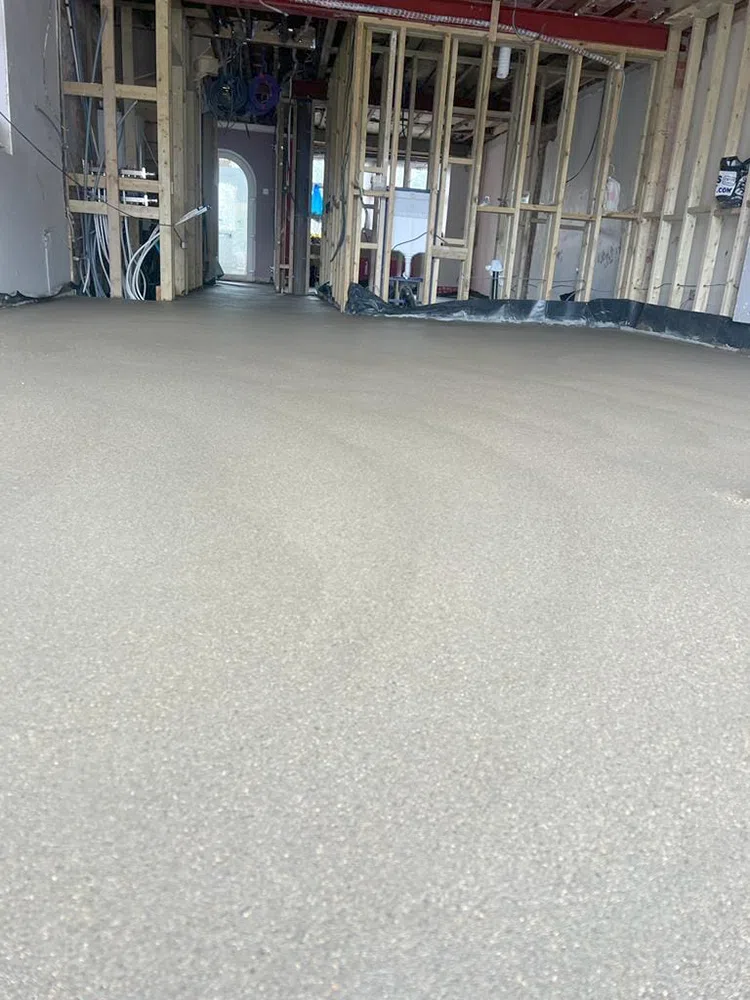
We put in the whole build-up ourselves before the pour, and the bays and joints are set out in advance. Where part of the floor is wrong for calcium sulphate, such as a shower area or a utility where water could sit, that zone gets a cement based flowing screed instead. For the chemistry without the jargon, read our plain guide to anhydrite screed.
Laitance and moisture testing on St Ives floors
A drying calcium sulphate screed grows a thin, weak crust on its surface, known as laitance, and it has to come off. When the floor has dried, we sand that layer away and prime with a product made for calcium sulphate. Adhesive or compound put straight onto laitance can lose its grip, and that is why tiles and LVT sometimes lift a few months after they were fitted. Sanding is part of our floor preparation service.
Then comes the moisture check. We take a hygrometer reading to see whether the floor has dried enough for the chosen covering, bearing in mind that many flooring makers set a lower limit for calcium sulphate than for cement. A floor that would be fine under a cement rule can still be too damp for its finish. If there is heating in the floor, force drying can usually begin from about 7 days, cutting the wait.
On a ground floor close to the river, damp settles it. If you cannot be sure a room will stay dry, put a cement based screed in that room and keep calcium sulphate for the rest of the house. The practical side of a pumped pour is covered on our St Ives liquid screed page.
Anhydrite in extensions to older St Ives houses
Just over half of St Ives homes, 51%, were built between 1973 and 1999, and most homeowners here have a semi or detached house from somewhere between the 1950s and the 1990s. The typical project is an extension or an open plan kitchen where a new floor has to meet an older slab at the same level, and that is where a flowing calcium sulphate screed can earn its place.
The pour depth is worked back from the existing floor. Because a flowing screed can float from about 35mm, the new floor leaves more room for insulation than a hand-laid one, while still finishing flush with the old kitchen or hall. Its low shrinkage also means a knocked-through room can be poured as one bay.
The join needs thought. The old slab and the new screed are different materials and will move differently, so the line where they meet is set out as a joint on the bay plan, with edge strip against the old floor. The flooring fitter can then follow it rather than discover it.
In the lower lying riverside parts of town, the membrane under the extension matters as much as the screed. It should be continuous, lapped and taped, and joined properly to whatever damp protection the old floor has, so that the new calcium sulphate floor never sits on a base that can draw up moisture.
Anhydrite and flow screed prices in St Ives
Liquid flowing screed (which includes anhydrite): £24 to £31 per m² supplied and laid (MyJobQuote, August 2026), so £960 to £1,240 for 40 m². MyJobQuote does not say whether these figures include VAT. See our liquid screed cost per m² guide or screed calculator.
Who lays your anhydrite and flow screed in St Ives
K & B Screeding’s own team, led by director Donatas Bardisevicius. Founded 2019, company 12298780.
See what customers say in our Google reviews and on our testimonials page.
Anhydrite and flow screed from Slough to St Ives
On the map, St Ives sits north-north-east of Slough, about 59.9 miles from our base in a straight line (postcodes including PE27), next to Huntingdon (4.7 miles), Chatteris (10.6 miles), St Neots (10.6 miles) and Cambridge (11.6 miles).
Where the anhydrite delivery must park in a marked bay in St Ives, a suspension or dispensation from Huntingdonshire District Council (suspensions and waivers) covers it; the quote tells you if it is needed.
More on anhydrite screed, part of our screeding services. For every screed we lay locally, see floor screeding in St Ives.
Further reading: calcium sulphate screed guide.
