
Older floors around the Whittlesey Market Place
Houses built before 1919 make up 10% of Whittlesey homes, and terraced houses 16%. Around the Market Place, an older solid floor may never have had a damp proof membrane, or its membrane may have broken down. Before a new floor finish goes down, those floors need attention.
Often the answer is to take the old floor up and build a new one: a firm base, a damp proof membrane, insulation, then the screed. If the slab underneath is dry and in good order, we can bond a thinner 25 to 40mm screed directly to it. Floating over insulation, a house screed needs to be 65mm thick. Our guide to screed thickness explains how each depth is chosen.
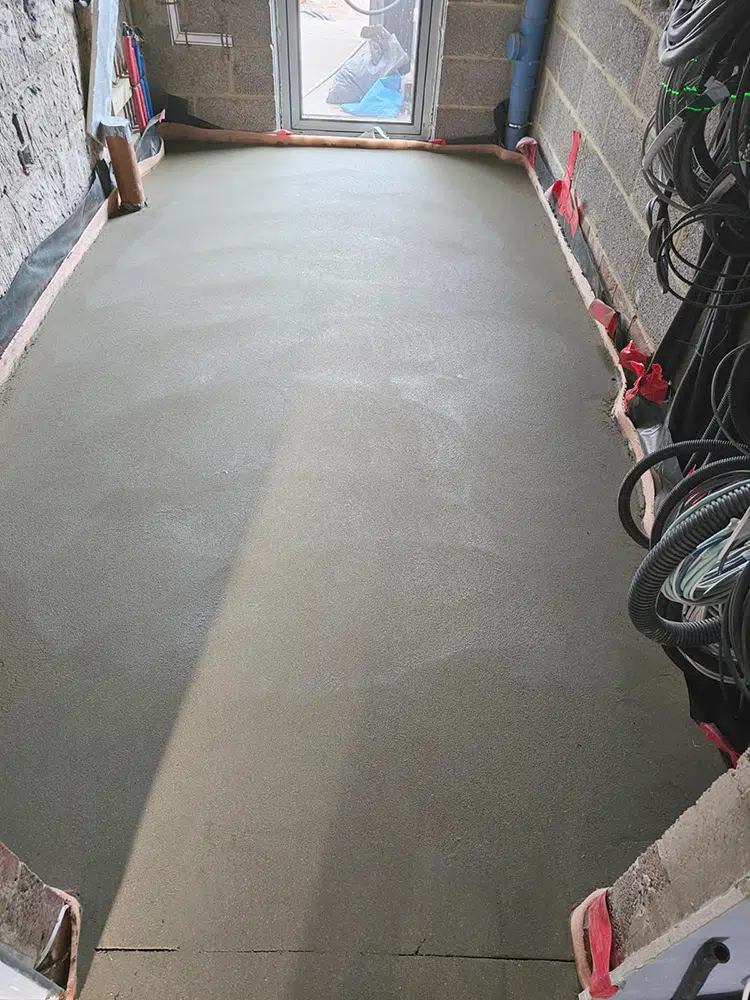
Because we make it up in batches on site, the mix can be matched to each room and the depth it needs. Narrow hallways, small kitchens and rooms at slightly different levels are all manageable by hand. Each area is then tamped firm and floated off flat and dense.
Damp is something a cement screed tolerates and a calcium sulphate one does not. In an older house where ground moisture is a worry, a cement screed over a sound membrane is the safer build-up. If the membrane and insulation layers need supplying, our insulation and membranes service covers them.
What you give up is speed. Hand-laid floors take longer to dry than liquid ones: around one day for each millimetre through the first 40mm, and slower beyond it.
Wet rooms, garages and repairs in Whittlesey
Certain rooms call for sand and cement in a new house as much as an old one. Showers without a tray, and full wet rooms, need the floor to slope to the drain, and screed laid by hand can be shaped to that fall. Once tanked and tiled, it copes with water.
Garage conversions are another typical job. Most garage slabs are a step down from the house, and we raise them with insulation and screed to meet the hall. See our garage conversion floor guide for the layers involved.
With so many homes built recently in Whittlesey, repairs on developer floors are likely too. A cracked or hollow patch of screed can often be cut out and relaid in sand and cement without replacing the whole floor, which is covered by our screed repairs service.
Sand and cement screed is listed at £18 to £25 per m² in 2026 UK price figures. If the floor would benefit from fibres to resist cracking, that adds £1 to £3 per m². On a small job, hand laying is often the more cost effective route, since there is no pump or truck to set up and the material arrives in loads sized to the room.
Sand and Cement Screed prices in Whittlesey
Sand and cement screed: £18 to £25 per m² supplied and laid (MyJobQuote, August 2026), so £450 to £630 for 25 m². MyJobQuote does not say whether these figures include VAT. See our floor screeding cost guide or screed calculator.
Who lays your sand and cement screed in Whittlesey
K & B Screeding’s own team, led by director Donatas Bardisevicius. Founded 2019, company 12298780.
See what customers say in our Google reviews and on our testimonials page.
Sand and Cement Screed from Slough to Whittlesey
As the crow flies, our yard in Slough is about 74.2 miles from Whittlesey, which lies to the north-north-east. Postcodes here include PE7, and Peterborough (5 miles), March (9.1 miles), Chatteris (10.1 miles) and Huntingdon (15.8 miles) are close by.
More on sand & cement screed, part of our screeding services.