
Older floors around Ely Cathedral and Waterside
Homes built before 1919 are 12% of Ely's stock, and the oldest buildings cluster in the historic core around the cathedral and down to Waterside, where the riverside Maltings dates from 1868. Floors there can be solid and laid directly on the ground, without the damp proof membrane a modern floor would have. When a floor of that kind cracks or turns damp, it usually has to come out and go back with a membrane, insulation and fresh screed.
Listed status changes the order of that work. If a building is listed, altering an original floor may need consent, and the approved build-up may be thinner than a modern one or keep part of the old floor in place. We price to what has been agreed, and we can explain what each option means for depth and drying before an application goes in.
Sand and cement suits these rebuilds because it is mixed and laid in small batches by hand. It handles narrow rooms, uneven walls, stepped thresholds and floors with no clear route for a pump hose. On a floating floor over insulation it goes down at 65mm in a home; bonded to a sound base, 25 to 40mm is typical, which helps where depth is limited. Adding fibres to the mix cuts down on cracking.
It dries more slowly than a liquid screed, so programmes need to allow for that. A bonded screed is worth considering where only a thin new layer will fit, and preparing the old base is often the first stage.
Ely garages, wet rooms and terraced back rooms
Away from the historic core, sand and cement earns its place in particular rooms rather than particular streets. Terraced houses make up 26% of Ely's homes, and narrow kitchens and bathrooms are often easier to screed by hand than with a pump.
A wet room is one place where cement screed is a must. Calcium sulphate loses strength if moisture hangs about, so an Ely walk-in shower or wet room gets sand and cement, with the slope to the drain shaped by hand. Tanking goes on after curing.
Turning a garage into a room normally means lifting its floor to the level of the house, with a membrane and insulation laid before the screed. Levels for that are covered in screeding a converted garage.
Some floors also need a cement surface for the flooring system chosen, or need to take load sooner than a calcium sulphate screed would allow. If dates are tight, a faster drying sand and cement mix brings the flooring forward. Those faster mixes come in at £20 to £28 per m² on the published 2026 UK figures.
If the room is large and open instead, compare this with pumped liquid screed for Ely, which covers big floors faster.
Sand and Cement Screed prices in Ely
Sand and cement screed: £18 to £25 per m² supplied and laid (MyJobQuote, August 2026), so £450 to £630 for 25 m². MyJobQuote does not say whether these figures include VAT. See our floor screeding cost guide or screed calculator.
Who lays your sand and cement screed in Ely
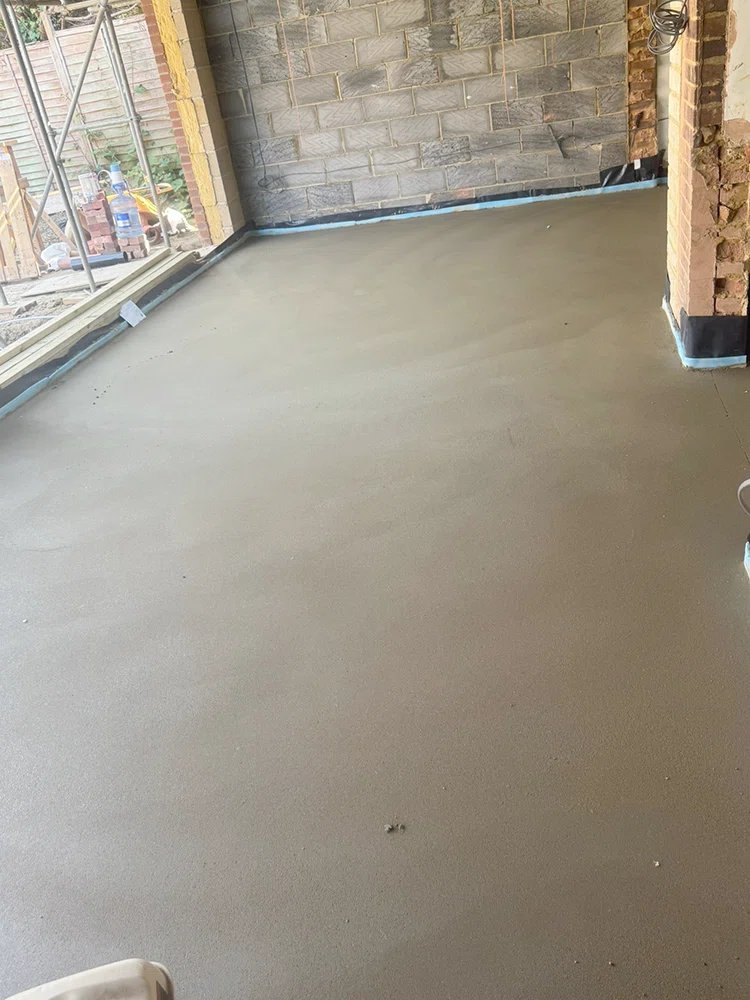
K & B Screeding’s own team, led by director Donatas Bardisevicius. Founded 2019, company 12298780.
See what customers say in our Google reviews and on our testimonials page.
Sand and Cement Screed from Slough to Ely
As the crow flies, our yard in Slough is about 71.4 miles from Ely, which lies to the north-north-east. Postcodes here include CB7, and Soham (5.7 miles), Chatteris (9.9 miles), Newmarket (12.4 miles) and March (12.6 miles) are close by.
More on sand & cement screed, part of our screeding services.
