What latex screed does in Ely kitchens and bathrooms
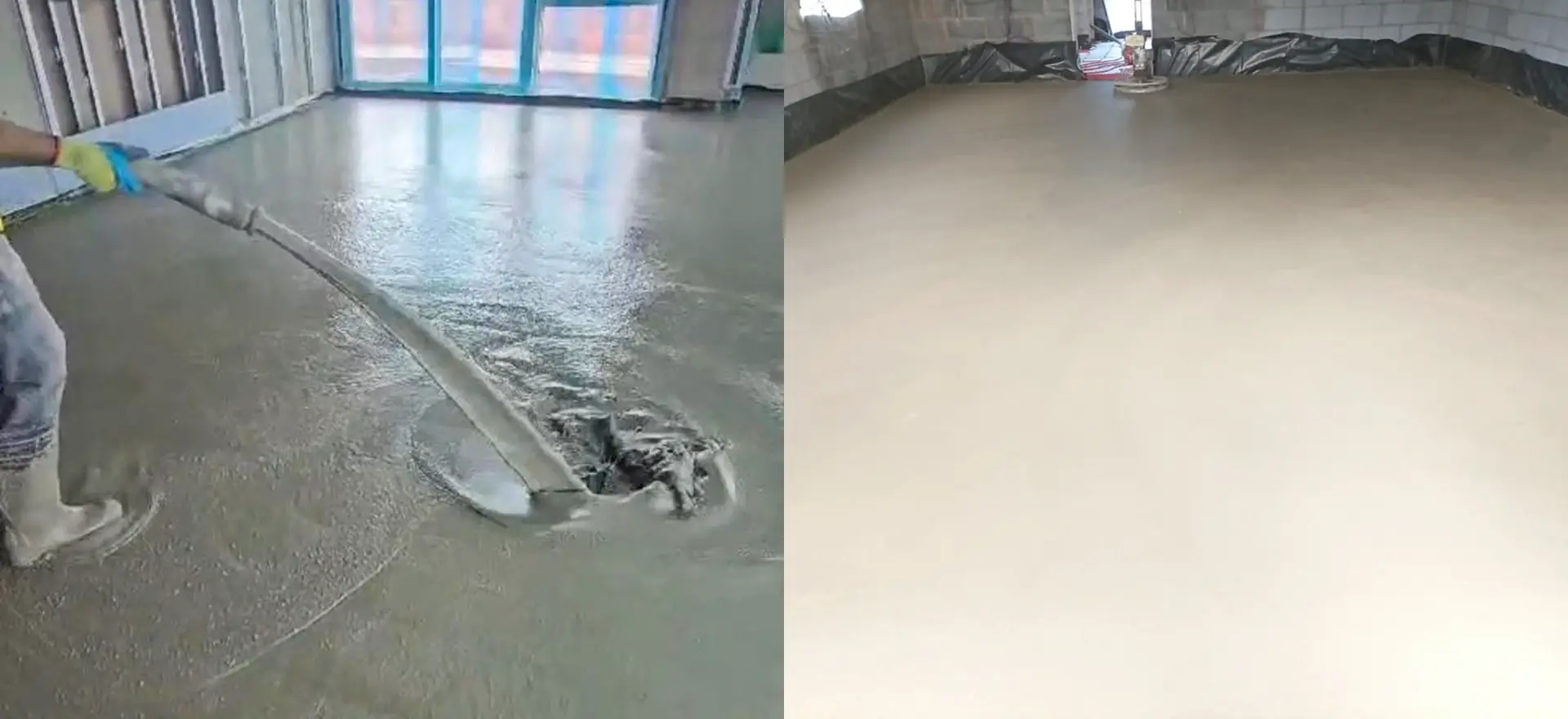
The name confuses people. Latex screed is not a screed in the usual sense, and it is never laid 65mm deep. The pack holds a powder with a cement base and a bottle of liquid latex, which is used instead of water, and the latex gives the cured layer a little flexibility and a strong grip on bases that ordinary compound struggles with. It goes down a few millimetres thick and is spread to a smooth finish.
That makes it a refit material. In Ely, homes built between 1919 and 1944 account for 7% of the stock, and flats of all kinds for 13%. Kitchens and bathrooms in both tend to be stripped and refitted more than once over their lives, and each time the floor underneath becomes more of a patchwork: an old tiled area, a strip of concrete where a wall came out, boards near the door. Sheet vinyl, LVT, lino, rubber and safety flooring all show those changes through the finish within weeks.
Latex covers them in one layer. Firmly bonded ceramic or quarry tiles can stay where they are if they are sound, cleaned and primed, which saves breaking them out and the dust that goes with it. Uneven older concrete takes it well once it has been cleaned back. Old adhesive can sometimes stay too, provided it is thin, hard and stuck fast.
Timber needs one extra step. Latex never goes straight onto bare floorboards, because the boards move and the layer cracks. They are first overboarded with flooring grade plywood, screwed down at close centres, and the latex goes over that.
For general compound work and the flatness classes, see our Ely floor levelling page.
When latex is the wrong fix for an Ely floor
Latex is a finishing layer, not a cure. Three things rule it out until they are dealt with.
Damp comes first. In those older cathedral and Waterside buildings, moisture coming up through an unprotected slab will lift a latex layer and the vinyl on top of it. We take a reading before quoting, and where it is high the floor needs a membrane or a rebuild first. Listed status can also limit what is changed, so that conversation comes before any product choice.
Movement is the second. A timber floor that bounces underfoot will crack latex however well it is laid. The joists and boards are fixed first, then overboarded.
Level is the third. If a floor drops away by more than a thin layer can make up, latex is the wrong product, and a new screed or a repair to the concrete base comes first.
Priming ties it together. Each base takes its own primer, and a calcium sulphate screed is always primed, with its laitance taken off, before latex touches it. Cleaning and priming of that kind sits under floor preparation. Readers in Soham, about 5.7 miles off, can find the Soham latex screed page.
Latex over developer floors on Ely's newer estates
Ely's newer estates, built in large numbers in the 2000s and since, bring a different latex job from the old city centre. The floors are young, but they are rarely as smooth as sheet vinyl or LVT demands, and snagging repairs on developer floors come up there too.
Start by finding out what the floor is. New homes may have a calcium sulphate flowing screed, a sand and cement screed or, upstairs, a timber deck, and the handover documents often say which. That decides the preparation: a calcium sulphate floor needs the sanding and priming described above before anything goes on it, while a cement screed and a timber deck each have their own route.
A young floor is not always a dry one. A screed that has been under carpet since handover may still hold moisture, especially where it was laid deep, so we take a reading before any latex goes down rather than assuming a newer house is dry.
Next, deal with the repairs. Where a developer floor has been cut for a pipe or patched after a leak, the patch often sits slightly proud or low and has a different surface from the floor around it. Those areas are brought into line and primed to suit their own base before the latex coat goes over everything.
Latex then gives the whole room one even bed, which shows its value most under glossy sheet vinyl and LVT, where every patch line would otherwise catch the light.
Latex screed prices for Ely floors
Latex has no separate rate in the trade2base guide; a thin levelling layer over concrete is £10 to £20 per m² (trade2base, June 2026), so £200 to £400 for 20 m². trade2base does not say whether these figures include VAT. See our floor levelling cost guide.
Who lays your latex screed in Ely
K & B Screeding, led by director Donatas Bardisevicius. Founded 2019, company 12298780.
See what customers say in our Google reviews and on our testimonials page.
Latex screed from Slough to Ely
As the crow flies, our base in Slough is about 71.4 miles from Ely, which lies to the north-north-east. Postcodes here include CB7, and Soham (5.7 miles), Chatteris (9.9 miles), Newmarket (12.4 miles) and March (12.6 miles) are close by.
More on latex screed, part of our floor screeding service. For every screed we lay locally, see floor screeding in Ely.
Further reading: levelling compound on wooden floors and which screed primer to use.