
Replacing old terrace floors in Newmarket
Homes from before 1919 make up 18% of Newmarket's stock, and terraced houses 28%. Older terraces here often have suspended timber floors or early concrete ones with no damp proof membrane. Once a timber floor has rotted, or a concrete floor has cracked and let damp through, the usual renovation is to replace it outright.
Here is the sequence. The old floor is taken up and removed and the ground below is compacted. Next comes the damp proof membrane, lapped up the face of the walls. Insulation is added on top, then a separating layer, and finally the new screed. For a home, the floating screed goes down at 65mm as a minimum.
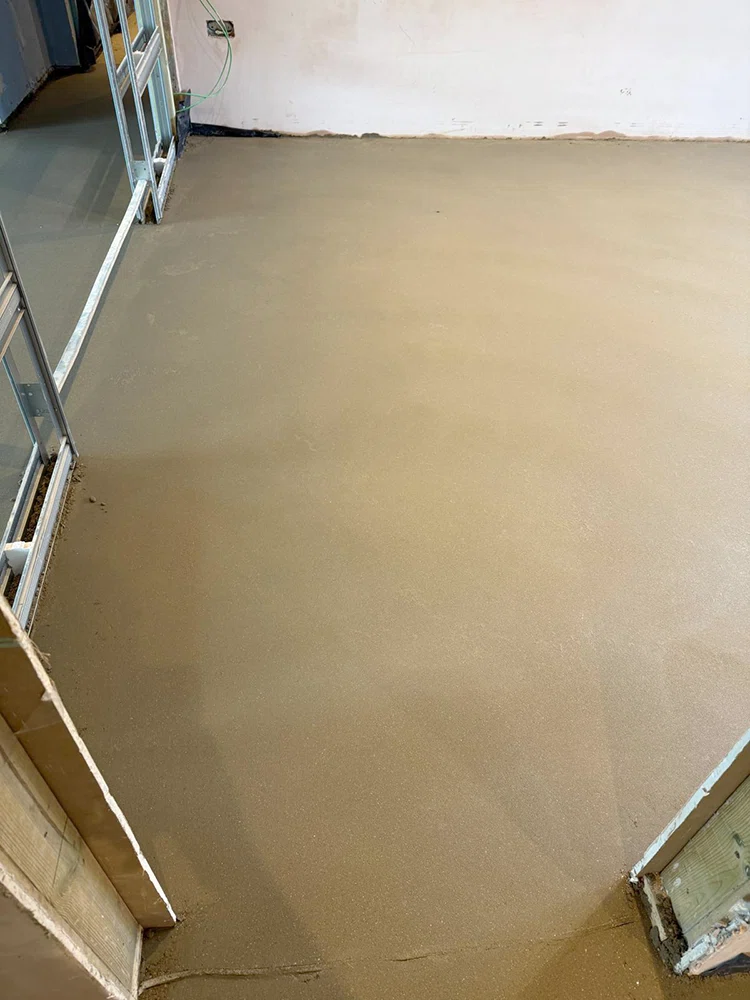
Hand laying suits these houses. Terraces have small rooms, narrow hallways and doorways, and a pump offers little over a mixer and barrow for a front room and a kitchen. We pack it down properly and trowel it dense and level, ready for whatever flooring follows.
Height is the constraint. Front doors, stairs and fireplaces were set for the original floor, and the new build-up must fit under them. Where there is too little depth for insulation plus 65mm of screed, a bonded screed at 25 to 40mm over a sound slab, or a thinner liquid screed alternative, can sometimes help.
For period houses, check listed building controls before any floor is removed.
Tack rooms and wash bays across Newmarket
Racing buildings ask more of a floor than most homes. A wash bay is hosed down, so the screed must fall to a drain, resist water and stand up to hooves and barrows. A tack room or veterinary area needs a hard wearing, cleanable surface. These are cement screed jobs: calcium sulphate screed must not be used where floors may get wet.
The falls are set out before laying so water runs away from doors and walls to a gully. For heavy use, a sand and cement screed can be laid at 75mm, strengthened with fibres at about £1 to £3 per m², or specified as a higher strength sand and cement mix. We do not lay structural concrete slabs, so any new slab must come from a groundworker first.
The same approach suits domestic wet rooms, utility rooms and garages. The one drawback is time. The first 40mm needs something close to 40 days and every millimetre after that takes longer, so a tack room or utility floor needs weeks, not days, before anything goes on top. Depths for each kind of room are listed in how thick screed should be.
Sand and Cement Screed prices in Newmarket
Sand and cement screed: £18 to £25 per m² supplied and laid (MyJobQuote, August 2026), so £450 to £630 for 25 m². MyJobQuote does not say whether these figures include VAT. See our floor screeding cost guide or screed calculator.
Who lays your sand and cement screed in Newmarket
K & B Screeding’s own team, led by director Donatas Bardisevicius. Founded 2019, company 12298780.
See what customers say in our Google reviews and on our testimonials page.
Sand and Cement Screed from Slough to Newmarket
Newmarket is about 66.6 miles north-east of our Slough base as the crow flies, with postcodes including CB8. The nearest towns to it are Soham (6.7 miles), Haverhill (11.2 miles), Ely (12.4 miles) and Cambridge (12.4 miles).
More on sand & cement screed, part of our screeding services.
