
Renovating older floors around Castle Street and Bridge Street
Historic homes on and around Castle Street and Bridge Street often have old solid or suspended floors, and those deserve a look before anyone hires a breaker. In many of these buildings a breathable approach and careful levelling count for more than a heavy new slab, so we start by finding out what the floor is built from and what made it fail.
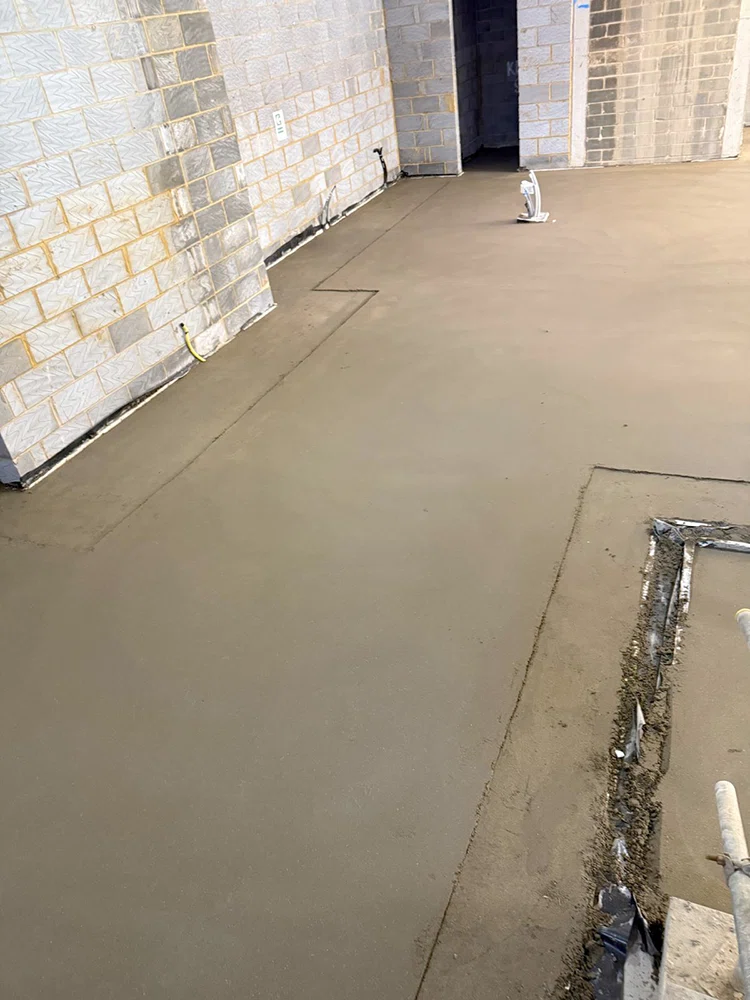
When a solid floor has cracked, dropped or turned damp and must be taken up, its replacement is usually sand and cement over a fresh membrane and insulation. This is hand work. Rooms in old houses are seldom square, doors can be tight and floor heights shift from one room to the next, and a site-mixed screed can be taken right up to every threshold and packed into corners a pumped screed would not reach well.
Terraced houses make up 22% of Saffron Walden's homes, and their back kitchens and bathrooms raise the same points. For a few square metres in an awkward room, sand and cement makes sense because no pump needs setting up.
Depth depends on what lies beneath. Floating over insulation in a house, this screed goes down at about 65mm, while a bonded screed laid straight onto a sound slab is 25 to 40mm. The difference between the two is set out in our screed thickness guide, and if the base needs attention before anything goes on it, see our floor preparation service.
Wet rooms, garages and falls in Saffron Walden
Some jobs only sand and cement can do. Calcium sulphate cannot go in a wet room or shower area, where the floor must fall towards a drain and may stay damp, and some tiling systems insist on a cement substrate. Forming a fall is done by hand, shaping the screed to a gradient from the walls down to the outlet before compacting and finishing it.
Garage conversions are the other regular use. The floor has to be raised to match the house, often over insulation and a membrane, and sand and cement can be built up to whatever depth that needs. Our garage floor screeding guide goes through that build-up one layer at a time.
Its weak spot is the wait. Count a day for every millimetre up to 40mm, and more per millimetre past that, which leaves a 65mm floor unready for timber or vinyl for a long stretch. If the programme is tight, fibres or a rapid drying additive can go into the mix, and our fibre reinforced screed page has more on that. For a new room with heating in the floor, read the Saffron Walden underfloor heating screed page on pipe cover and heat-up times.
Sand and Cement Screed prices in Saffron Walden
Sand and cement screed: £18 to £25 per m² supplied and laid (MyJobQuote, August 2026), so £450 to £630 for 25 m². MyJobQuote does not say whether these figures include VAT. See our floor screeding cost guide or screed calculator.
Who lays your sand and cement screed in Saffron Walden
K & B Screeding’s own team, led by director Donatas Bardisevicius. Founded 2019, company 12298780.
See what customers say in our Google reviews and on our testimonials page.
Sand and Cement Screed from Slough to Saffron Walden
Saffron Walden is about 51 miles north-east of our Slough base as the crow flies, with postcodes including CB10. The nearest towns to it are Haverhill (9.3 miles), Bishop's Stortford (11.1 miles), Royston (11.3 miles) and Great Dunmow (11.7 miles).
More on sand & cement screed, part of our screeding services.