
Specifying anhydrite for Saffron Walden plots and apartments
Under the European standard for screed materials, calcium sulphate is graded by two figures. The number after C is how much load it takes in compression and the number after F is its bending strength, both in N/mm2. A spare bedroom that sees little wear can get by on CA-C20-F4. Ordinary family homes, apartment blocks and offices are usually drawn at CA-C25-F5, and CA-C30-F6 is saved for floors that take a hammering. For the newer estates on the town's edges the grade comes off the engineer's drawings, and that is the one we pour.
Occasionally the drawings call for an alpha hemihydrate screed in place of ordinary anhydrite. It earns its place on jobs where the floor must be ready sooner or built up thinner, and from then on the manufacturer's data sheet, not a rule of thumb, decides depth and drying time.
What makes the material useful on a big floor is how little it shrinks. Joints can be spaced well apart across wide bays, which is why it sits so well under an open-plan ground floor or a storey of apartments. Flats are 20% of Saffron Walden's homes, and a level of apartments, poured once over insulation and often over heating, is just where that keeps a programme on track. Doorways and the line where one heating zone meets the next still get a joint, and every bay and joint is planned out before the pour.
Our own team prepares every build-up, from the edge strip through to the membrane. If you want to know more about how it behaves, read what anhydrite screed is.
Sanding, priming and testing before Saffron Walden floors are finished
Calcium sulphate grows a weak surface crust, known as laitance, while it dries. Adhesives for tiles, levelling compounds and flooring glues cannot be relied on to hold to it, so when the screed is dry enough we sand the surface back to sound material and prime it with a product designed for calcium sulphate. Missing out the sanding, or picking a primer that does not suit, often explains finishes that come loose.
Then comes the moisture test, which trips up plenty of projects. The makers of wood and LVT flooring commonly hold calcium sulphate to a stricter moisture figure than cement, so a screed that seems bone dry when you walk on it can still be too damp for them. So we read it with a hygrometer instead of going by the calendar. If pipes are in, running the heating can usually speed the drying from roughly day 7.
Anhydrite should stay out of any floor that may get wet. In a shower, wet room or utility, use a cement-bound flowing screed instead, or a hand-laid traditional screed shaped to falls where water has to run to a drain. For pumping, speed and where it suits in general, see liquid screed for Saffron Walden homes.
Anhydrite & Flow Screed prices in Saffron Walden
Liquid flowing screed (which includes anhydrite): £24 to £31 per m² supplied and laid (MyJobQuote, August 2026), so £960 to £1,240 for 40 m². MyJobQuote does not say whether these figures include VAT. See our floor screeding cost guide or screed calculator.
Who lays your anhydrite and flow screed in Saffron Walden
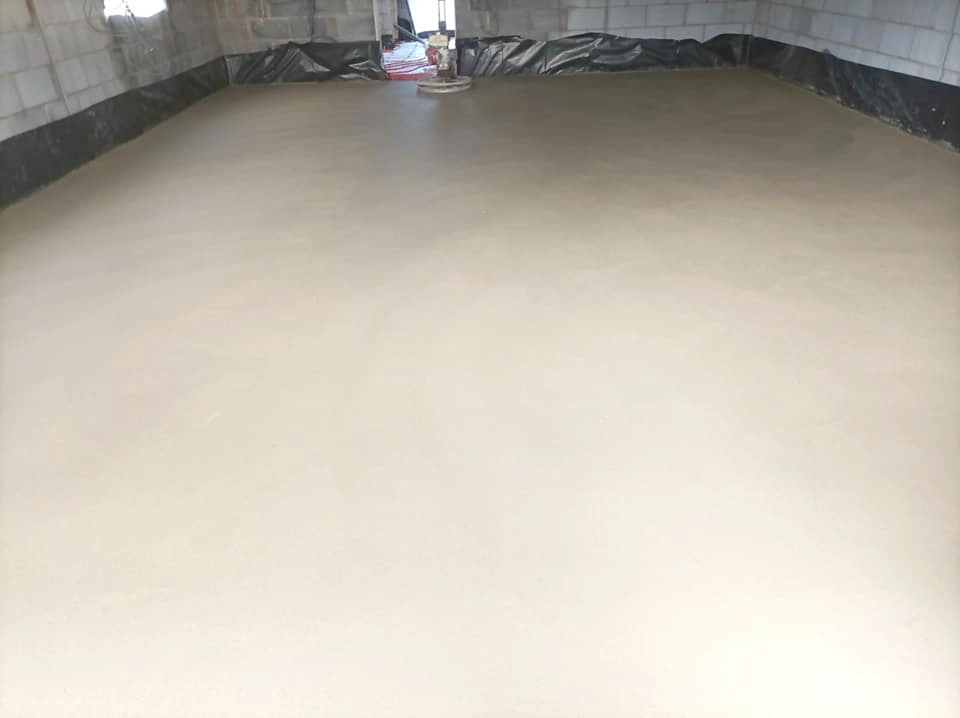
K & B Screeding’s own team, led by director Donatas Bardisevicius. Founded 2019, company 12298780.
See what customers say in our Google reviews and on our testimonials page.
Anhydrite & Flow Screed from Slough to Saffron Walden
Saffron Walden is about 51 miles north-east of our Slough base as the crow flies, with postcodes including CB10. The nearest towns to it are Haverhill (9.3 miles), Bishop's Stortford (11.1 miles), Royston (11.3 miles) and Great Dunmow (11.7 miles).
More on anhydrite screed, part of our screeding services.