
Heated floors on Saffron Walden's newer estates
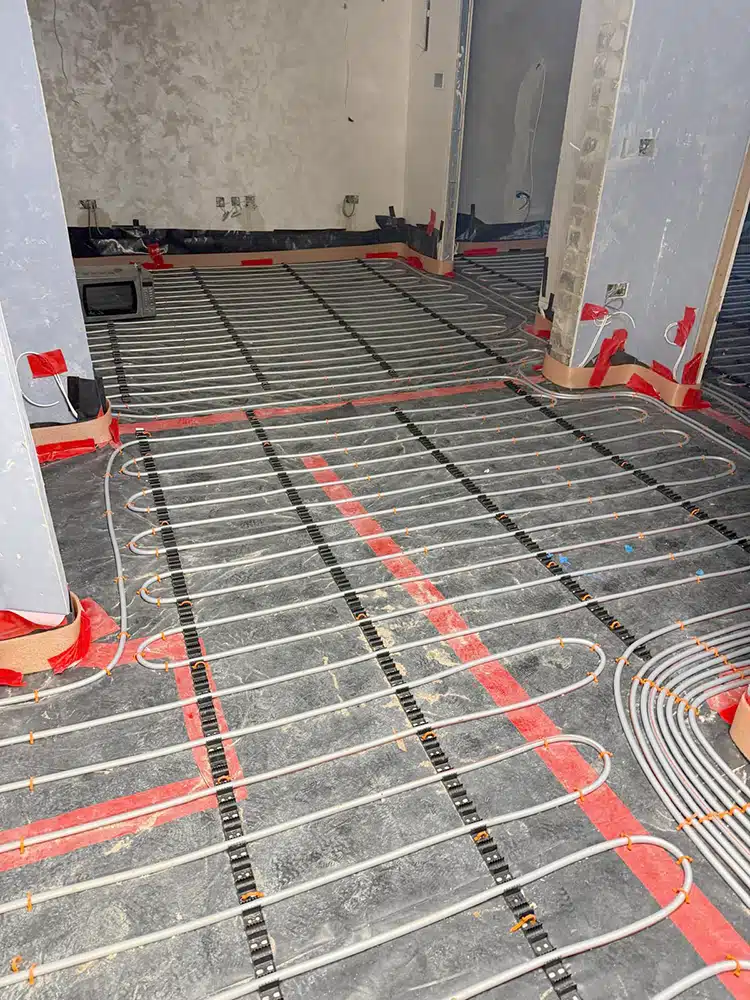
In a new house, heating and screed are planned as one. Insulation comes first, followed by the edge strip and membrane, and then the pipes are clipped down and pressure tested. The screed goes over the lot and must fill around every pipe, because a void beneath a pipe leaves a cold patch the thermostat cannot cure.
So flowing screeds are the norm on Saffron Walden's recent estates, where 13% of homes date from 2015 or later. Liquid screed flows round and beneath the pipes without leaving gaps, and with the minimum 25mm above them the floor ends up about 45 to 50mm deep. A thinner, denser layer like that warms faster than a thick traditional one and follows the controls more closely.
Sand and cement remains an option over heating. It takes about 45mm over the pipes and goes down thicker overall, so it stores more heat and is slower to respond. Some builders choose it where a room might want a cement base, a shower area for example. Our screed depths guide lines the numbers up together.
Our job is the screed, not the pipework. Fitting and testing the system is the heating engineer's job, done before we come, and on arrival we check the insulation, membrane and edge strip. If those layers still need supplying, see insulation and membranes.
Retrofitting underfloor heating near Castle Street and beyond
Retrofitting heating under an older house's floor brings problems a new build never has, and height tops the list. The new floor must finish flush with the rooms and doors around it, and over an old solid or suspended floor there is often little depth left for insulation, pipes and screed. One way round it is to dig out the old solid floor; another is a thin liquid screed on a low-profile build-up.
Near Castle Street and Bridge Street the historic floors may need a breathable, careful approach, so whether to heat those rooms at all is worth settling with the builder and heating designer before anyone prices the screed.
Once the screed is down, keep the floor circuit switched off for a while: calcium sulphate can usually take warmth after about 7 days, sand and cement not before 21. Commissioning is then gradual, lifting the flow temperature a little at a time over several days instead of all at once, so the screed does not crack. The reasons are in our drying time guide. To choose the material for a heated extension, read about pumped liquid screed in Saffron Walden, or look at underfloor heating screed in Cambridge.
Underfloor Heating Screed prices in Saffron Walden
Liquid screed over underfloor heating: £20 to £35 per m² supplied and laid (trade2base, June 2026), so £700 to £1,230 for 35 m². trade2base gives these figures excluding VAT. See our floor screeding cost guide or screed calculator.
Who lays your underfloor heating screed in Saffron Walden
K & B Screeding’s own team, led by director Donatas Bardisevicius. Founded 2019, company 12298780.
See what customers say in our Google reviews and on our testimonials page.
Underfloor Heating Screed from Slough to Saffron Walden
Saffron Walden is about 51 miles north-east of our Slough base as the crow flies, with postcodes including CB10. The nearest towns to it are Haverhill (9.3 miles), Bishop's Stortford (11.1 miles), Royston (11.3 miles) and Great Dunmow (11.7 miles).
More on underfloor heating screed, part of our screeding services.