
Getting pipe cover right in Bishop's Stortford floors
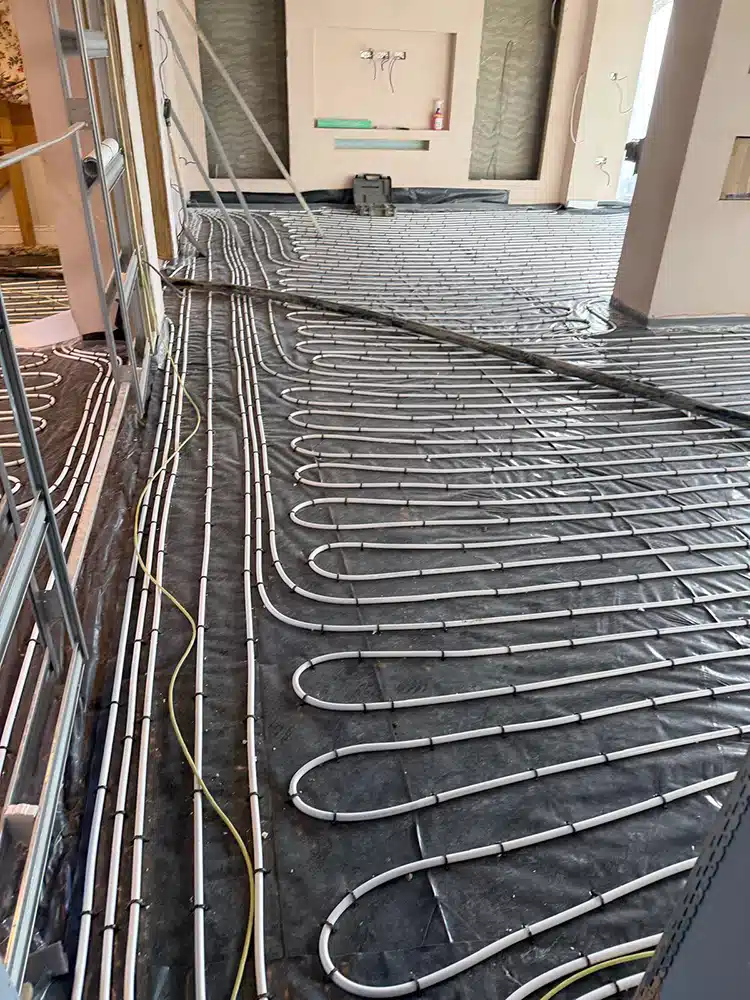
A heated floor depends on the screed as much as on the pipes. The screed must surround every pipe with no voids, carry the heat evenly across the room and be deep enough above the pipes to take loads without cracking.
With a liquid screed, 25mm above the pipes is the minimum, usually making 45 to 50mm in all, and it runs beneath and around each pipe and heats up fast. Cover with sand and cement is about 45mm, and the finished floor sits higher as a result. Our screed thickness guide lays out the depths for each case.
On new plots at Stortford Fields and St Michael's Hurst, where liquid screed over underfloor heating is standard, the floor is designed with these depths from the start. Detached houses make up 33% of the town's homes, and a large detached ground floor is where heating under the whole floor pays off.
Retrofits are different. Take an older house in Hockerill or New Town: to fit insulation, pipes and screed without lifting the finished floor, the original floor first has to be removed. The thinner section of liquid screed is often what makes it work; in small or broken-up rooms, a hand-laid sand and cement floor over pipes remains an option.
Heated extensions and garden rooms sit between the two: new construction, but tied to an existing floor level.
First heat-up for a Bishop's Stortford heated floor
Before the pour, the heating engineer pressure tests the pipes and leaves the system full and under pressure. On pour day we inspect the insulation and membrane, and the edge strip in particular, since it is what allows the screed to move a little as it heats and cools.
Waiting is part of the job. Calcium sulphate is normally ready for gentle heat after roughly 7 days; sand and cement should be given 21 days, if not more. The first warm-up follows the heating manufacturer's commissioning schedule, starting at a low flow temperature and increasing gradually. Go to full heat at once and the screed may crack.
When it is dry and commissioned, the floor gives a flat base for tiles, LVT and engineered wood. The UK range published for 2026 for a liquid screed laid on heating pipes is £20 to £35 per m², and your own price depends on the floor's area, its depth and the access.
Where a new build has calcium sulphate specified by grade, the material is covered on our anhydrite flow screed page. Over towards Great Dunmow, see heated screeds for Great Dunmow.
Underfloor Heating Screed prices in Bishop's Stortford
Liquid screed over underfloor heating: £20 to £35 per m² supplied and laid (trade2base, June 2026), so £700 to £1,230 for 35 m². trade2base gives these figures excluding VAT. See our floor screeding cost guide or screed calculator.
Who lays your underfloor heating screed in Bishop's Stortford
K & B Screeding’s own team, led by director Donatas Bardisevicius. Founded 2019, company 12298780.
See what customers say in our Google reviews and on our testimonials page.
Underfloor Heating Screed from Slough to Bishop's Stortford
On the map, Bishop's Stortford sits north-east of Slough, about 41.8 miles from our base in a straight line (postcodes including CM23), next to Sawbridgeworth (4.1 miles), Harlow (7.6 miles), Great Dunmow (8.7 miles) and Ware (9.2 miles).
More on underfloor heating screed, part of our screeding services.
