
Anhydrite grades on Smiths Farm and Woodlands Park plots
On plot drawings the screed is given as a coded grade. C is for compressive strength and F for flexural strength, and both numbers are in N/mm2.
CA-C20-F4 covers domestic floors that take light foot traffic.
CA-C25-F5 is where most homes, apartments and offices sit.
CA-C30-F6 is the heavier duty grade.
On a new plot the developer or designer normally sets the grade and depth, and we pour to it. A specification may instead call for an alpha hemihydrate product, picked when quicker drying or a slimmer floor is the priority. Each of those has its own data sheet, and the manufacturer's depth and drying figures are what we follow, not rules of thumb.
The case for calcium sulphate is low shrinkage. Big bays go down with few joints, and we work out where the bays and joints fall before pour day. Over underfloor heating, which pairs well with the air source heat pumps used at St Mary's Park, it can usually be force dried with the heating from about 7 days.
Everything under the screed, insulation up to the edge strip, is put down by our own team, so we know what we are pouring onto. For how the material behaves as it sets and dries, read our guide, anhydrite screed explained. The same service in Chelmsford is on our anhydrite screed in Chelmsford page.
Finishing an anhydrite floor in Great Dunmow homes
Pouring it is only the start. Before flooring, a calcium sulphate screed needs three things.
First, the laitance must go. Laitance is the thin, weak skin left on top as the screed sets. Once dry, it is sanded off and the dust removed; flooring stuck to laitance can come loose.
Second, the floor is primed with a product compatible with calcium sulphate, and we name it in the handover so the flooring fitter works with the same system.
Third, the moisture test. Flooring manufacturers frequently set a lower limit for this material than for cement, and an anhydrite floor can seem dry yet still hold too much water for its tiles, LVT or boards. A hygrometer test settles it.
We hand over drying and laitance advice in writing, so a flooring contractor who arrives weeks later knows what grade was laid, when, and what still has to be done before they start. There is one more limit to bear in mind: calcium sulphate has no place in rooms that may get wet. So in a new Great Dunmow house, the en-suite with its walk-in shower and the utility room with its floor drain are poured in a cement based flowing screed or given a hand-laid sand and cement wet room floor.
Anhydrite & Flow Screed prices in Great Dunmow
Liquid flowing screed (which includes anhydrite): £24 to £31 per m² supplied and laid (MyJobQuote, August 2026), so £960 to £1,240 for 40 m². MyJobQuote does not say whether these figures include VAT. See our floor screeding cost guide or screed calculator.
Who lays your anhydrite and flow screed in Great Dunmow
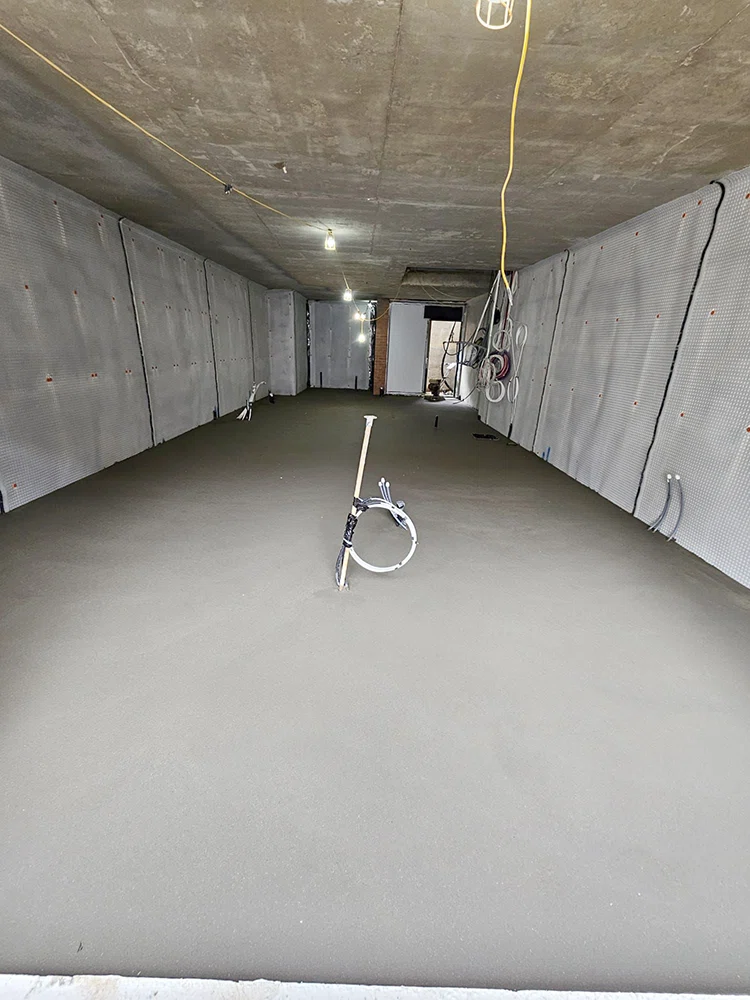
K & B Screeding’s own team, led by director Donatas Bardisevicius. Founded 2019, company 12298780.
See what customers say in our Google reviews and on our testimonials page.
Anhydrite & Flow Screed from Slough to Great Dunmow
On the map, Great Dunmow sits east-north-east of Slough, about 49.3 miles from our base in a straight line (postcodes including CM6), next to Braintree (8.1 miles), Bishop's Stortford (8.7 miles), Sawbridgeworth (10 miles) and Chelmsford (10.4 miles).
More on anhydrite screed, part of our screeding services.
