
Anhydrite specifications for Chelmsford new builds and flats
On a Channels or Beaulieu Park specification, the calcium sulphate screed appears as a code drawn from the European screed standard. Its C value tells you crushing strength and its F value bending strength, in N/mm2 for both. A lightly used room in a house may only need CA-C20-F4, the general run of homes, apartments and offices take CA-C25-F5, and harder-working floors go up to CA-C30-F6.
That choice belongs to the engineer for a new house or a block of flats, and our lorry brings precisely what they wrote. A tight programme or a shallow floor can lead the engineer to an alpha hemihydrate product, whose data sheet then sets its depth and drying.
Day to day, what makes this screed useful is how little it shrinks. Whole apartment floors and wide open-plan ground floors can go down in big bays with hardly any joints. Thresholds and the borders between heating zones do still get joints, which we mark out in advance. On a new plot that layout is agreed with the site manager so other trades know where the joints fall.
The local plan aims for 18,000 more homes by 2036, and on new plots the screed grade is usually written into the specification before work starts. If you want more on how calcium sulphate behaves, the anhydrite explainer covers it. Where a cement surface or early load is needed instead, see sand and cement screed in Chelmsford.
Laitance and moisture testing on Chelmsford floors
As it cures, a soft, powdery crust called laitance builds up on the surface. Glue that grips the crust comes away with it, so on a dry floor we sand the laitance off and prime with something made to suit calcium sulphate.
Next, a hygrometer goes on the floor. Flooring suppliers frequently want calcium sulphate drier than cement, so looking ready and being ready are different things. Where heating pipes are in, running them from about day 7 to force dry the floor usually helps when a new build handover date is close.
Wet areas are where calcium sulphate should not go. Keep it out of any room where water may linger, such as a wet room, a shower room with a walk-in tray or a utility that could flood from a leak; those get a flowing mix bound with cement. That is a common mix on apartment floors, where bathrooms and living areas sit side by side.
Once sanded, primed and dry, the floor may still need a thin smoothing layer under sheet finishes. Our latex screed service covers that final step. Every floor is handed over with our written notes on drying and laitance, so the flooring contractor can see what is done and what to check before any adhesive.
Anhydrite & Flow Screed prices in Chelmsford
Liquid flowing screed (which includes anhydrite): £24 to £31 per m² supplied and laid (MyJobQuote, August 2026), so £960 to £1,240 for 40 m². MyJobQuote does not say whether these figures include VAT. See our floor screeding cost guide or screed calculator.
Who lays your anhydrite and flow screed in Chelmsford
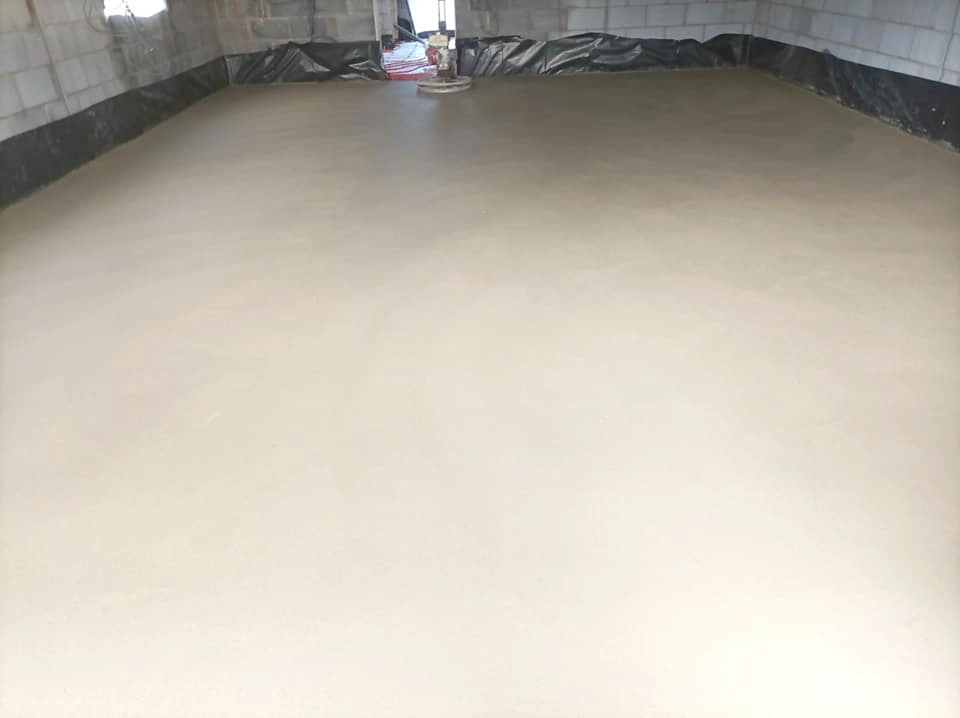
K & B Screeding’s own team, led by director Donatas Bardisevicius. Founded 2019, company 12298780.
See what customers say in our Google reviews and on our testimonials page.
Anhydrite & Flow Screed from Slough to Chelmsford
Chelmsford is about 50.2 miles east-north-east of our Slough base as the crow flies, with postcodes including CM1, CM3 and CM2. The nearest towns to it are Billericay (8.2 miles), Witham (8.4 miles), Wickford (8.8 miles) and Maldon (8.8 miles).
More on anhydrite screed, part of our screeding services.
