
Thin latex finishes for Chelmsford kitchens and bathrooms
Refits strip a room back to whatever was laid before, and in an older Chelmsford house that can be almost anything. Homes from between the wars make up 11% of the city's stock, and post-war homes are more common still, so a bathroom floor may turn out to be boards hidden under hardboard, a slab with ceramic tiles glued to it, or concrete scarred by decades of fixings. Thin finishes need something better.
Latex forms a smooth, hard skin over a base that is basically sound. Because the liquid half is latex, the cured layer clings to dense surfaces and has a degree of flexibility, which is why it is the usual choice over plywood. Floorboards themselves are never covered directly. They are screwed down, overboarded with flooring grade plywood fixed at close centres, and the latex goes onto the ply.
Old quarry and ceramic tiles can stay if they are firmly stuck, cleaned and given a bonding primer. Thin, well bonded adhesive left after carpet or vinyl comes up can sometimes stay too, once tested and primed. Uneven concrete simply needs to be clean and sound. On a calcium sulphate screed, the laitance comes off and a compatible primer goes on every time.
The finishes that rely on this layer include sheet vinyl, LVT, lino, rubber and safety flooring in a kitchen or bathroom, and all of them telegraph ridges and grout lines. If you are weighing latex against a deeper levelling pour, levelling compound in Chelmsford sets out that choice.
When Chelmsford floors need more than latex
Latex is a finishing layer, and it cannot rescue a floor with deeper faults. Three turn up in older houses.
Movement is one. A suspended timber floor that flexes will crack a thin compound along the joints, however good the plywood. A carpenter needs to stiffen it first.
Damp is another. In Moulsham terraces, old solid floors without a membrane let moisture through, and a few millimetres of latex laid over that will blister and lift. Those floors need digging out and relaying, and sand and cement for older Chelmsford floors explains how.
The last is level. A thin skin is not meant to fill a deep dip or raise one room to meet the next. Where a floor is well out, a new screed or a deeper levelling product comes first.
In flats, the build-up may include an acoustic layer, and any added thickness has to suit the doors along the corridor. With 56% of Chelmsford homes in council tax bands A to C, a thin skin over a sound floor is often a far smaller job than a new screed, so it is worth checking for first. Across Galleyend, Widford, Blasford Hill and both Oxney Greens the same checks apply. For the same service nearby, see latex screed in Witham.
How we price latex screed in Chelmsford
A fixed written price within 24 hours, once we know the area and the base. See our floor screeding cost guide.
Who lays your latex screed in Chelmsford
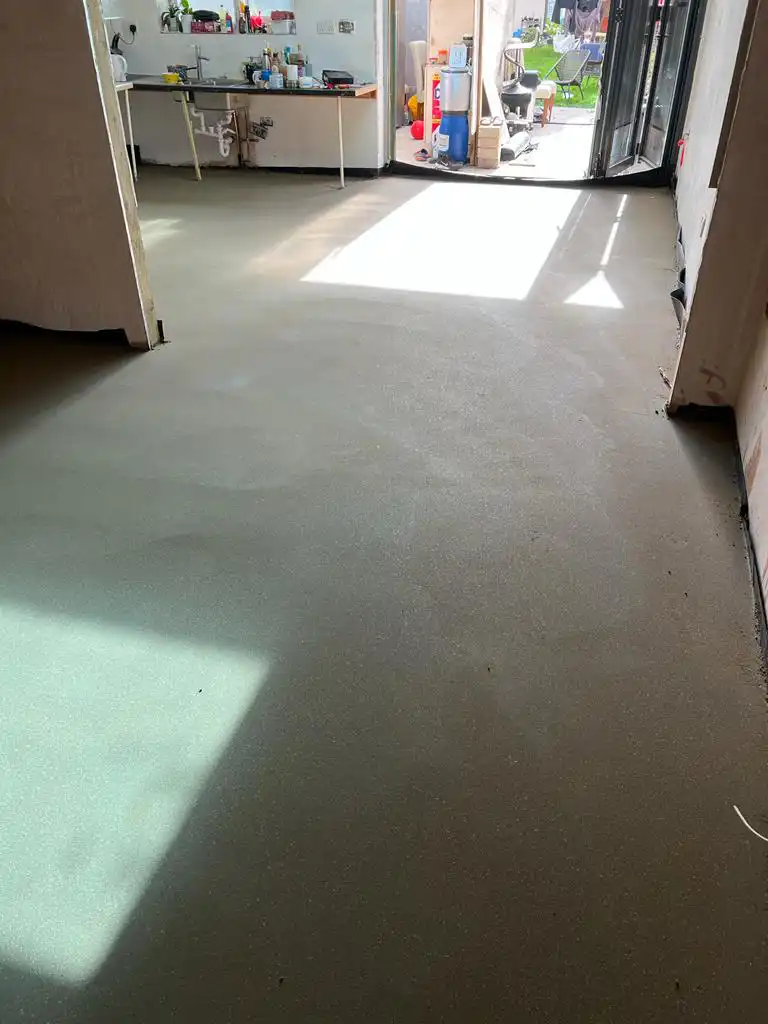
K & B Screeding’s own team, led by director Donatas Bardisevicius. Founded 2019, company 12298780.
See what customers say in our Google reviews and on our testimonials page.
Latex Screed from Slough to Chelmsford
Chelmsford is about 50.2 miles east-north-east of our Slough base as the crow flies, with postcodes including CM1, CM3 and CM2. The nearest towns to it are Billericay (8.2 miles), Witham (8.4 miles), Wickford (8.8 miles) and Maldon (8.8 miles).
More on latex screed, part of our screeding services.
