
Reading a calcium sulphate specification for Halstead plots
Calcium sulphate screeds are labelled by strength. Take CA-C25-F5: in the European standard for screeds, that code describes a calcium sulphate screed reaching 25 N/mm2 in compression and 5 N/mm2 in flexure.
For lightly used rooms in a home, such as the bedrooms of a new house, CA-C20-F4 is enough. The middle grade, CA-C25-F5, covers the bulk of houses, flats and offices, while a floor that will be worked harder is poured at CA-C30-F6. Then there are alpha hemihydrate products, which fall outside that grading. They are picked when a floor has to be thinner or dry sooner, and their own product data sheet sets the rules for them.
For apartments and new build plots, the material has clear benefits. Its shrinkage is minimal, which allows big bays with very few joints, and it sits well over insulation and heating pipes. Even so, where the bays and joints go must be worked out before pouring, above all at doorways and wherever the floor changes shape.
If your specification allows calcium sulphate or a cement based flowing screed, we will talk through the pros and cons before anything is ordered. For more on the chemistry, read our anhydrite screed explainer. If all you need to know is how a big floor gets pumped and how fast, our Halstead liquid screed page is the place for that; this one deals with the calcium sulphate material and its specification.
Laitance, moisture and wet areas in Halstead
Every calcium sulphate floor needs two follow-up steps. First comes the laitance, a soft, dusty film that rises to the top while the screed sets; when the floor has dried out we sand it away, or adhesive and levelling compound will not stick. A primer formulated for calcium sulphate then goes on.
Second is the moisture test. Many flooring makers set the bar lower for calcium sulphate, so a Halstead floor that would pass on cement can still read too damp. Only a hygrometer can tell you the floor is ready for its covering; counting days is not enough. From around a week after the pour, gentle use of the underfloor heating normally helps drive the moisture out.
Calcium sulphate and water do not mix well, so shower rooms, utility rooms and garages get sand and cement, or a flowing screed made with cement, instead. In Halstead 13% of homes are purpose-built flats, and on an apartment floor the bathrooms have to be thought about at the start.
Sound but not smooth enough after sanding? Self levelling compound for Halstead floors can follow, laid over the right primer. For the same material in a bigger town nearby, see Colchester anhydrite screed.
Anhydrite & Flow Screed prices in Halstead
Liquid flowing screed (which includes anhydrite): £24 to £31 per m² supplied and laid (MyJobQuote, August 2026), so £960 to £1,240 for 40 m². MyJobQuote does not say whether these figures include VAT. See our floor screeding cost guide or screed calculator.
Who lays your anhydrite and flow screed in Halstead
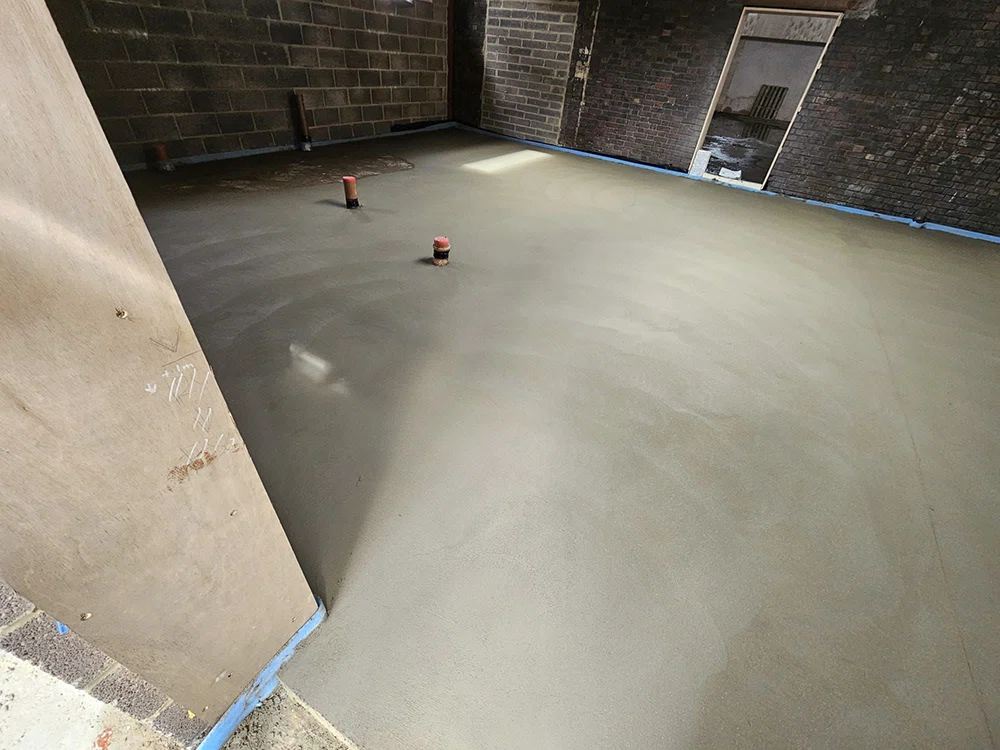
K & B Screeding’s own team, led by director Donatas Bardisevicius. Founded 2019, company 12298780.
See what customers say in our Google reviews and on our testimonials page.
Anhydrite & Flow Screed from Slough to Halstead
As the crow flies, our yard in Slough is about 61.8 miles from Halstead, which lies to the east-north-east. Postcodes here include CO9, and Braintree (5.7 miles), Sudbury (7.8 miles), Witham (10 miles) and Colchester (12 miles) are close by.
More on anhydrite screed, part of our screeding services.
