
Pipe cover and floor height in Halstead homes
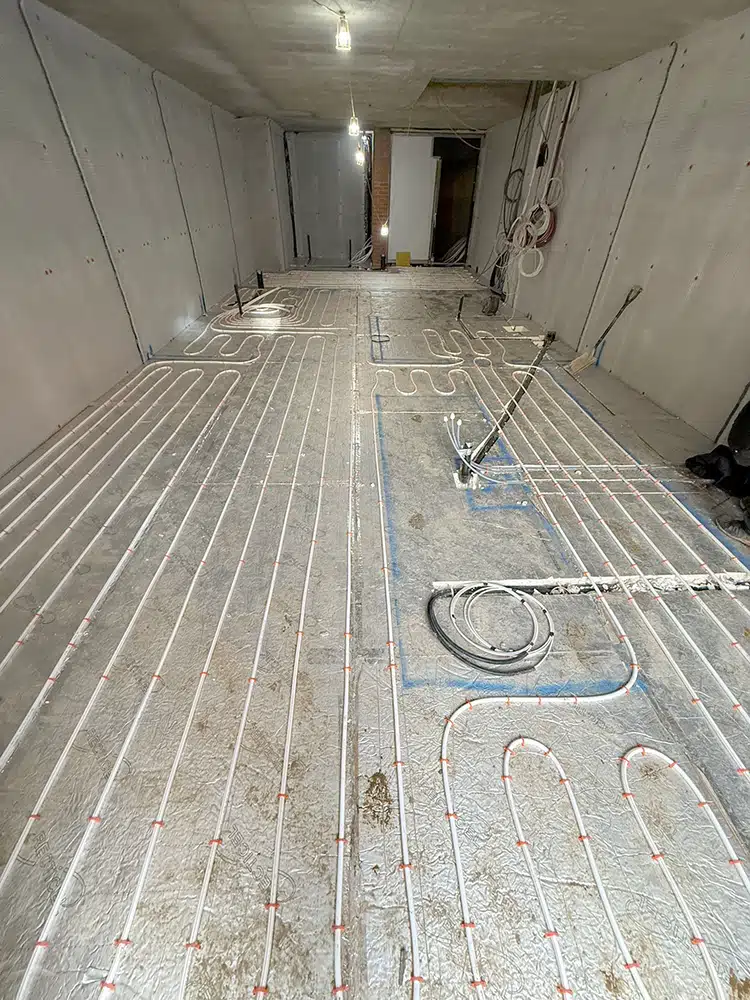
Screed is the part of the floor that carries the warmth outwards, so the depth above the pipes is not somewhere to save money. Give liquid screed 25mm or more of depth above the pipework and the finished floor is typically 45 to 50mm. A sand and cement floor wants about 45mm over the same pipes, so it ends up thicker. Put insulation underneath and the full build-up can easily pass 100mm.
When a post-war semi is being extended, that depth goes into the plan from day one. The builder digs to the right level and the extension floor finishes flush with the house.
Old cottages are trickier. If ceilings are low and the solid floor is coming up anyway, a deep build-up may cost too much headroom. You can dig further down, go for liquid screed because it can be thinner, or fit a slimline heating system on top of the existing floor under a thin covering. Each route has its price, and which one is right depends on the room, so give us the ceiling height and present floor level when you get in touch.
Whatever we lay has to wrap the pipes completely, leaving no pockets of air. A pumped liquid screed flows round them on its own, while sand and cement depends on being well compacted. Insulation and membrane need to be correct too, and we can supply and fit insulation and membranes ahead of the heating engineer laying the pipes.
Heating up a new Halstead floor safely
Do not run the heating flat out to dry a new floor. Nudge the flow temperature up a few degrees each day instead; rushing it is how new floors crack, or lift and curl along the walls.
How soon you can start depends on the material. With calcium sulphate, commissioning can usually begin roughly 7 days after the pour. Sand and cement has to be left 21 days at minimum before any heat goes through it. The exact schedule comes from your heating engineer or the screed manufacturer, and we leave clear guidance with you on the day.
That timing shapes the rest of the job. Homes built since 2015 make up 14% of Halstead's stock, and on a new plot of that kind the heating schedule sits inside the handover programme. On a renovation it decides when the floor fitter can come, since the screed has to be dried and tested before tile or timber goes on. Drying times are explained in our screed drying guide.
Heating a floor in Witham as well? Read about heated floor screeds in Witham.
Underfloor Heating Screed prices in Halstead
Liquid screed over underfloor heating: £20 to £35 per m² supplied and laid (trade2base, June 2026), so £700 to £1,230 for 35 m². trade2base gives these figures excluding VAT. See our floor screeding cost guide or screed calculator.
Who lays your underfloor heating screed in Halstead
K & B Screeding’s own team, led by director Donatas Bardisevicius. Founded 2019, company 12298780.
See what customers say in our Google reviews and on our testimonials page.
Underfloor Heating Screed from Slough to Halstead
As the crow flies, our yard in Slough is about 61.8 miles from Halstead, which lies to the east-north-east. Postcodes here include CO9, and Braintree (5.7 miles), Sudbury (7.8 miles), Witham (10 miles) and Colchester (12 miles) are close by.
More on underfloor heating screed, part of our screeding services.
