
Adding underfloor heating when a Clacton-on-Sea floor comes up
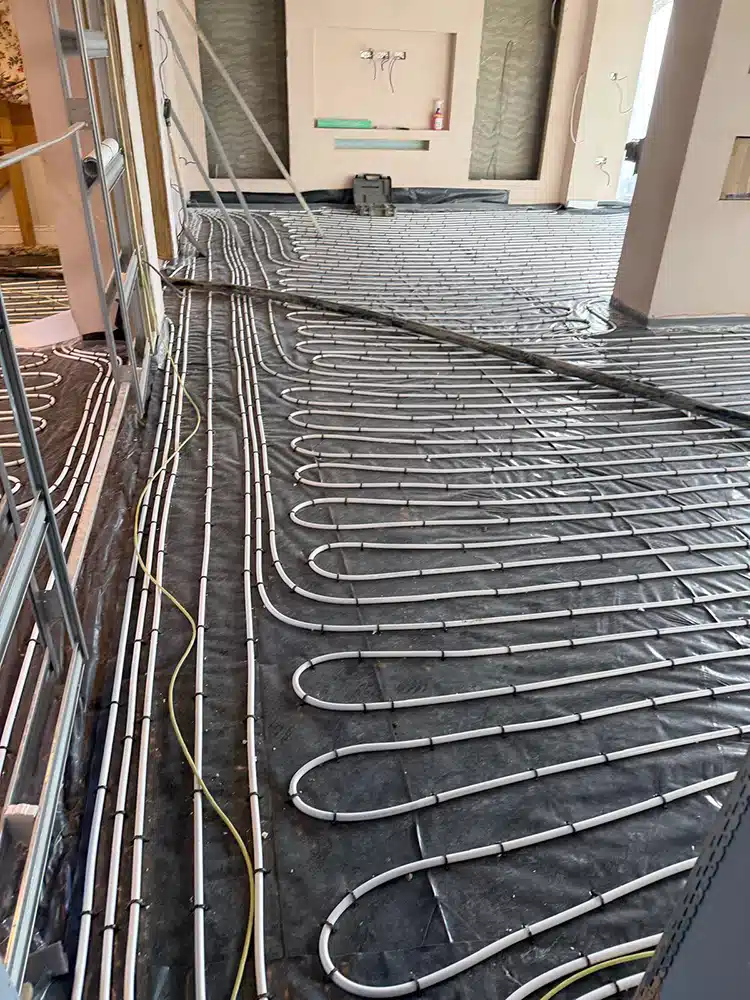
30% of Clacton's homes were built between 1973 and 1999, and most of the rest are older still. Few of those houses were built with heating under the floor. Retrofitting pipes over an existing slab is possible, but the extra height soon causes problems at doors, steps and kitchen units. When a floor is being replaced in full, the dig can simply go deeper to fit insulation, pipes and screed.
The cover over the pipes is what matters. A liquid screed needs at least 25mm above the top of the pipe, giving about 45 to 50mm in total, and it flows right round every pipe with no air pockets. A sand and cement screed needs about 45mm of cover, so the finished screed is thicker and heavier. Get the depth wrong and the floor can crack along the pipe runs or heat patchily.
For a single storey home the heated area is often the whole footprint, so the choice between a pumped liquid screed for bungalow floors and a hand-laid one can make a real difference to drying time and cost. Published 2026 rates for liquid screed over underfloor heating are £20 to £35 per m².
We do not install the pipes. Your heating engineer lays and pressure tests them, and they are normally kept under pressure during the pour.
First heat-up in a Clacton-on-Sea garden room
On the newer estates at the edge of town, the usual floor job is a conservatory or garden room conversion, and heating under the floor makes a glazed room usable in winter. Homes built since 2015 are 5% of the town's stock, so most of these rooms are added to existing houses.
The first heat-up must be gradual. With calcium sulphate screed the system can usually be started from about 7 days after the pour; with sand and cement, wait at least 21 days. Start at a low water temperature, raise it a few degrees a day, hold at working temperature, then bring it back down before any flooring goes on. Rushing it causes cracking and can spoil tiles later.
If the room has large glazed doors, keep it closed and shaded while the screed cures, because strong sun and draughts dry the surface unevenly. Our drying time guide for screed shows how temperature and depth change the wait. The same service is offered in Colchester homes with underfloor heating.
Underfloor Heating Screed prices in Clacton-on-Sea
Liquid screed over underfloor heating: £20 to £35 per m² supplied and laid (trade2base, June 2026), so £700 to £1,230 for 35 m². trade2base gives these figures excluding VAT. See our floor screeding cost guide or screed calculator.
Who lays your underfloor heating screed in Clacton-on-Sea
K & B Screeding’s own team, led by director Donatas Bardisevicius. Founded 2019, company 12298780.
See what customers say in our Google reviews and on our testimonials page.
Underfloor Heating Screed from Slough to Clacton-on-Sea
On the map, Clacton-on-Sea sits east-north-east of Slough, about 79.3 miles from our base in a straight line (postcodes including CO15 and CO16), next to Colchester (12.9 miles), Maldon (20.8 miles), Witham (22 miles) and Rochford (24 miles).
More on underfloor heating screed, part of our screeding services.