
Replacing tired floors in Clacton-on-Sea bungalows and chalets
Inter-war and 1950s bungalows and chalet homes are a familiar part of Clacton. Of the town's homes, 18% date from 1919 to 1944 and 28% from 1945 to 1972. Houses of that age were rarely built with insulation under the floor, and many have a thin concrete slab with no reliable damp proof membrane. When the floor is cracked, cold or damp, patching it seldom works for long, and a full replacement is the lasting fix.
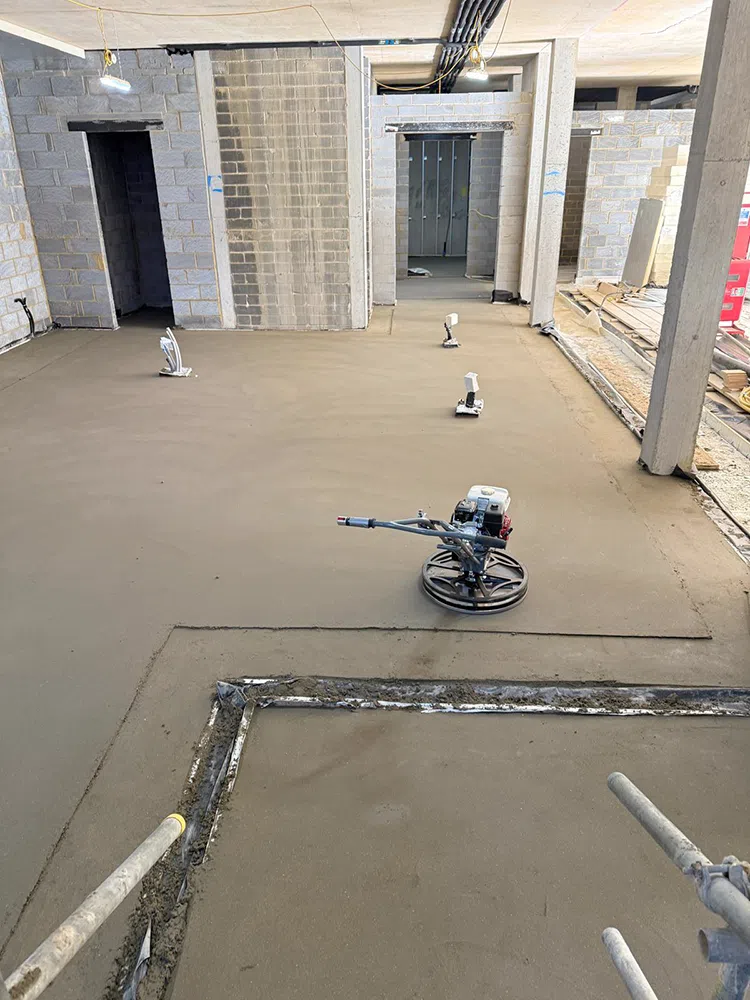
A full replacement follows a set order. The old slab is broken out and removed, the ground is dug down to allow for the new layers, then comes a sub-base, insulation, a membrane lapped and taped, and finally the screed. With sand and cement, a floating domestic screed is laid about 65mm thick, compacted and floated to a dense, level surface.
Hand-laying suits these plans well. Bungalow rooms are often small and separated by walls, and each can be screeded to its own exact height to meet door linings and hearths. Where a room has a sound slab that just needs raising slightly, a bonded screed onto the old concrete at 25 to 40mm is another option.
If the whole floor is being replaced and you want the heat under your feet, see our underfloor heating screed page for Clacton, because the depth changes once pipes are involved.
Wet rooms, falls and garages in Clacton-on-Sea homes
Sand and cement is a cement based material, which means it copes with water far better than a calcium sulphate screed. For a Clacton bungalow being adapted with a level access shower or wet room, that matters. The screed can be laid to a fall towards a gully, thicker at the door and thinner at the drain, and then tanked and tiled.
Garages are another good fit. A garage floor often sits lower than the house, so turning it into a bedroom or study means building up insulation, a membrane and screed until it meets the hall. The garage floor screed guide goes through the heights involved.
The trade-off is drying time. Sand and cement dries more slowly than liquid screed, roughly a day per millimetre for the first 40mm, so a 65mm floor can take several weeks before it is ready for vinyl or wood. Where the programme is tight, a quick drying sand and cement mix shortens the wait, with published rates of £20 to £28 per m².
Sand and Cement Screed prices in Clacton-on-Sea
Sand and cement screed: £18 to £25 per m² supplied and laid (MyJobQuote, August 2026), so £450 to £630 for 25 m². MyJobQuote does not say whether these figures include VAT. See our floor screeding cost guide or screed calculator.
Who lays your sand and cement screed in Clacton-on-Sea
K & B Screeding’s own team, led by director Donatas Bardisevicius. Founded 2019, company 12298780.
See what customers say in our Google reviews and on our testimonials page.
Sand and Cement Screed from Slough to Clacton-on-Sea
On the map, Clacton-on-Sea sits east-north-east of Slough, about 79.3 miles from our base in a straight line (postcodes including CO15 and CO16), next to Colchester (12.9 miles), Maldon (20.8 miles), Witham (22 miles) and Rochford (24 miles).
More on sand & cement screed, part of our screeding services.