
Replacing old floors in Lexden and the Dutch Quarter
13% of Colchester's homes were built before 1919. Houses of that age were rarely built with insulation or a reliable damp proof membrane under the floor. Some have suspended timber floors over a void; others have thin solid floors that are cold, damp or cracked. Laying new tiles or boards straight over such a floor only hides the problem for a while.
Replacement starts with removal. The old floor is taken out, the ground dug to the depth needed, then a sub-base, insulation and a membrane go down before the screed. A floating sand and cement screed in a home is laid at about 65mm, compacted and floated to a dense, level surface.
Care matters in period buildings. Door linings, skirting and hearths set the finished height, and old walls may need the membrane taken up to meet their damp course. Where a building is listed or sits in a conservation area, confirm what the council expects before any original floor is removed.
Hand-laid screed is well suited to these homes because rooms are often small and separate, and each can be set to its own exact height. Where only a small area is damaged, screed repairs may be enough without relaying the whole room. For guidance on how deep each layer should be, see the thickness guide for screed.
Greenstead extensions, wet rooms and garages
Council-era homes in Greenstead are frequent candidates for extensions, and the new floor has to be laid to match the existing level. Sand and cement is useful here because it can be laid to exact heights room by room, and built up or trimmed to meet an existing threshold without a step.
It is also the usual material for wet areas. Being cement based, it tolerates water in a way calcium sulphate screed does not, and it can be shaped by hand to a fall towards a shower gully. Once tanked, it takes tile directly.
Garage conversions follow the same logic. Turning one into a room usually means building the floor up with insulation, a membrane and screed until it meets the house. Where cracking is a concern, fibre reinforced screed adds £1 to £3 per m².
The trade-off is drying time. Sand and cement dries more slowly than liquid screed, at roughly a day per millimetre for the first 40mm, so leave enough time before the flooring fitter arrives.
Sand and Cement Screed prices in Colchester
Sand and cement screed: £18 to £25 per m² supplied and laid (MyJobQuote, August 2026), so £450 to £630 for 25 m². MyJobQuote does not say whether these figures include VAT. See our floor screeding cost guide or screed calculator.
Who lays your sand and cement screed in Colchester
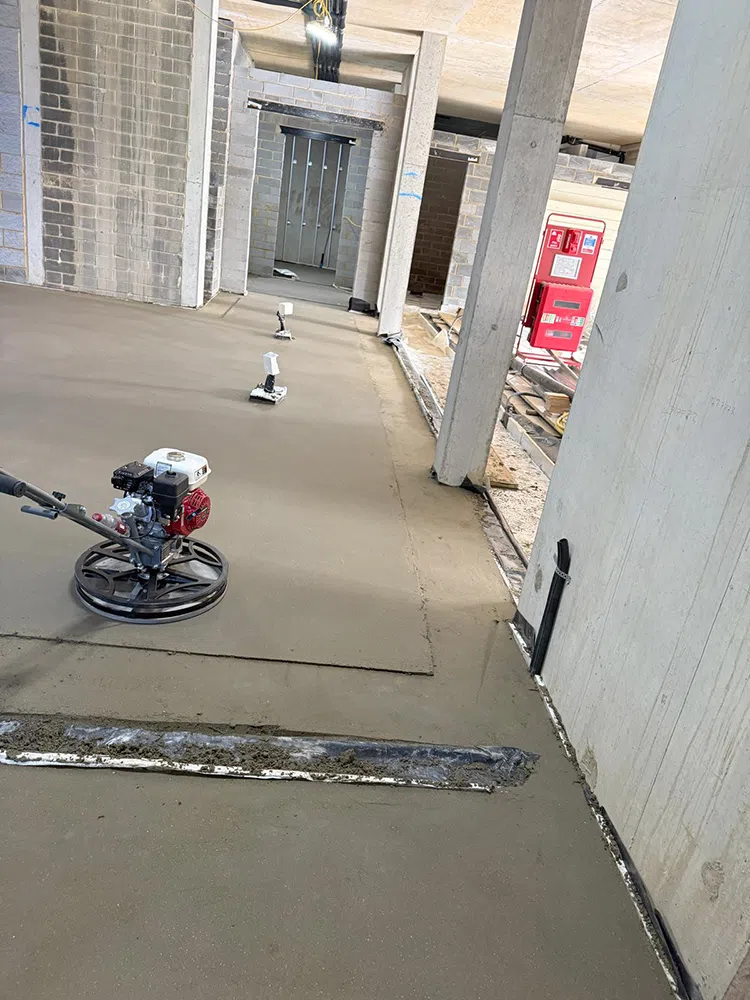
K & B Screeding’s own team, led by director Donatas Bardisevicius. Founded 2019, company 12298780.
See what customers say in our Google reviews and on our testimonials page.
Sand and Cement Screed from Slough to Colchester
On the map, Colchester sits east-north-east of Slough, about 70.8 miles from our base in a straight line (postcodes including CO1, CO3, CO2 and CO4), next to Halstead (12 miles), Sudbury (12.6 miles), Witham (12.7 miles) and Clacton-on-Sea (12.9 miles).
More on sand & cement screed, part of our screeding services.
