
Rebuilding floors in Witham's older cottages
In an older cottage, the ground floor may be little more than a thin slab or old tiles laid over earth, with no damp-proof membrane beneath. Damp rising through that kind of floor spoils new finishes quickly. Putting a membrane and insulation in means taking the old floor up, digging down far enough to fit the new build-up, and relaying the floor so it finishes at the same level as before.
Sand and cement suits that sequence well. The rooms are often small and irregular, with alcoves, fireplaces and uneven walls, and the screed can be laid in bays and ruled to exact heights room by room. There is no pump to set up, and small batches can be mixed as each area is ready.
Depth follows a simple rule. Floating on insulation in a home, it goes down about 65mm thick, because a thinner layer tends to crack. If the dig-out cannot go deep enough for insulation and 65mm of screed together, the build-up is adjusted rather than the screed thinned. How we balance those depths is set out in our screed depth guide.
Houses built between the wars, 7% of Witham's homes, can raise similar questions, especially where a ground floor has cracked or sunk. Before any digging starts, it is worth confirming the damp-proofing and the finished levels, and our insulation and membranes service can supply the layers under the new screed.
Wet rooms and bonded screeds in Witham homes
Being cement based, this screed does not mind getting wet. So when a Witham bathroom is turned into a wet room or gets a level-access shower, we build the slope down to the drain into the screed, and your tiler simply follows it.
Where a concrete floor is sound and only needs raising a little, a full floating screed is not needed. Instead we prepare the slab, brush on a bonding agent and lay a thin bonded layer of 25 to 40mm, which uses far less height. Published 2026 prices for bonded screed are £12 to £18 per m² (trade2base, June 2026), while standard sand and cement runs from £18 to £25 per m².
The material also gives an early, firm cement base. That matters in a garage conversion or a utility room that will take a heavy appliance.
Where it loses out is drying. A 65mm floor needs much more time than a thin pumped one, and a cold Essex winter stretches that further. If the room is needed back quickly, mention it and we can price a quick drying mix.
Sand and Cement Screed prices in Witham
Sand and cement screed: £18 to £25 per m² supplied and laid (MyJobQuote, August 2026), so £450 to £630 for 25 m². MyJobQuote does not say whether these figures include VAT. See our floor screeding cost guide or screed calculator.
Who lays your sand and cement screed in Witham
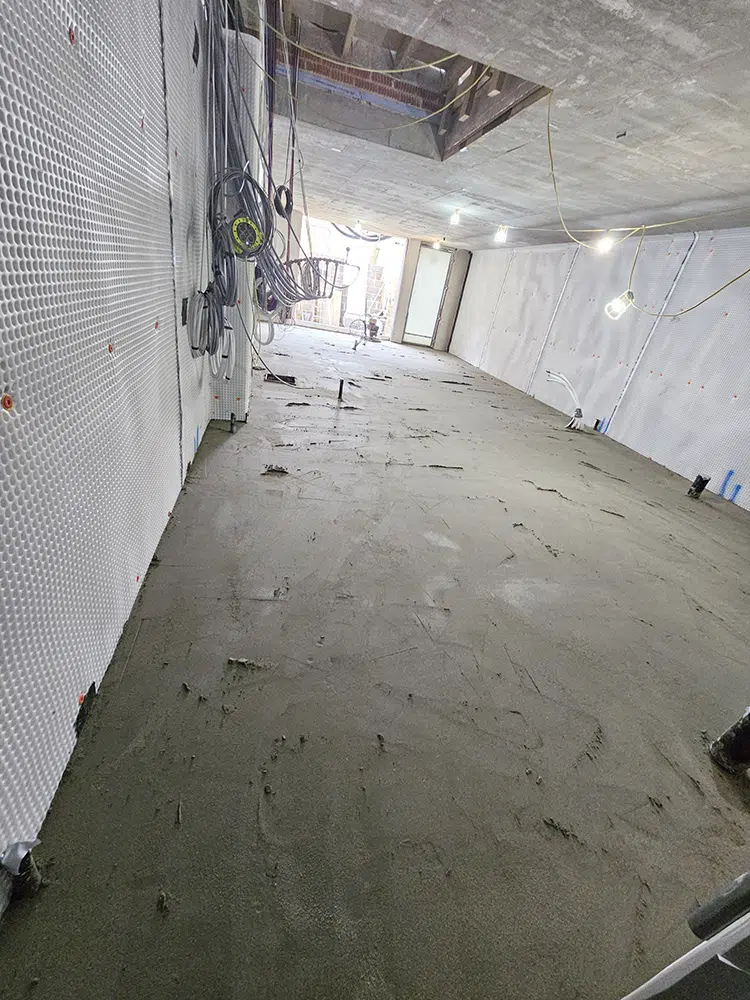
K & B Screeding’s own team, led by director Donatas Bardisevicius. Founded 2019, company 12298780.
See what customers say in our Google reviews and on our testimonials page.
Sand and Cement Screed from Slough to Witham
On the map, Witham sits east-north-east of Slough, about 58.3 miles from our base in a straight line (postcodes including CM8), next to Maldon (5 miles), Braintree (6.6 miles), Chelmsford (8.4 miles) and Halstead (10 miles).
More on sand & cement screed, part of our screeding services.
