
Relaying solid floors in Halstead's Victorian terraces
A typical Victorian terrace in Halstead has an old solid ground floor of concrete or tiles. There is often no damp proof membrane, little or no insulation, and years of patching. When the flooring comes up, the base is cold, uneven and sometimes wet.
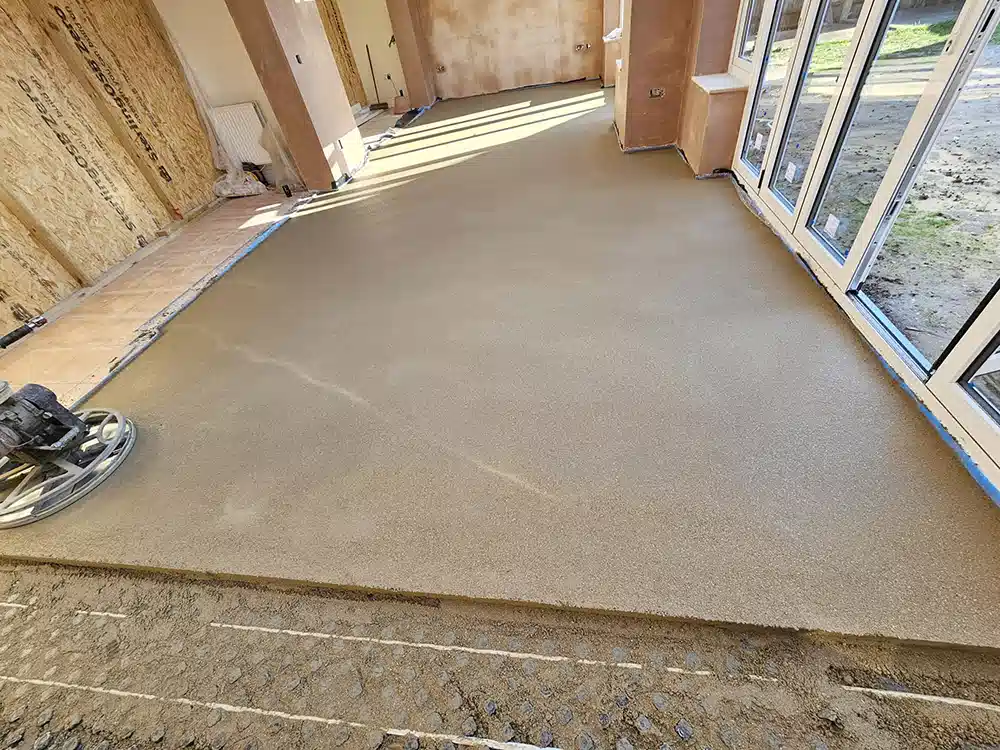
To fix it for good, we break the old floor out, dig down as far as the new build-up needs, and start again: a compacted sub-base, then insulation, then a membrane turned up the walls to meet the damp course, and the screed last. In a house, sand and cement floating on insulation wants 65mm as a minimum. Where the old concrete turns out sound enough to keep, a bonded layer of 25 to 40mm laid straight onto it is enough.
There are good reasons this method suits Halstead's terraces. We mix beside the house and barrow it in, so there is no pump to position and no lorry to park, which helps where the front door opens onto the pavement. Chimney breasts, tiny rooms and doorways at different heights are easy to work round. The screed can be given a fall towards a shower or wet room drain, somewhere calcium sulphate has no place. It also carries load sooner than calcium sulphate does, so the kitchen fitter gets in earlier.
Adding fibres makes the screed more resistant to cracking, as our page on fibre reinforced sand and cement describes. For the right depth on each kind of floor, check our guide to screed thickness.
Garages, wet rooms and listed rows in Halstead
Converting a garage is another job for this screed. The garage floor normally sits below the level of the house, so we fill the difference with insulation and sand and cement until the new room runs into the hall with no step. How the depth is built up for a garage is explained in converting a garage floor.
Some Halstead homes are listed, Factory Terrace among them: the Grade II* row put up for the Courtauld firm's managers. Floor changes in a listed building need the council's agreement first, and we then lay exactly the detail they approve.
The downside of sand and cement is the wait. It dries at something like one day per millimetre over the first 40mm and then slows, which leaves a 65mm floor needing several weeks before any moisture-sensitive finish can go on it. Trust a hygrometer reading, not how many weeks have passed. If the builder is chasing a finish date, ask about quicker drying screed mixes, which shorten that wait.
On published 2026 UK figures, this kind of floor costs somewhere from £18 up to £25 per m² in a Halstead house. Got a floor in Sudbury too? Our Sudbury sand and cement page covers it.
Sand and Cement Screed prices in Halstead
Sand and cement screed: £18 to £25 per m² supplied and laid (MyJobQuote, August 2026), so £450 to £630 for 25 m². MyJobQuote does not say whether these figures include VAT. See our floor screeding cost guide or screed calculator.
Who lays your sand and cement screed in Halstead
K & B Screeding’s own team, led by director Donatas Bardisevicius. Founded 2019, company 12298780.
See what customers say in our Google reviews and on our testimonials page.
Sand and Cement Screed from Slough to Halstead
As the crow flies, our yard in Slough is about 61.8 miles from Halstead, which lies to the east-north-east. Postcodes here include CO9, and Braintree (5.7 miles), Sudbury (7.8 miles), Witham (10 miles) and Colchester (12 miles) are close by.
More on sand & cement screed, part of our screeding services.
