
Retrofitting heated floors in older Sudbury houses
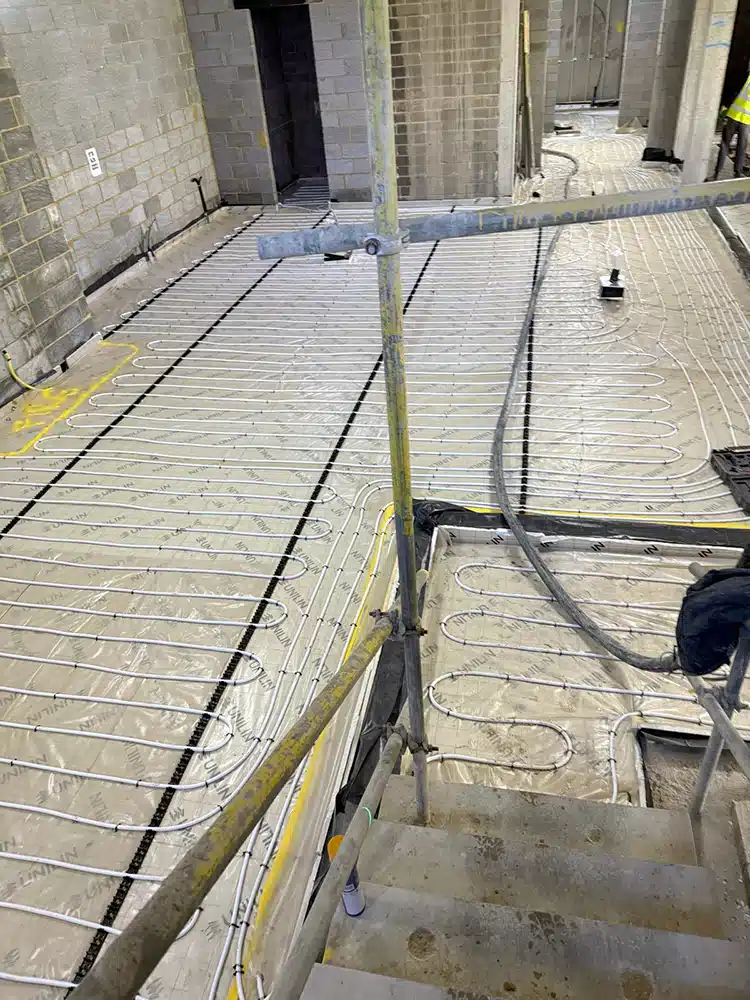
In a post-war or older house, floor height is the constraint. Insulation, pipes and screed all need room, and the finished floor must still meet doorways, stairs and the rooms that are not being changed. That usually means digging out the existing floor rather than building on top of it.
The screed choice follows from the depth available. With liquid screed the pipes need 25mm or more on top, usually 45 to 50mm in all, which is why it fits a tight retrofit. Sand and cement asks for about 45mm over the pipes and a deeper build-up overall, though it can be the better choice where the floor may get wet.
The layers below matter as much as the screed. In the oldest terraced streets the original floor often had no membrane, so one goes in before the insulation and pipes. In a dug-out Sudbury floor we check the insulation, membrane and edge strip are right before pouring, or bring them ourselves, so the screed is not left on a poor base. The membrane and insulation layer has its own page if you want the detail. Getting the edge strip right matters too, because it lets the heated screed expand without cracking at the walls. We check it is in place and continuous before any screed goes down.
A pumped screed also closes round every pipe without leaving gaps, so the heat spreads evenly. For that route, see liquid screed in Sudbury.
Heated extensions and garden rooms in Sudbury
Heated floors are simpler in new work. An extension or garden room is designed from the start with the depth it needs, and the pipes can be clipped to insulation at the right level for the screed. Of Sudbury's homes, 26% were built between 1973 and 1999, and a house of that age taking a new heated kitchen extension can have the floor depth designed in from the start.
Once the screed is down, the heating is not switched on straight away. Give a calcium sulphate floor around 7 days before warming it, and a sand and cement one 21 days at the least. The first warm-up is gradual, raising the water temperature a little each day, and the heating engineer normally sets the programme. Rushing it risks cracking the screed or stressing the pipes. Keep the rooms ventilated during this period and avoid covering the floor with plastic sheeting or stacked materials.
Running the heating does speed drying, but tiles, LVT and engineered wood still need a moisture test first, and screed drying times explained shows why.
Underfloor Heating Screed prices in Sudbury
Liquid screed over underfloor heating: £20 to £35 per m² supplied and laid (trade2base, June 2026), so £700 to £1,230 for 35 m². trade2base gives these figures excluding VAT. See our floor screeding cost guide or screed calculator.
Who lays your underfloor heating screed in Sudbury
K & B Screeding’s own team, led by director Donatas Bardisevicius. Founded 2019, company 12298780.
See what customers say in our Google reviews and on our testimonials page.
Underfloor Heating Screed from Slough to Sudbury
As the crow flies, our yard in Slough is about 68.7 miles from Sudbury, which lies to the east-north-east. Postcodes here include CO10, and Halstead (7.8 miles), Colchester (12.6 miles), Haverhill (12.9 miles) and Braintree (13.5 miles) are close by.
More on underfloor heating screed, part of our screeding services.
