
Calcium sulphate grades on Braintree new builds and flats
Drawings name calcium sulphate screed by its grade. The code starts CA, for calcium sulphate, followed by a C number for compressive strength and an F number for flexural strength, both in N/mm2. A lightly used domestic floor can take CA-C20-F4. CA-C25-F5 is the standard for most homes, apartments and offices. Heavier use needs CA-C30-F6.
Flats make up 20% of homes in the town, and in an apartment block CA-C25-F5 is the likely grade for the flats themselves. Separating floors between flats may also need an acoustic layer beneath the screed. Calcium sulphate suits large bays because it shrinks very little, so a flat's floor can often be poured with few joints inside it.
Then there are alpha hemihydrate screeds. Specifiers pick them when the floor has to dry sooner or be thinner, say on a tight programme, and each takes its depth and drying rules from its own product sheet.
In a new Braintree house it normally floats on insulation, often over heating pipes. Bays and joints are set out in advance, and the insulation, membrane and edge strip below are laid by our own team. If the job is an extension joining a newer heated house, the underfloor heating screed page covers matching the two floors. For the pumping itself, see the liquid screed page, and the guide to anhydrite screed covers the material in depth.
Sanding, priming and testing anhydrite in Braintree
Pouring is the quick part. The steps afterwards decide whether the flooring stays down.
First, laitance. Drying brings a thin, weak skin to the top. When the floor is ready, we sand that away and clear the dust, since adhesive and compound will not grip it.
Second, moisture. Flooring makers often allow calcium sulphate less moisture than cement. Dry to the touch is not the same as ready for timber, LVT or tiles. A hygrometer test gives the real answer, and the covering's data sheet sets the limit. In a heated floor, the system can normally help force dry it from around day 7.
Third, priming. Before any adhesive or compound, the floor gets a primer suited to calcium sulphate, as some made for cement do not suit it.
Finally, location. Keep it away from floors that could take on water, like a wet room or shower. Those get a flowing screed with a cement binder, or sand and cement laid by hand. If a sanded floor still needs smoothing before thin sheet flooring, floor levelling finishes the job.
Anhydrite & Flow Screed prices in Braintree
Liquid flowing screed (which includes anhydrite): £24 to £31 per m² supplied and laid (MyJobQuote, August 2026), so £960 to £1,240 for 40 m². MyJobQuote does not say whether these figures include VAT. See our floor screeding cost guide or screed calculator.
Who lays your anhydrite and flow screed in Braintree
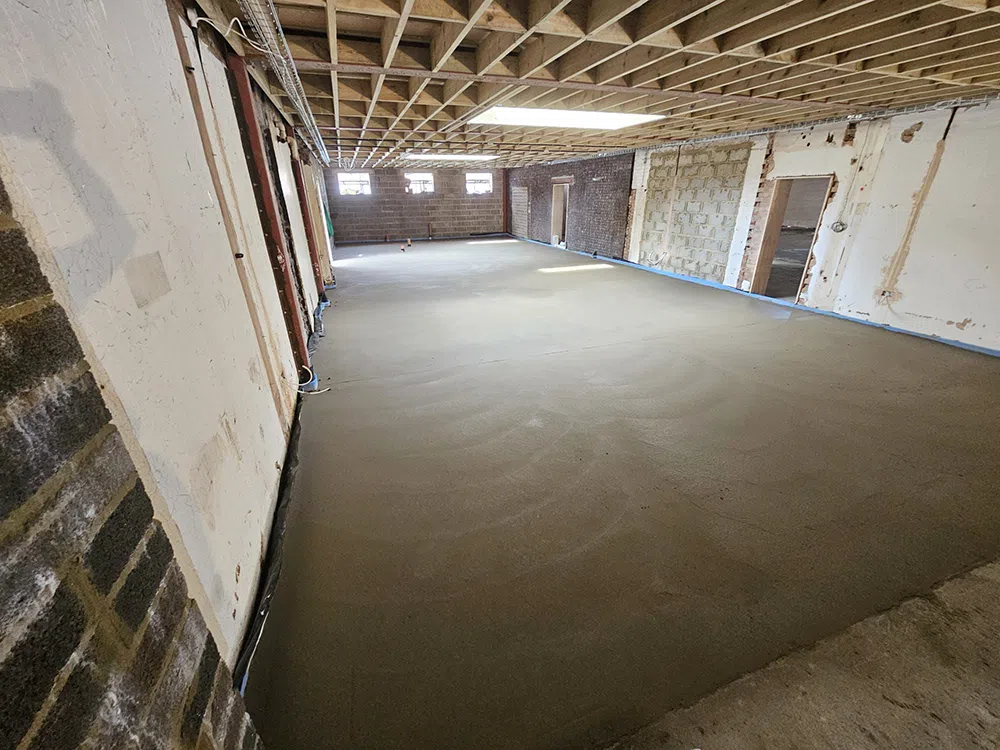
K & B Screeding’s own team, led by director Donatas Bardisevicius. Founded 2019, company 12298780.
See what customers say in our Google reviews and on our testimonials page.
Anhydrite & Flow Screed from Slough to Braintree
Braintree is about 56.7 miles east-north-east of our Slough base as the crow flies, with postcodes including CM7 and CM77. The nearest towns to it are Halstead (5.7 miles), Witham (6.6 miles), Great Dunmow (8.1 miles) and Chelmsford (10.3 miles).
More on anhydrite screed, part of our screeding services.
