
Relaying old floors around Hall Street and Townsend
In a Georgian or Victorian house in Soham's historic core, the original floor is often a solid one laid directly on the ground, with no insulation and no damp proof membrane. It may be cold, uneven or damp, and a renovation usually brings the question to a head.
The standard fix is to break it out, dig down to the right level, and lay insulation, a membrane and a new screed. For that, sand and cement is a natural fit. It is mixed on site in small batches, laid room by room, and compacted by hand around hearths, steps and awkward corners that old houses tend to have.
Depth depends on the construction. Floated over insulation, a house floor takes about 65mm, and a commercial one 75mm. Bond it to a slab in good order and 25 to 40mm is the norm.
Floor level is the tight point. The new floor has to meet thresholds, stairs and any original flooring that stays, so we measure before recommending a build-up. Our screed depth guide explains the options.
Old houses also tend to have smaller rooms, which suit hand work better than a pump. Terraced homes make up 22% of Soham's housing, and a narrow terrace with no side access is exactly where a traditional screed makes sense.
Expect slower drying than liquid, with each of the first 40 millimetres taking about a day, and build that slack into the timetable.
Garages, wet rooms and early loads in Soham
Renovation is only one reason for a cement floor. A garage conversion in Soham turns a cold concrete floor into a bedroom or study. Since the garage slab normally sits lower than the house, insulation, polythene and screed lift it until the hall and the new room meet. The layers are listed in screeding a converted garage floor.
Showers you step straight into, and full wet rooms, want cement based screed sloping down to the outlet. Calcium sulphate cannot go anywhere the floor keeps getting wet. Sloping a floor is hand work, and cement and sharp sand is what that work calls for. The screed is ruled from the edges down to the outlet, checked with a level, and left ready for tanking and tiles.
A workshop or a utility room may have to carry weight soon after laying. The mix can include fibres, adding about £1 to £3 per m², or a stronger mix can be specified. Where the programme is tight, a fast drying cement screed cuts the wait before flooring.
Sand and Cement Screed prices in Soham
Sand and cement screed: £18 to £25 per m² supplied and laid (MyJobQuote, August 2026), so £450 to £630 for 25 m². MyJobQuote does not say whether these figures include VAT. See our floor screeding cost guide or screed calculator.
Who lays your sand and cement screed in Soham
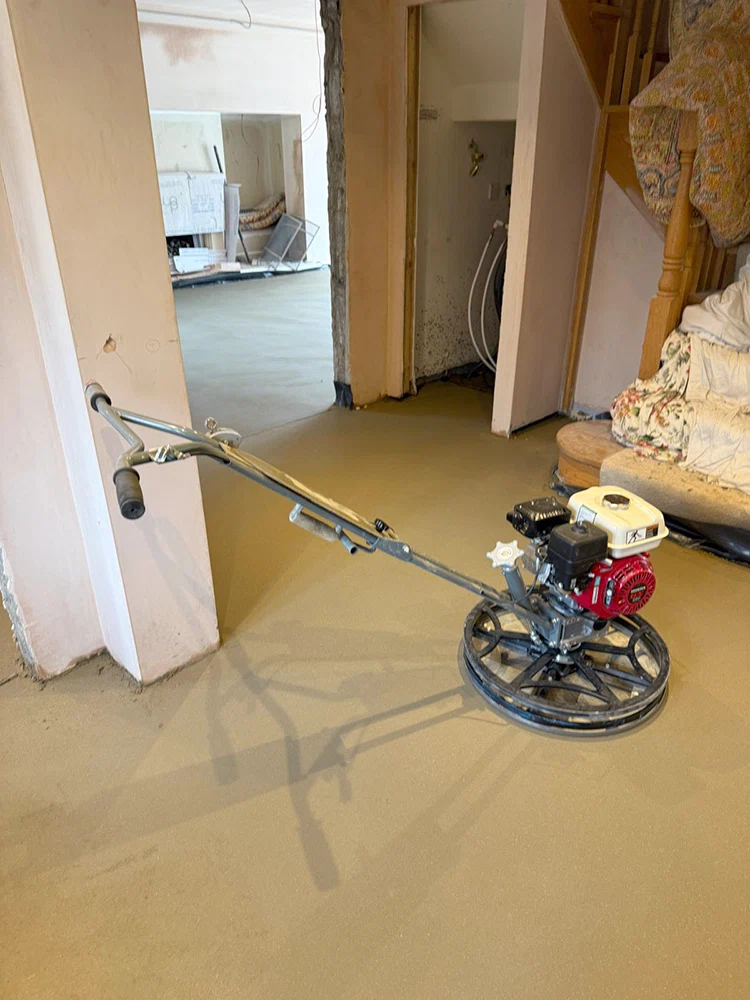
K & B Screeding’s own team, led by director Donatas Bardisevicius. Founded 2019, company 12298780.
See what customers say in our Google reviews and on our testimonials page.
Sand and Cement Screed from Slough to Soham
Soham is about 69.4 miles north-east of our Slough base as the crow flies, with postcodes including CB7. The nearest towns to it are Ely (5.7 miles), Newmarket (6.7 miles), Cambridge (12.8 miles) and Chatteris (15.1 miles).
More on sand & cement screed, part of our screeding services.
