
Retrofit heating in Soham's older estates
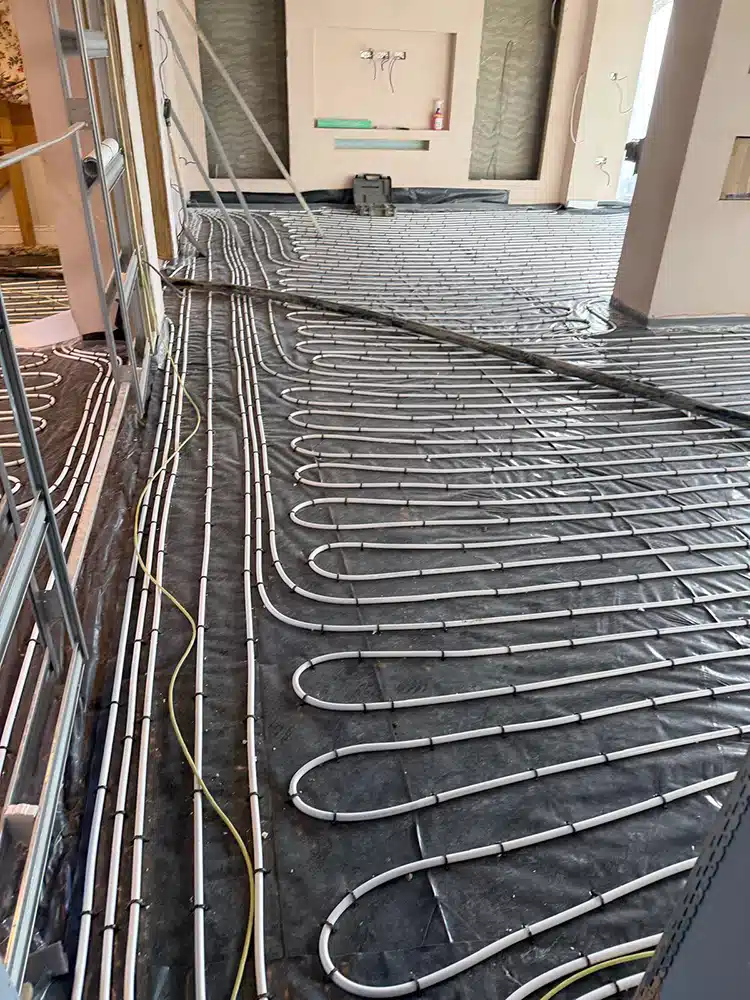
Adding underfloor heating to an existing house is common during a big kitchen or extension project. The difficulty is depth. A heated floor needs insulation, the pipes and a screed on top, and a house from the 1970s to the 1990s was not built with that in mind.
The council estates from the 1950s, such as Downfields, and the streets added from the late 1960s are where extensions and knock-through kitchens often happen. When heating goes into the new space, the new floor must still meet the old one at the same level.
That is where the choice of screed matters. Pipes under liquid need 25mm of cover at the very least, and the whole thing ends up near 45 to 50mm. Under a traditional mix they get roughly 45mm, which adds up to a thicker floor. In a Downfields kitchen with little height to give, flowing screed is often the one way to get heating in and leave the door frames alone.
The existing floor may need digging out to create room. We measure thresholds and stair positions first and tell you honestly whether it will fit.
New houses are simpler. The estates off Fordham Road and Sand Street suit wet underfloor heating laid in a liquid screed, and on new plots the depth is already on the drawings. Our screed thickness guide sets out typical build-ups, and the Soham liquid screed page covers the pour.
First heat-up on a Soham heated floor
The screed is poured; the heating has to wait. For a calcium sulphate screed that is usually about 7 days. Sand and cement asks for 21 days or longer.
Then the heating is brought up slowly. The water temperature rises in small steps over several days, is held, and is then lowered again. The boiler programme is your heating engineer's to set; the notes we leave in writing cover the screed. A gradual heat-up protects the floor and helps it dry.
Heated extensions and garden rooms are where this counts, because people are eager to use the new space. Turning the heating to full on day one can crack the screed. Keeping a simple record of the dates and temperatures also helps the flooring fitter judge when the floor is ready.
Insulation and edge strip matter too. Without insulation, much of the heat is lost to the ground, and without edge strip the floor cannot expand. We check both before the pour, and our membranes and insulation service can supply them.
Underfloor Heating Screed prices in Soham
Liquid screed over underfloor heating: £20 to £35 per m² supplied and laid (trade2base, June 2026), so £700 to £1,230 for 35 m². trade2base gives these figures excluding VAT. See our floor screeding cost guide or screed calculator.
Who lays your underfloor heating screed in Soham
K & B Screeding’s own team, led by director Donatas Bardisevicius. Founded 2019, company 12298780.
See what customers say in our Google reviews and on our testimonials page.
Underfloor Heating Screed from Slough to Soham
Soham is about 69.4 miles north-east of our Slough base as the crow flies, with postcodes including CB7. The nearest towns to it are Ely (5.7 miles), Newmarket (6.7 miles), Cambridge (12.8 miles) and Chatteris (15.1 miles).
More on underfloor heating screed, part of our screeding services.
