
Pipe cover and depth in March homes
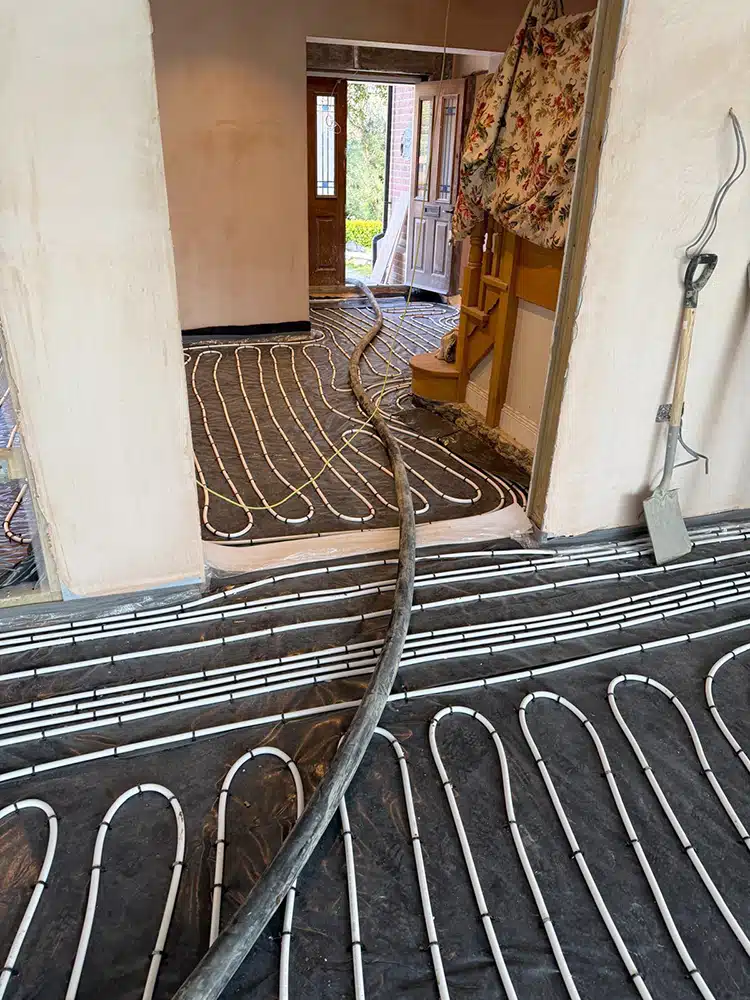
Wet heating depends on its screed far more than most people expect it to. It spreads the warmth from the pipes across the whole floor, and it protects them from the loads above. Too thin, and it can crack along the line of the pipes. Too thick, and the room takes a long time to warm up.
Over the pipes, liquid needs a cover of 25mm minimum, so total depth tends to land around 45 to 50mm. It flows fully around each pipe, so there are no air pockets, and heat reaches the surface quickly. Sand and cement gets tamped by hand between pipe runs, finishing roughly 45mm above them.
New homes in March are likely to be designed for this from the start. The South East March site, with its concept plan for about 650 homes, is the sort of development where homes are likely to use underfloor heating, and the depth is normally set on the drawings before anyone reaches site.
Retrofit is harder. Houses built between the 1970s and the 1990s have finished floor levels that were never meant to rise by 100mm or more. Before committing, measure what the doors, stairs and thresholds will allow, and check our screed thickness guide. A thinner liquid screed option may be the only way to fit a heated floor in.
Switching the heating on in March
Switching on too soon, or too hot, spoils more heated floors than anything else. It must be gradual, and it must wait until the screed is ready.
Calcium sulphate normally lets the heating go on from day 7 after pouring; sand and cement holds out until day 21 at the earliest. From then the water temperature climbs in stages across several days, holds at the top, and steps back down. Your heating engineer draws up that timetable; our written notes cover what the screed needs.
Picture a new garden room or heated extension in March, finished and waiting. Owners are often keen to use the space, and switching straight to full heat can crack the floor. Heating the screed gently also helps it dry, which brings flooring forward. Keep a note of the dates and temperatures, so the flooring fitter can see how the floor was brought up to heat.
Before the pour we check that the insulation, membrane and edge strip are right, since a heated floor loses far more energy downwards without them. We can supply that layer through our screed preparation and membranes service if needed.
Underfloor Heating Screed prices in March
Liquid screed over underfloor heating: £20 to £35 per m² supplied and laid (trade2base, June 2026), so £700 to £1,230 for 35 m². trade2base gives these figures excluding VAT. See our floor screeding cost guide or screed calculator.
Who lays your underfloor heating screed in March
K & B Screeding’s own team, led by director Donatas Bardisevicius. Founded 2019, company 12298780.
See what customers say in our Google reviews and on our testimonials page.
Underfloor Heating Screed from Slough to March
March is about 76.8 miles north-north-east of our Slough base as the crow flies, with postcodes including PE15. The nearest towns to it are Chatteris (6.5 miles), Whittlesey (9.1 miles), Ely (12.6 miles) and Peterborough (14 miles).
More on underfloor heating screed, part of our screeding services.
