
Hand-laid floors for Stamford terraces and older houses
A traditional screed is barrowed into the room, spread between level screeding rails, compacted and then finished with a float. Because the screeder controls every metre, it can be worked around steps, bay windows and out-of-square walls, and set to meet an existing hall or kitchen floor exactly. That suits the older housing stock. About 10% of Stamford's homes were built between 1919 and 1944, and interwar houses, like those of other periods, often come to a floor renovation with a tired solid floor that has cracked or settled. Rebuilding one means breaking out the old floor, laying a compacted base, membrane and insulation, then a floating screed about 65mm deep. If the old slab is solid and the screed is bonded straight onto it, 25 to 40mm will do. Listed and conservation area buildings are a separate case. Many are lime based, with old stone flags or solid floors, and a standard membrane with sand and cement screed on top may not be appropriate because it can drive moisture into the walls. The build-up is agreed with the owner and the conservation officer before any work, and sometimes the answer is a breathable floor rather than a cement screed. The mix can be tuned. Adding fibres cuts down cracking, and rapid drying additives bring the flooring date forward. A higher strength screed suits floors that will take heavier loads.
Stamford garages, wet rooms and working floors
Turning a garage into a room is one of the commonest reasons to choose this screed. The garage slab is usually lower than the house floor, and the new floor has to make up that difference with insulation and screed while keeping to building regulations. Layers and depths for that job are set out in our guide to screeding a converted garage. Wet rooms need falls. A walk-in shower floor is laid by hand with a gentle slope to the drain, and a cement based screed is the right base under tanking and tiles because calcium sulphate screeds do not suit floors that may stay wet. Small industrial and mixed-use buildings in older parts of Stamford also tend to need a cement floor, because it takes load earlier and tolerates harder use. Where speed matters, a quick drying mix helps. Drying is the main drawback. It dries slowly, at about 1 day per mm up to 40mm and slower after that, so build the wait into your plans. Where the existing floor is solid and simply uneven, levelling a Stamford floor can be enough on its own.
Sand and Cement Screed prices in Stamford
Sand and cement screed: £18 to £25 per m² supplied and laid (MyJobQuote, August 2026), so £450 to £630 for 25 m². MyJobQuote does not say whether these figures include VAT. See our floor screeding cost guide or screed calculator.
Who lays your sand and cement screed in Stamford
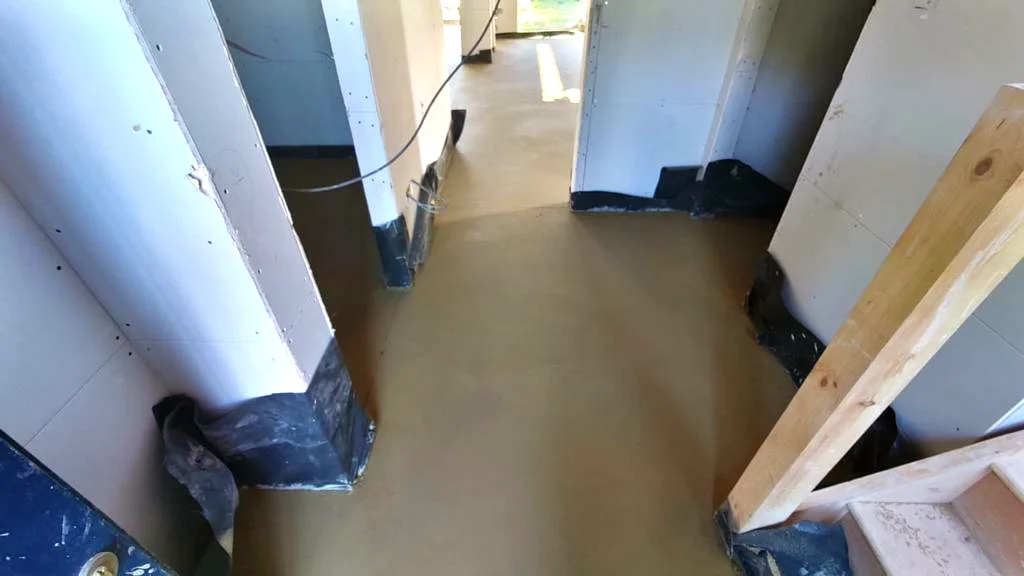
K & B Screeding’s own team, led by director Donatas Bardisevicius. Founded 2019, company 12298780.
See what customers say in our Google reviews and on our testimonials page.
Sand and Cement Screed from Slough to Stamford
Stamford is about 77.7 miles north of our Slough base as the crow flies, with postcodes including PE9. The nearest towns to it are Oakham (10.5 miles), Peterborough (11.4 miles), Corby (14.7 miles) and Whittlesey (16.3 miles).
More on sand & cement screed, part of our screeding services.