
Relaying old solid floors near High Street, Burton Latimer
Many homes around High Street and Church Street went up after ironstone quarrying started around 1872 and the clothing and shoe factories opened, and a few are older. Back then, solid floors were often laid with no barrier against ground moisture. Damp comes up through a floor like that, the finishes lift, and the room stays cold in every season.
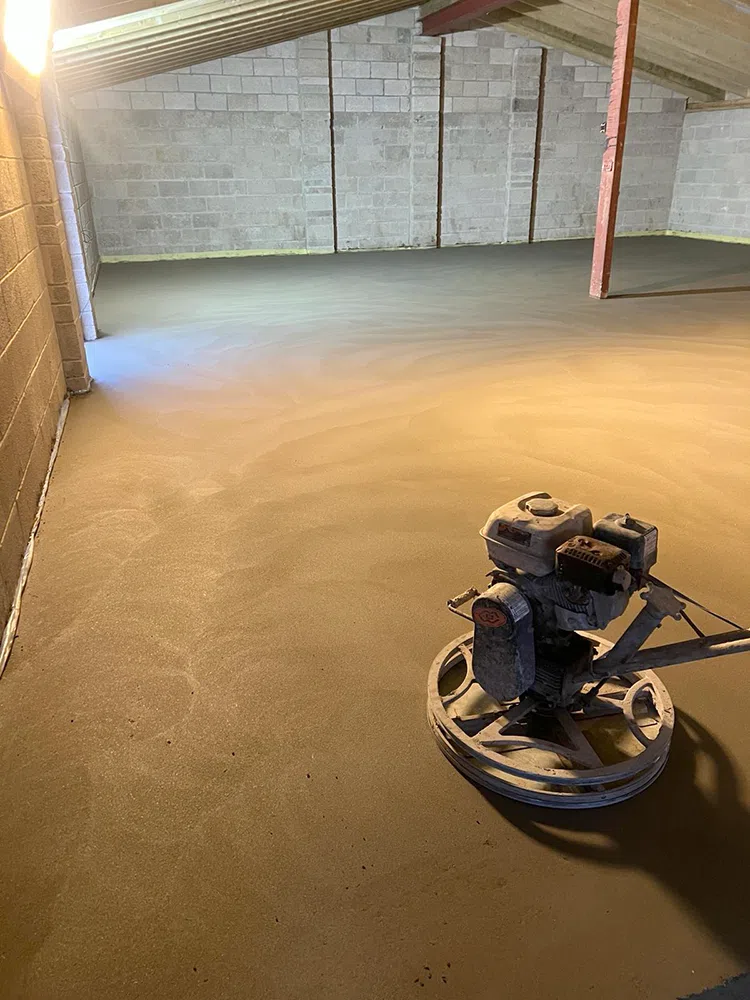
A floor like this needs rebuilding rather than covering over. We break out the old floor and dig deep enough to fit a damp proof membrane, insulation and screed, and still finish at the right height for the doorways and the bottom stair. The breaking out and base work are covered under floor preparation before screeding. With the build-up in, the screed is mixed on site, laid in bays, compacted and floated.
The build-up sets the depth. On top of insulation, a domestic floating screed of this kind is laid 65mm thick, whereas one bonded straight to a sound concrete base needs only 25 to 40mm. Because it adapts so easily, it suits a renovation where each room needs something a little different.
Terraces make up 22% of Burton Latimer's homes, and they tend to have narrow rooms, small doorways and one way in from the street. A hand-laid screed handles that well, arriving by barrow and being finished one room at a time. If you are weighing up the two main options, our comparison of liquid and sand and cement screeds sets them side by side.
Wet rooms, garages and falls in Burton Latimer
Water is where sand and cement beats calcium sulphate. It copes with getting wet, so it is the usual base for wet rooms and walk-in showers, laid with a fall towards the drain. That slope is shaped in the screed, giving the tiler a firm base already falling the right way instead of building it up in adhesive.
Garages suit it too. A garage conversion normally means bringing the floor up to the house level, with a membrane and insulation below a new screed, and the garage conversion screed guide walks through it. If the floor must take weight early, or the tiler is booked, fibres or rapid drying additives can go in the mix. On published 2026 figures, fibres add £1 to £3 per m².
Drying is the catch. It dries more slowly than liquid screed, and with heating pipes inside it the heating stays off until at least 21 days after laying. For a heated room, the depth needed over the pipes is on our Burton Latimer heated floor screed page.
Sand and Cement Screed prices in Burton Latimer
Sand and cement screed: £18 to £25 per m² supplied and laid (MyJobQuote, August 2026), so £450 to £630 for 25 m². MyJobQuote does not say whether these figures include VAT. See our floor screeding cost guide or screed calculator.
Who lays your sand and cement screed in Burton Latimer
K & B Screeding’s own team, led by director Donatas Bardisevicius. Founded 2019, company 12298780.
See what customers say in our Google reviews and on our testimonials page.
Sand and Cement Screed from Slough to Burton Latimer
On the map, Burton Latimer sits north of Slough, about 57.4 miles from our base in a straight line (postcodes including NN15), next to Kettering (3.3 miles), Wellingborough (4.2 miles), Rushden (6 miles) and Raunds (6.2 miles).
More on sand & cement screed, part of our screeding services.
