
Pipe cover for heated floors around Hanwood Park
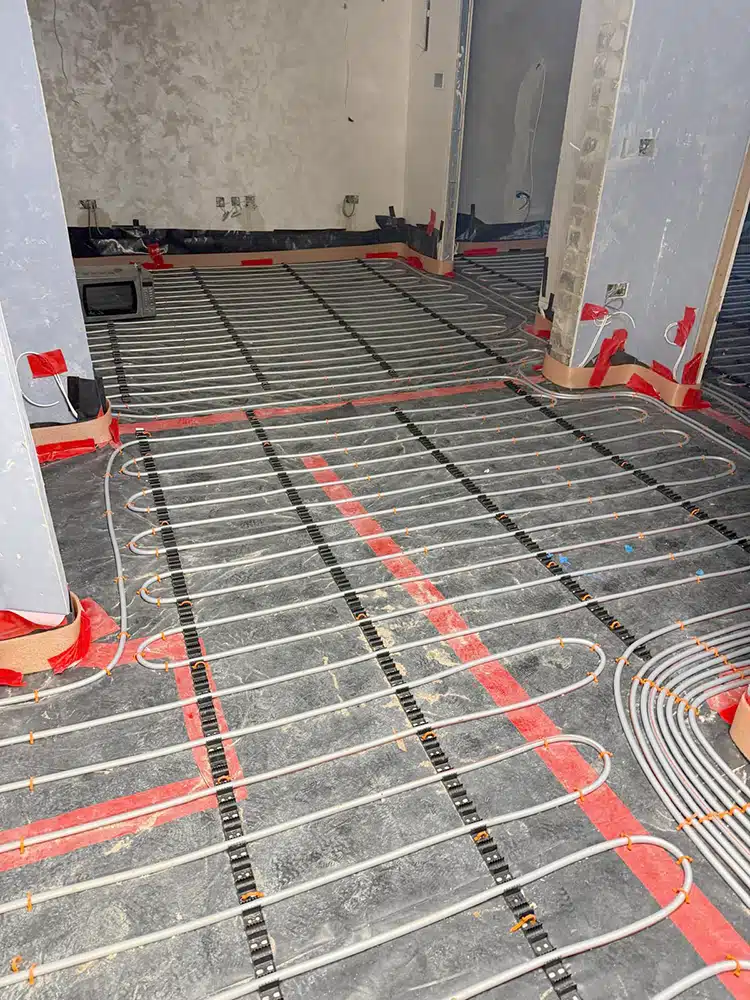
Pipes alone do not make a heated floor. The screed around them does that, and it has to wrap each pipe with no air gaps and sit deep enough over the top to spread the warmth and stay strong along the pipe runs. Too shallow and you get warm stripes, or cracks that follow the pipes.
A flowing screed has to bury the pipes by 25mm or more, so the finished heated floor usually ends up 45 to 50mm deep. A traditional mix wants roughly 45mm on top of the pipes, which adds height that a tight older room may not have. Pumped liquid screed runs right round the pipes as it goes down, which explains why newer heated floors mostly use it, and why our page on liquid screed for Burton Latimer homes is worth a look before you choose.
Plenty of the town is recent, with 21% of homes built between 2000 and 2014. Houses from then onwards usually have insulated ground floors, so a heated extension can be planned with the correct build-up from day one. Before pouring we look over the boards, the membrane and the perimeter strip, or bring our own, and the heating engineer confirms the pipe pressure test is done.
Older houses are harder to retrofit, because there is little floor height to spare. Adding the full build-up on top can foul doors, thresholds and stairs. A thinner liquid screed may help, and at times the better route is to dig the floor out and relay it instead of building upwards.
Switching on the heating in a Burton Latimer extension
Most trouble with heated screeds starts at the first warm-up. Turn the heating straight up to full and the surface dries too quickly, which can crack or curl it. Instead the temperature goes up a little at a time over several days, is held there, then is brought back down.
When you can start depends on the screed. With calcium sulphate, heating can usually be introduced from about 7 days after laying, and it then helps force dry the floor. A traditional cement mix makes you wait longer, a minimum of 21 days, until the boiler is asked to warm it. Commissioning steps and dates are handed over in writing, so whoever runs the system after us knows how fast to raise the temperature. Our screed drying guide explains what happens if you rush it.
Whatever goes on top, whether tiles, LVT or engineered boards, the warm floor underneath needs to be both flat and dry by that maker's standard. The layers below are covered under insulation and membranes before screeding. For homes nearer Kettering, there is a Kettering page for heated floor screeds.
Underfloor Heating Screed prices in Burton Latimer
Liquid screed over underfloor heating: £20 to £35 per m² supplied and laid (trade2base, June 2026), so £700 to £1,230 for 35 m². trade2base gives these figures excluding VAT. See our floor screeding cost guide or screed calculator.
Who lays your underfloor heating screed in Burton Latimer
K & B Screeding’s own team, led by director Donatas Bardisevicius. Founded 2019, company 12298780.
See what customers say in our Google reviews and on our testimonials page.
Underfloor Heating Screed from Slough to Burton Latimer
On the map, Burton Latimer sits north of Slough, about 57.4 miles from our base in a straight line (postcodes including NN15), next to Kettering (3.3 miles), Wellingborough (4.2 miles), Rushden (6 miles) and Raunds (6.2 miles).
More on underfloor heating screed, part of our screeding services.